Did you know that Daphne du Maurier, of REBECCA fame, wrote a novel set during the French Revolution? My discovery of THE GLASSBLOWERS was a lovely surprise. The novel, published in 1963, recounts the story of a family of glass makers in the Sarthe region, about 100 miles southwest of Paris, during the years 1749-1844. Written as the memoir of Sophie Duval, one of five siblings, the novel recounts the family's struggles during the Revolution, as societal upheaval changed not only the economy, but the very fabric of society. The five siblings embrace the new ideas to varying degrees and participate in the Revolution in various ways. Robert, the eldest, throws his lot with the Duc d'Orléans and winds up emigrating to England; Pierre, a devoted adherent of Rousseau, serves as a notary for the poor; Michel wholeheartedly--and cold-heartedly--embraces the revolution, becoming regional leader of the National Guard; sister Edmé, like Michel, sustains the fight for radical causes even after Napoléon assumes power. Sophie, the narrator, remains fluid, vacillating at various times to either extreme, mirroring, in many ways, the emotional swings of the nation as a whole. Through her eyes, the reader witnesses both the promise and the atrocities of the country's attempt to ensure equal rights for all citizens; her conflicts capture the struggles individuals faced in reconciling personal morality with the demands of imposing a supposedly superior political system. The novel's provincial setting offers an interesting perspective on the Revolution, revealing how, far from the central events taking place in Paris, the populaces of small towns had little but rumor and old news to guide their actions as they fended off counter-revolutionary forces sweeping into central France from the western provinces. If you can find a copy, THE GLASSBLOWERS is well worth a read and provides a perspective that both counters and completes better-known Revolution novels like A TALE OF TWO CITIES and THE SCARLET PIMPERNEL.
Friday, February 26, 2021
Tuesday, February 23, 2021
Q & A with Patricia Bracewell, Author of THE STEEL BENEATH THE SILK
The final volume of Patricia Bracewell's trilogy on Emma of Normandy, Queen of England, publishes on March 2, 2021 from Bellastoria Press. Yesterday, I reviewed this marvelous book; today, Patricia answers a few questions about her novel.
1. Why Emma? How is the saga of an 11th century queen of Anglo-Saxon England relevant to today’s readers? What aspects of her actions and personality do you think speak most strongly to modern women?
I think that women of today will find Emma inspirational. In our time women are breaking glass ceilings; in Emma’s time that ceiling was made of marble. The Anglo-Saxons were wary of the very concept of queenship, and Emma was only the second queen of all England. She was burdened by her youth and by the fact that she was a foreigner. She had to learn about England’s history, language and cultural norms, probably as an adolescent, and then figure out how to use them to her advantage. That took courage, but Emma has another kind of courage, as well. She is willing to speak truth to power, and although she is rarely thanked for it, that doesn’t stop her. So I think that courage and tenacity are two qualities that speak to women today, as well as Emma’s willingness to recognize the limits of her power and reach out to those who can help her get whatever she is after.
2. While writing, did you ever fear that Emma might teeter on the brink of "the perfect queen" stereotype? How did you try to humanize her? What faults define her and how does she suffer for them?
I am not a fan of novels in which the heroine is adored by everybody else in the book. So I’ve given Emma plenty of enemies who despise her, or don’t trust her, or who misinterpret her actions. Æthelred, Edmund, Edyth, Elgiva, even Emma’s own son are definitely not fans of the queen. Their opinions of her, right or wrong, throw some shade on her character. Emma herself, as clever as she is, does not have all the answers to the problems that she faces. She has to turn to others for help. Sometimes she makes bad decisions. On one occasion she acquires important information but doesn’t do anything with it, and that leads to catastrophe. On another occasion she makes a decision that leads to anguish when she realizes that she’s put her children at risk. Emma is courageous, yes, but that means, too, that she’s a risk-taker. She weighs the risks and makes a choice, but sometimes it turns out to be the wrong choice and she is not the only one who pays the price.
3. Æthelred, Athelstan, Cnut, Elgiva, Thorkell, Edmund, Edward, Edyth, Richard of Normandy—Emma has personal and political relationships with so many characters over the course of the trilogy, and these relationships all had to be tied up in this final volume. Which relationship was the hardest to get “right”? Is there any relationship you wished you could have spent more time wrapping up? Which relationship did you most enjoy exploring?
The relationship between Emma and Cnut was the most difficult to get “right” especially because I wanted anyone who had not read the earlier books to be able to understand it; and that is the relationship I most enjoyed exploring. They had a few scenes together in Shadow on the Crown when we saw Cnut through Emma’s eyes, and of course as I wrote that first book I was already thinking about what would happen in this one. But when I began writing The Steel Beneath the Silk I had to figure out a way for each of them to recall that first meeting which had happened ten years earlier. When I finally brought them together again towards the end of the book, I had to design some scenes that would allow them to interact and would reveal in a very short time how their relationship was evolving on both sides. It meant a lot of revisions. I think I was successful. I hope so. I wish I could have found a way to wrap up the relationship between Emma and Thorkell—have some sort of dialogue between them. But I had to focus on Emma and Cnut. Thorkell would have gotten in the way!
![]() |
| Winchester's Norman Great Hall, which is evocative of Anglo-Saxon great halls |
4. How did you manage to keep the setting fresh over the course of three novels? Which location in the book did you most enjoy visiting in real life during your extensive research?
The first novel opens in Normandy, but almost all of it is set in Wessex, mostly Winchester, with side trips to Exeter and to the Rollright Stones in Oxfordshire. The second novel is split between various royal estates in southern England and manors located in the northeast. All of these estates and manors were based on places I found mentioned in the Domesday Book, but I actually visited those areas if not the sites themselves. This third book goes much further afield, to Jorvik (York), Denmark, and Normandy as well as to numerous sites all over England. Of course, the scenes themselves are set in the great hall, or a church, or a bed-chamber or an abbey. There are several that are set on ships and one in the tower of one of the gates of London. I tried very hard to vary the setting as much as possible. I suppose the place I enjoyed visiting the most was Winchester. It was the Anglo-Saxon royal city; it was where Emma had a manor named Godbegot, the site of which you can still see today; and it is where Emma and Cnut are buried. It was, for me, the most evocative of that Anglo-Saxon world, and I’m longing to go back.
5. Emma has occupied your thoughts and hours for so many years now—how will your own life change now that you have completed your task and made her known to new readers? What did you learn about yourself as you researched and imagined her life and captured it in the pages of three books?
Well, I expect that I will have more time to pursue other activities like gardening and, unfortunately, dealing with piles of books and papers that need sorting, closets and drawers that need cleaning out, and a garage that resembles an industrial waste site. But I already have a list of books that I want to read or study, and I might find myself pondering ideas for a new novel—although not a trilogy! What I’ve learned about myself is that I love research; that I’m not interested in travel unless there is an element of education involved; and that I have more determination than I ever realized. Also, now, when I run up against some difficulty or hardship, I tend to ask myself “What would Emma do?”
**********
Many thanks to Patricia for offering this behind-the scenes look at her novel.
THE STEEL BENEATH THE SILK can be purchased from Amazon, Barnes and Noble, and Indiebound.
Patricia Bracewell's love of reading led to college degrees in Literature, a career as a high school English teacher, and an unquenchable desire to write. Shadow on the Crown, the first book in her trilogy about the 11th century queen Emma of Normandy, was published in 2013 in the U.S. and England, and has been translated into Italian, German, Portuguese and Russian. Her second novel, The Price of Blood, published in 2015, continues the gripping tale of a queen whose marriage to an English king set in motion a series of events that would culminate in the Norman Conquest of 1066. In 2014 Patricia was honored to serve as Writer-in-Residence at Gladstone's Library in Wales where she conducted research for The Steel Beneath the Silk, the third book in her trilogy about Queen Emma. Patricia and her husband live in Oakland, California. Visit her at her website.
Monday, February 22, 2021
Review: THE STEEL BENEATH THE SILK by Patricia Bracewell
The wait was definitely worth it.
THE STEEL BENEATH THE SILK (Bellastoria Press, March 2) caps off Patricia Bracewell's trilogy on eleventh-century Emma of Normandy, Queen of England, with all the drama, emotion, and skill that fans of the series have come to expect. With consummate ease, Bracewell plunges her readers back into a perilous, war-torn England ravaged by marauding Danish raiders from without and crumbling from treachery within. As King Swein of Denmark and his ambitious son Cnut penetrate ever farther into England, suborning English lords and capturing city after city, Emma's raddled husband, King Æthelred, alienates allies and squanders the loyalty of his people. Calling upon her wits, her faith, and the counsel of a trusted few, Emma must discern rumor from fact, friend from foe, solid hope from fleeting fancy as she strives to hold the besieged country together and make her dream of a united, peaceful England an enduring reality.
Sunday, January 31, 2021
Jacques du Fouilloux's Treatise on Hunting
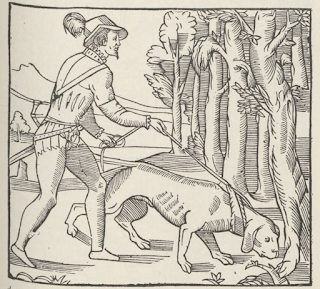
While researching hunting dogs in sixteenth century France, I discovered Jacques du Fouilloux's treatise, LA VÉNERIE, online at Gallica. This work, first published in 1561, served as the preeminent reference work on hunting for almost two centuries. Du Fouilloux discusses not only methods and techniques for hunting deer, boar, wolf, and other game, but provides astute observations on the habits of forest animals that have since been corroborated by naturalists. Written in clear and engaging sixteenth-century prose, the work offers a fascinating insight into the hunting culture of the time. Amply illustrated with contemporary woodcuts, LA VÉNERIE is a joy to peruse.
Sunday, January 3, 2021
Ten Favorite Reads of 2020
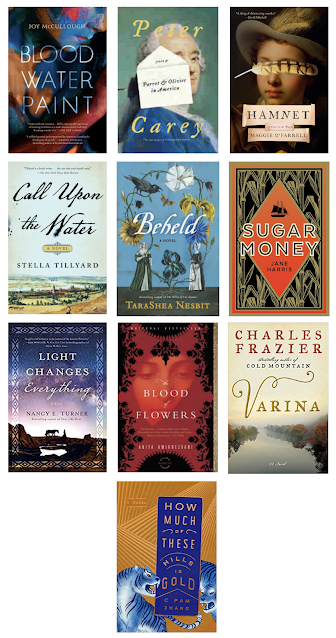
Despite the trauma of the pandemic (or maybe because of it), 2020 turned out to be an amazing year of reading for me. I managed to finish 44 books by the end of December, a personal record since I began keeping track in 2012 (you can see my yearly lists in the sidebar). I've been an avid reader my entire life, and I can hardly remember a year during which book after book not only entertained but impressed me. As a reader, it was exhilarating to read so many great novels; as a writer, it was both inspiring and somewhat daunting to encounter such craft. Blood Water Paint by Joy McCullogh, a powerful novel in verse about the seventeenth century artist Artemisia Gentileschi, was far and away my favorite of the year, but nine other books stood out as particular gems:
Wednesday, November 11, 2020
Why Read Historical Fiction Set in Sixteenth Century France? Reason #10
Over the past few weeks, we've examined ESCAPE, RELEVANCE, DRAMA, EMOTION, GLITZ, HISTORY, FRANCE, CHATEAUX and LITERARY LINEAGE as reasons to read historical fiction set in sixteenth century France. All of these contribute, in their own way, to our culminating reason...
Reason #10--DIFFERENCE
Trends arise in historical fiction, as they do with most cultural phenomena. A particular book will capture the attention of a significant number of readers, who, having enjoyed what they just read, want more. They start looking for other books that share a similar setting or topic or structure. Writers (who, of course, are readers, too) participate in the trend by creating what the public wants; agents and editors (whose job is to sell books) actively seek out manuscripts that meet those criteria. Within a couple of years (remember, it takes 18+ months from the sale of a manuscript to the appearance of the published book on the shelves), a trend has been established. A significant number of newly published works will feed the craze, even to the point of rehashing characters and plotlines. Eventually, however, readers do tire of the trend and authors run out of material to sustain it. At that point, a new book or topic garners attention and the cycle recommences. Trends are not necessarily sequential; they overlap, differ in length, and vary in detail and emphasis depending on audience and genre. One truth holds, however: it is quite difficult, if not impossible, to predict what the public will desire next, once they've had their fill.
Since I began writing historical fiction, I've witnessed several trends in the genre. Back in the early 2000's, Tudor fiction was all the rage. Inspired by Philippa Gregory's THE OTHER BOLEYN GIRL, published in 2001 and filmed in 2008, this trend focused on marital machinations at Henry VIII's court.
Anne Boleyn was by far the favorite protagonist, but the trend produced countless novels about all of Henry's wives. It expanded to include the Elizabethan court
as well as peripheral characters like Thomas Cromwell.
Eventually, however, writers exhausted the historical material and satiated their readers. Although Tudor-era fiction continues to draw a devoted subset of readers, its widespread appeal dampened and new trends came to the fore.
Overlapping the Tudor trend was that of "marquee characters." This was essentially the writing of fictionalized biographies of historical personages immediately recognizable to the reading public. This trend included novels about Marie Antoinette,
Thomas Jefferson,
and Nefertiti, to name only a few.
For many years, few editors would consider novels featuring fictional characters in a historical setting. They felt that readers wanted both the thrill of recognizing the portrait/name on the cover and the satisfaction of learning more about these famous men and women. Novels that relied on fictional characters as protagonists, no matter how accurate the depiction of historical events in the novel or the historical backdrop against which fictional events played out, were considered less appealing to readers. Biographical fiction can be challenging to write, as the sequence of events in a person's life does not always follow a particularly engaging dramatic arc. Many authors addressed this problem by narrating the famous subject's story from the perspective of a fictional servant or friend. Although biographical fiction will always enjoy a prominent place in the range of historical fiction, readers and publishers have in recent years given warmer reception to fictional protagonists inserted into well-research historical settings.
The most current trend in historical fiction is that of fiction set during World War II. This trend began in the mid-2000's with the publication novels like Marcus Zusak's THE BOOK THIEF.
Friday, October 23, 2020
Why Read Historical Fiction Set in Sixteenth Century France? Reason #9
Two reasons left! As a literature professor as well as a writer, I hold this one close to my heart.
Reason #9--LITERARY LINEAGE
Current historical fiction set in sixteenth century France participates in a rich tradition stretching back to the seventeenth century. In fact, the novel most scholars consider to be the very first historical novel written in French was set during the sixteenth century--La Princesse de Montpensier by Madame de La Fayette.
Penned in 1662, La Princesse de Montpensier is set a hundred years earlier, during the Wars of Religion. With great psychological depth, it tells the story of Renée d'Anjou-Mézières, a young noblewoman trapped in a loveless marriage, who falls victim to her passion for the Duc de Guise. Guise's friend, the Duc d'Anjou (who will take the throne as Henri III), himself becomes enamored of Renée, with disastrous results. La Fayette's novel is the first to take actual historical personnages as characters and set them in circumstances in which historical tensions and events (the 1572 St. Bartholomew's Day Massacre) are intrinsic to the plot. The novel was made into a successful film by noted director Bernard Tavernier in 2010
The twentieth century saw an explosion of interest in sixteenth century France as a setting for historical fiction. In 1935 and 1938, the German author Heinrich Mann wrote two novels about Henri of Navarre, who ruled as Henri IV.
Tuesday, October 20, 2020
Why Read Historical Fiction Set in Sixteenth Century France? Reason #8
The next reason I'll propose for reading historical fiction set in sixteenth century France is a corollary of Reason #7--FRANCE, but one that merits its own mention...
Reason #8--CHATEAUX
France's scenic countryside is dotted with thousands of castles. They range from ruined medieval fortresses
| Château Galliard |
to elaborate nineteenth century wine estates
![]() |
| Photo credit |
![]() |
| Photo credit: Zairon |
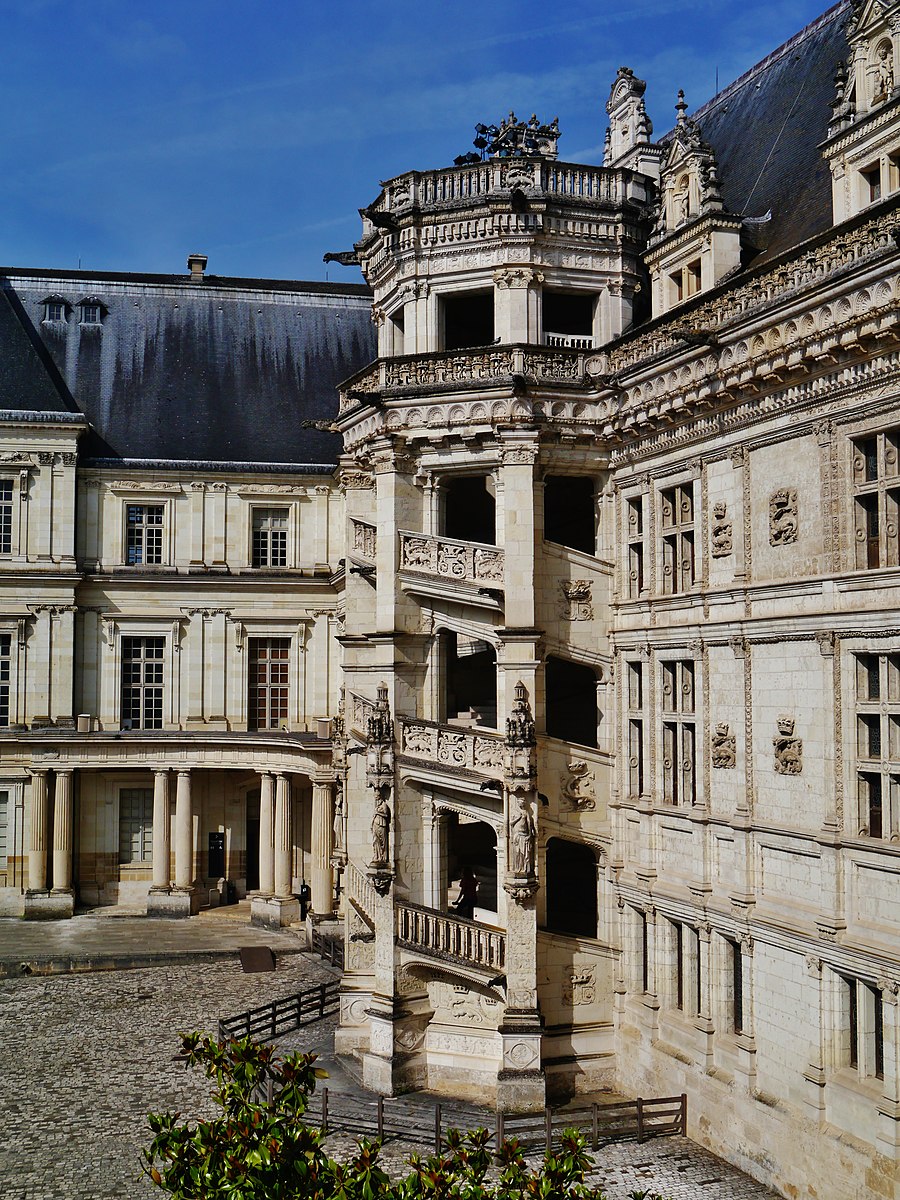
In 1515, François I and his wife Claude ascended to the throne. At Claude's urging, François began to refurbish the château de Blois, which had been used by French kings since the 13th century. He built a new wing with a spiral staircase at its center and consolidated his prodigious collection of books in the library. However, after Claude, mother of his seven children, died at the age of 24, François neglected Blois in favor of other palaces. He moved his library to Fontainebleau and seldom returned to Blois. Perhaps memories of his years there with Claude, of whom he had been fond, made François uncomfortable? Later in the century, Henri III resided at Blois with his mother, Catherine de Medici, during the chaos of the Wars of Religion. In December 1588, Henri summoned to Blois the Duc de Guise, a powerful and charismatic Catholic leader who nurtured ambitions for the throne. Once arrived, the Duc was assassinated by the king's body guard as the king looked on. How is that for an inciting incident, or a novel's climax?
![]() |
| Photo credit: Tim Sackton |
![]() |
| Chaumont. Photo credit: Tim Tim |
Friday, October 16, 2020
Why Read Historical Fiction Set in Sixteenth Century France? Reason #7
Today's reason almost goes without saying...
Reason #7--FRANCE
France is the most popular travel destination in the world, visited by 89 million foreign tourists in 2018 alone. The country's vineyards
beaches
mountains
tug at the hearts and pursestrings of enthusiastic travelers and compilers of bucket lists the world over. Paris tops New York on lists of "Most Visited Cities" and flaunts its undisputed title as the "Most Romantic." Its cultural attractions, like the Musée du Louvre, the Eiffel Tower, and Arc de Triomphe, as well as its luxury boutiques, fine restaurants, and outdoor cafés, are a perennial draw. For well-seasoned travelers and armchair dreamers alike, France holds a distinctive and dynamic appeal.