
Showing posts with label Charles V. Show all posts
Showing posts with label Charles V. Show all posts
Monday, September 21, 2020
Festivals, Balls, and Hunts in Honor of Charles V
On this day in 1558, Charles V, the Holy Roman Emperor and King François I's longtime enemy, died in Spain. The official social media streams of the Château of Fontainebleau (Twitter: @CFontainebleau, Facebook: Château de Fontainebleau) are commemorating Charles Quint's passing by recalling his visit to France in 1539. The French feed reads: "In December 1539, he arrives at the Golden Gate adorned with the emblem of the King of the Renaissance! Festivals, balls and hunts follow one after the other in this dwelling decorated by the brushes of the greatest Italian artists." The feed includes lovely photos of the Porte Dorée and François's salamander emblem. You can learn about the history and architecture of the château, as well as details about Charles Quint's visit, at the Château website.

Tuesday, September 12, 2017
King François I, "Père des arts, des armes et des lois"

Bon vivant. Ladies' man. Humanist scholar. Patron of the arts. Warrior. King.
In true Renaissance fashion, François I of France, born this day in 1497, was all those things and more. Guided by a single dream--to make of France a new Italy, a center of art and culture as well as commerce--François expanded the intellectual and geographical boundaries of France, transforming the medieval kingdom into a modern state that vied with England and Spain for dominance over the European continent and the New World.
And he certainly had a good time doing so.
Scion of a minor branch of the Valois line, François was never expected to become king. His son-less cousin Louis XII named him heir presumptive in 1498. In 1514, François married Louis's only daughter, Claude; the couple ascended the throne the next year, the start of a thirty-two year reign. After Claude died in 1524, having given birth to seven children in nine years, François married Eleanor of Austria, sister of Emperor Charles V. Throughout his second marriage, Anne d'Heilly, Duchess d'Étampes, wielded power at court and over François's heart as his official mistress. François died of illness in 1547 on the twenty-eighth birthday of his son and successor, Henri II.
 Jovial, athletic, and charming, François fostered chivalric ideals at a court that soon became known for its culture and sophistication. He loved to hunt and wrestle, and recreated the glory of his early military victories in Italy in frequent jousts and tournaments. His need for physical activity--both sportive and amorous--vied with his ardent intellectual curiosity. Having espoused the humanist ideals to which his tutors exposed him, François supported writers and scholars in many disciplines and invited them to court to discuss their work. He avidly collected books and manuscripts, amassing what would serve as the seed kernel of France's eventual national library.
François nurtured a similar passion for art and architecture. He invited prominent Italian artists like Leonardo Da Vinci and Rosso Fiorentino, as well as skilled artisans and craftsmen, to France. Together, these gifted men constructed and beautified the many châteaux that dotted the kingdom, transforming dreary fortifications and decrepit hunting lodges into dazzling pleasure palaces. François collected works of art like he did books, sending agents into Italy to purchase or copy works and displaying in his châteaux canvasses and statues sent to him as gifts or produced by the artists he supported.
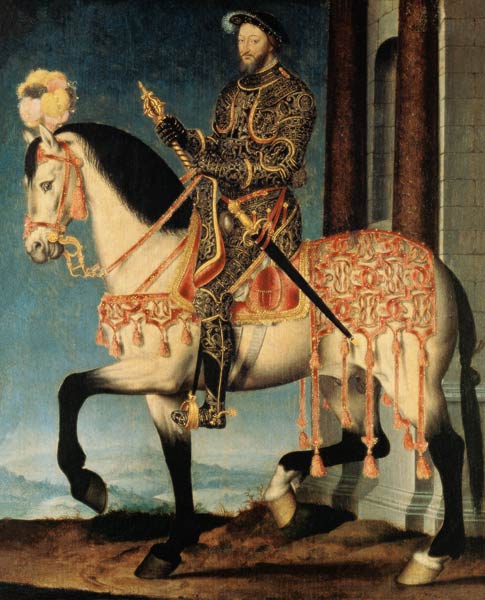 Politically, François solidified the evolving concept of the absolute monarch and pursued the formation of a nation-state. Throughout his reign, he defended France against the designs of the Holy Roman Emperor Charles V of Spain. Bitter rivals since Charles narrowly beat him out for the elected position, the two became sworn enemies once Charles's forces captured François at the battle of Pavia in Italy in 1525. The French king spent a year in Spain as Charles's prisoner, and was only released in exchange for his two sons and his marriage to Charles's sister Eléanor. After several years, François raised the money to ransom his sons, their relationship with him forever damaged by the grueling separation. In his perpetual effort to thwart Charles, François made alliances with Henry VIII of England and Suleiman, sultan of the Ottoman empire. He was still engaged in battle with Charles at the time of his death.
François I both fostered and personified the fruits of Renaissance endeavor. With unbounded energy and relentless enthusiasm, he led his kingdom on a voyage of discovery and smoothed the rougher edges of late medieval culture into a close facsimile of the Italian splendor he so admired. If France was the "mother of arts, arms, and laws," as the poet Joachim du Bellay would soon describe her, François I was their uncontested father.
Happy Birthday, sire!
Sunday, July 19, 2015
"Musical Frescos" at Fontainebleau
The Château of Fontainebleau is presenting a series of concerts dedicated to illuminating the history of the château and reviving the memory of the great kings who counted it among their favorite residences. The "Musical Fresco" scheduled for August 29 centers on François I and includes four separate concerts commemorating different aspects of the king's persona:
Le roi galant et le roi mécène -- Rêver d’amour et d’Italie
Le roi conquérant -- François Ier et Charles Quint
Le roi chrétien -- La Réforme musicale
Le roi chevalier - -François Ier et les guerres d’Italie, de la victoire de Marignan à la défaite de Pavie
Gallant King and Patron King -- Dreaming of love and of Italy
Conquering King -- François I and Charles V
Christian King -- Musical reform
Warrior king -- François I and the Italian Wars, from the victory of Marignan to the defeat at Pavie
Each of the concerts will feature Renaissance music performed by noted Baroque ensembles on period instruments.
The Château's official Facebook page provided this historical vignette as context for the "Conquering King" concert [translation mine]:

"François I received his rival Charles V in all magnificence at Fontainebleau from December 24-30, 1539. In order to dazzle the emperor, the king organized fantastical skirmishes and tournaments at the palace gates and erected a temporary triumphal arch. François concluded the palace visit in his private gallery (he alone kept the keys, of which he was so proud), decorated by Rosso. In this picture, the two protagonists arrive in Paris after their stay at Fontainebleau. The Christmas celebrations of 1539, with the meeting between the two most powerful sovereigns of Europe, certainly count among the most brilliant of the sixteenth century at Fontainebleau."
An unforgettable moment in the château's history---and a perfect backdrop for a historical novel, wouldn't you say? ;)
Le roi galant et le roi mécène -- Rêver d’amour et d’Italie
Le roi conquérant -- François Ier et Charles Quint
Le roi chrétien -- La Réforme musicale
Le roi chevalier - -François Ier et les guerres d’Italie, de la victoire de Marignan à la défaite de Pavie
Gallant King and Patron King -- Dreaming of love and of Italy
Conquering King -- François I and Charles V
Christian King -- Musical reform
Warrior king -- François I and the Italian Wars, from the victory of Marignan to the defeat at Pavie
Each of the concerts will feature Renaissance music performed by noted Baroque ensembles on period instruments.
The Château's official Facebook page provided this historical vignette as context for the "Conquering King" concert [translation mine]:

"François I received his rival Charles V in all magnificence at Fontainebleau from December 24-30, 1539. In order to dazzle the emperor, the king organized fantastical skirmishes and tournaments at the palace gates and erected a temporary triumphal arch. François concluded the palace visit in his private gallery (he alone kept the keys, of which he was so proud), decorated by Rosso. In this picture, the two protagonists arrive in Paris after their stay at Fontainebleau. The Christmas celebrations of 1539, with the meeting between the two most powerful sovereigns of Europe, certainly count among the most brilliant of the sixteenth century at Fontainebleau."
An unforgettable moment in the château's history---and a perfect backdrop for a historical novel, wouldn't you say? ;)
Friday, June 7, 2013
Sixteenth Century Quote of the Week
 |
| Charles V with a dog by Titian (1533) |
Michel de Montaigne (1533-1592), French statesman and essayist
"Of Sumptuary Laws," Essais I, Ch. XLIII
translated by George B. Ives
Wednesday, May 1, 2013
Interview with Nancy Bilyeau, author of THE CHALICE

Nancy was kind enough to answer questions I sent her about THE CHALICE and the history behind the novel.
1. Can you describe the genesis of the novel? Did a specific object or historical event serve as a catalyst? How difficult was it to mold the plot to the framework of historical events?
THE CHALICE is a sequel to THE CROWN, my debut novel. The main character is Joanna Stafford, a Dominican novice pledged to Dartford priory just when Henry VIII crushed the monasteries: the late 1530s. At the end of THE CROWN, the priory is "surrendered" to the king in 1538. What I wanted to do in the second book is explore what would happen to a person after losing their way of life, how would they handle it emotionally. What kind of despair and anger would these displaced people feel, and what would they do about it? The specific events that the book molds around are the arrests in the Courtenay Conspiracy, the king's betrothal to Anne of Cleves, the Act of Six Articles and, in Flanders, the Revolt of Ghent. I enjoy incorporating real events into my novels. The only problem they cause is elongating the timeline at some points. A thriller should move quickly but when you're working with things that really happened you have to allow the proper amount of time.
2. What was it about the years 1538-1540 that grabbed your attention and sparked your imagination?
That's a tense, strange time in the reign of Henry VIII. Most people look at it as an in-between time: after the death of his third wife and leading up to marriage to his fourth, Anne of Cleves. Part of the action of THE CHALICE wraps around the arrival of Anne. And without giving too much away, this marriage is key to the plot. That marriage--and its failure--is well known. Less well known is that England was braced for war, for invasion by a combined army of Charles V and Francis I, egged on by the Pope who had excommunicated Henry VIII. This is what runs through the entire plot: the fear, the paranoia, of Henry. Joanna doesn't directly interact with the king in this book, but his actions ripple out toward her in many ways. She sees people she cares for die because of the king's fears.
3. Joanna Stafford is a woman with strong loyalties to her Catholic faith, her noble family, and her country, England--loyalties which often conflicted with each other and complicated her course of action. As you wrote, did any of Joanna's choice surprise you? Do you think any of them surprised her?
Joanna had to make many choices in the book that have to do with faith and love and loyalty and courage. Hard choices. I was often moved by what Joanna had to do in THE CHALICE, because it required sacrifices. In this novel she is tested and yes, she would be surprised herself at how she survives those tests.
4. The Holy Roman Emperor, Charles V, was as important a player on the European stage as his peers Henry VIII and Francis I, yet he has been largely neglected in historical fiction. Why do you think this is the case? What are your impressions of the man?
That is a good question! He was an enormously important person--he was in power during the birth of Protestantism, the exploration of the Americas, cataclysmic wars with France and the rising Muslim power. Yet in much historical fiction he's ignored. I wonder if it's because he's not a romantic figure compared to Henry VIII and Francis I, both handsome men with multiple wives and mistresses. Charles was a homely man who I think seemed morose to others. I actually have some sympathy for him because of the absolutely enormous, crushing burden of his empire and the sense I get that he hated it and that is why he "retired" at a certain point and had a few years of quiet, private life with his family. His family was fiercely loyal to him, in a way that you don't see in the English or French royal families. His sister Mary of Hungary, after her husband was killed in battle, basically worked for her brother for the rest of her life--she took on the extremely difficult job of Regent of the Netherlands. She represented his interests and never remarried, retiring from the regency when Charles V resigned his position of emperor. When she died, she left her brother all her possessions. Hard to imagine Mary or Margaret Tudor doing any of that for Henry.
5. What prompted you to include fantasy elements in THE CHALICE?
The mid-16th century was filled with mystical beliefs in prophecy and astrology and necromancy, and I researched those very deeply. I was surprised by how the beliefs co-existed with Christianity. Devout Catholics also had their astrological charts done--by their physicians! I think it wasn't until Protestants had advanced their beliefs, and gained strength, that some of the skepticism set in and there were efforts to stamp out "pagan" beliefs. For instance, the Puritans tried to do away with Halloween...but it was too popular!
6. What was your favorite scene to write? The most difficult?
I think my favorite scenes were when Sister Joanna and Brother Edmund find themselves in an empty Blackfriars monastery all night, and I have to admit that an execution on Tower Hill was something I've always wanted to write. The most difficult were in the first third, when Joanna was in London and getting more and more suspicious and worried because all is not what it seems. The revelations had to be made so slowly and carefully, but not too subtly either. It's a challenging balance.
7. The fates of several characters are left unresolved at the end--will there be a third book in the series?
It looks that way! There will be an announcement soon.
8. Are there other eras or settings you would like to write about?
Oh yes, I am interested in the 18th century and drawn to it almost as much as I am to the Tudor era. I wrote a screenplay about Mary Wollstonecraft, who lived and wrote in the late 18th century. I have other ideas for this time period, too.
9. How does your training in magazine journalism help or hinder you in writing fiction?
It helps me with research but with the actual writing of the prose, it doesn't help or hinder. They are completely different skill sets, editing articles for a magazine and writing a novel. Far different uses of creativity. Except for the determination to use good spelling and grammar, perhaps. I always try to do that! Too many rigorous bosses shouting in my ear to ever let that go.

**********
Thank you for a marvelous interview, Nancy, to go with your wonderful novels!
You can learn more about Nancy and her work at her website.
Monday, April 29, 2013
Review: THE CHALICE by Nancy Bilyeau
When Henry VIII closes religious houses across England, novice Joanna Stafford, daughter of an English nobleman and one of Katherine of Aragon's Spanish ladies-in-waiting, hopes to supplement her meagre pension by establishing a tapestry-weaving business. The day she lugs home the first piece of her new loom, her life changes--but not in any way she'd expected. Her cousin Henry Courtenay, a trusted relation of the king, and his wife Gertrude arrive to invite her to spend time with them in London. A high-ranking family loyal to the Catholic faith, the Courtenays secretly scheme to place the Princess Mary on the throne and restore the true faith in England. Joanna finds herself swept up in a plot targeting King Henry, a plot that hinges on Joanna herself. Years earlier, a seer who tried to prevent Henry VIII's divorce had declared Joanna to be "the one who would come after"--the one who, after hearing the entire prophecy as revealed by two additional seers, would set in motion events that would alter England's history. Joanna's involvement with Gertrude Courtenay, and through her, the Holy Roman Emperor Charles V of Spain, propels Joanna to embrace her fate and race to uncover the prophecy before Henry fathers the sons that will ensure the supremacy of the Reformed Faith in England forever.
THE CHALICE places the religious turmoil unleashed by Henry VIII in an international context, capturing the turbulence of a time when Henry seemed to waver in his religious convictions and his opponents nurtured high hopes that Charles V might set things right. The prominence of the Emperor and his representatives in THE CHALICE is a splendid addition to standard Tudor fare. Despite being one of the three preeminent monarchs of the Tudor era, Charles seldom features in historical fiction. Although he does not appear in person in THE CHALICE, his constant menace finds expression through the machinations and relentless persistence of his wily ambassador Eustace Chapuys, with whom Joanna forges a reluctant alliance. THE CHALICE dramatizes how Henry's decision to break with Rome upset the balance of power in Europe and not only placed England in danger of being invaded by Spain and France, but encouraged France to flirt openly with an Ottoman alliance. Joanna's involvement with Imperial agents in an international plot underscores how Henry changed not just the course of English history, but that of all Catholic Europe. I have been immersed in research about Charles V for my own novel, set in France during the same years as THE CHALICE (1538-40), and it is exciting to see another author evoke the complicated contours of this era.
Bilyeau balances this broad political focus with attention to the effects of Henry's actions on the lives of individual believers. The novel's principal characters all confront decisions that pit their personal beliefs against the will of the king. Powerful noblemen must choose between allegiance to their faith or to their anointed monarch; dispossessed nuns must betray their vows and marry in order to survive; defrocked monks consider violence in order to protect holy relics; servants must decide whether to protect or reveal the activities of their recusant employers. Joanna's personal conflicts are many and involve her heart as well as her head. Looming foremost is the question of whether to pursue the prophecy despite her aversion to such practices and what to do with the knowledge once she gains it. With courage and great personal sacrifice, Joanna follows a course of action that offers her Catholic brethren in England continued hope yet does not betray her principles. Convincing in her faith and endearing in her loyalties, Joanna is a heroine to admire. I look forward to following her on further adventures. In THE CHALICE, a stand-alone novel that may be read in conjunction with the author's debut, THE CROWN (2012), Bilyeau has crafted a deft novel that will appeal to readers of suspense as well historical enthusiasts looking for a unique take on a popular era.
**********
Come back tomorrow to read my interview with Nancy Bilyeau about THE CHALICE. To learn more about Nancy and her books, visit her website.
This review is part of the Historical Fiction Virtual Book Tour for THE CHALICE. To read the other reviews and interviews that are part of the tour, see the tour schedule.

**********
Come back tomorrow to read my interview with Nancy Bilyeau about THE CHALICE. To learn more about Nancy and her books, visit her website.
This review is part of the Historical Fiction Virtual Book Tour for THE CHALICE. To read the other reviews and interviews that are part of the tour, see the tour schedule.

Friday, October 19, 2012
Sixteenth Century Quote of the Week

Portrait by Titian
"My cousin Francis and I are in perfect accord--he wants Milan, and so do I."
Charles V (1500-1558), Holy Roman Emperor
Monday, October 15, 2012
A December Surprise
Imagine for a moment that only two years after the 9/11 terrorist attack, President Bush announced that he was inviting Osama Bin Laden to pass through the United States on his way to Canada. Not only would the President guarantee America's worst enemy safe passage, he intended to organize parties and receptions at each of the cities along the route, culminating in an extravagant gala at the White House, which was being completely redecorated for the event. And, by the way, no politics would be discussed at all during the visit, for fear of forcing Bin Laden to make, for politeness's sake, concessions he otherwise would never consider.
What would your reaction be? SURPRISE, surely, if not outrage.
Such must have been the reaction of the French populace when they learned that their King, François I, had invited the Holy Roman Emperor, Charles V, to pass through France on his way to Ghent in 1539. Charles V and François had been mortal enemies for over a decade, ever since Charles captured François at the Battle of Pavia in 1525 and held him hostage for more than a year, releasing him only after receiving a huge ransom, François's two sons as hostages, and the king's pledge to marry his sister Eléonore. Seemingly perpetual war broke out between the two monarchs after François returned to France, with François determined to regain both his honor and the duchy of Milan, lost at Pavia. The campaign of 1536-38 was particularly devastating to France, with Charles invading and laying waste to huge portions of Provence. Encouraged by the Pope to unite against the Turk, the monarchs entered an uneasy truce in the summer of 1538. Then, in 1539, when Charles needed quick access to the Low Countries to suppress a rebellion there, François, to the consternation of many, invited the emperor to pass overland through France rather than travel by sea.
Of course this overture had political motives. François hoped to obtain through friendship what he had failed to win through war. In an effort to secure Charles's promise to marry his daughter to François's youngest son and grant the couple Milan as a dowry, François spared no expense or effort on this extraordinary visit. He met Charles in person in southwestern France and traveled with him north all the way to Paris. Cities along the route staged elaborate entries; François entertained his royal guest at his finest châteaux with feasts and jousts and pageants. A month of sumptuous December festivity left the sober, somber Spaniards aghast at the French king's extravagance. As promised by the connétable de Montmorency (the chief promoter the king's new strategy), the subject of Milan was never broached directly while Charles was on French soil. Showered with expensive gifts and words of affection, Charles departed, promising to reach a decision regarding the proposed marriage soon.

Surprised to see his strategy fail in such stupendous fashion, the connétable de Montmorency could hardly be surprised to find himself disgraced and banished from François's court.
And you -- don't tell me you're surprised that I think this a splendid setting for a historical novel!
*******
This post is my contribution to my writing group's new weekly topic challenge. Author Susan Spann, author of the forthcoming ninja detective novel CLAWS OF THE CAT (Thomas Dunne, 2013), will propose a topic on her blog each Monday and we each of us will respond. Marci Jefferson (author of THE DUCHESS OF RICHMOND, St. Martins, 2014) posted her response on Susan's blog. Amanda Orr, working on a novel set in New Orleans, "the poor man's Paris," posts about a surprise 9-months-in-the-making and its effects on her writing. Feel free to join in and post your link in the comments below!
Saturday, July 16, 2011
And It Keeps on Ticking
Stumbled across an utterly fascinating story of a sixteenth-century wooden automaton of a monk on permanent display at the Smithsonian Institution. Watch the monk walk and kiss his rosary in this video, then read the article by Elizabeth King about the machine's genesis and attribution. "Monkbot" appears to have been built in 1560 by Juanelo Turriano, Emperor Charles V's mechanician. Representing Fray Diego de Alcala, a fifteenth century monk whose cause for sainthood was being promoted at the time, the automaton was commissioned by Charles's son, King Philip II, in thanksgiving for the miraculous healing of his own son Don Carlos from a near fatal head wound. It's amazing to watch the six hundred year old figure move and to read King's account of her attempts to determine its origins. Thanks to the Radiolab blog for running a recent post about this "Clockwork Miracle."
Saturday, September 18, 2010
Power Billboards

Fascinating article by scholar Lisa Jardine on the use of commissioned tapesty and other artwork to proclaim the power, influence and cultivation of their owners on the international stage in the sixteenth century. An excerpt:
As part of the preparations for an unprovoked military attack on Muslim forces in North Africa in 1535, the Hapsburg Emperor Charles V hired the same Pieter Coeck van Aelst and the artist Jan Cornelisz Vermeyen from Haarlem in the Netherlands to travel with his military retinue and record the progress of the campaign for propaganda purposes. By late July the Imperial forces had conquered Tunis. The campaign was - as Charles V had hoped - a surprise victory over the increasingly invulnerable Muslim forces, and a blow to the international prestige of the French king, Francis I, who had declined to be drawn into a North African war.
On Charles V's return, no expense was spared in creating a magnificent tapestry series, The Conquest of Tunis, based on Coeck's and Vermeyen's eye-witness drawings, and a room in the imperial palace at Toledo was constructed to house the twelve panels of the series. Thereafter they often travelled with the Emperor - carefully rolled, and stacked on purpose-built wagons - to be unfurled on the occasion of a state visit, to remind those attending an Imperial gathering of the awesome power of the Habsburgs.
The article includes photographs of the Acts of the Apostles tapestries designed by Raphael and executed by the same Pieter Coeck van Aelst, presently on display at the Victoria and Albert Museum in London.
Tuesday, September 14, 2010
Young Turks
In 1520, Suleiman the Magnificent became sultan of the Ottoman world, which stretched from Hungary to Baghdad to the Eastern Mediterranean. He was only 26 years old. At the time of his accession, the leaders of the western world's three superpowers, France, the Holy Roman Empire (which included Spain and the Netherlands), and England, were just as young: François I (born the same year as Suleiman, 1494), was 26; Charles V (born in 1500) was only 20; Henry VIII (born in 1491) was eldest at 29.


To put this in perspective, imagine a world whose supreme leaders were the likes of Zac Efron, Justin Timberlake, Elijah Wood and Daniel Radcliffe (all born in the 1980's).


Scary thought, isn't it?
Of course, unlike the celebrities listed above, François, Charles, Henry and Suleiman had all been groomed since childhood in preparation for kingship. They were well-educated, trained in the arts of war and governing, and counseled by seasoned statesmen and diplomats, many of whom had served previous monarchs. Convinced of their divine right to rule, these kings knew it was their duty to serve the best interests of their people.
Still. Nowadays we consider a politician "young" at forty. But twenty?
Men in their twenties are notorious for "strutting their stuff," vying with each other to claim that "top dog" status. François, Charles, Henry and Suleiman did compete directly with each other not only for territory, but for wealth, possessions, and influence. As they fought each other for chunks of Europe, they strove to construct the most magnificent palaces, employ the most accomplished artists and maintain the most cultured courts (Henry and François dug deep into their countries' coffers to outshine the other's extravagance at the Field of Cloth of Gold in 1520; François pulled the stops again in 1539 when Charles traveled through France on a state visit). They competed for the same offices (Charles beat out François in 1519 for the title of Holy Roman Emperor) and spheres of diplomatic influence (especially papal alliances). They raced to beat the others in exploring and colonizing the New World and monopolizing trade routes. They might have shared a woman or two (rumor has it that François might have been friendly with a young Anne Boleyn). Henry and François even wrestled each other for fun in front of the court at Cloth of Gold (François won handily, I might add).
I attribute much of the vim and verve of the first half of the sixteenth century directly to the youth and raw masculinity of these four rulers. How many battles were motivated not by the best interests of the country, but by a desire to beat the other guy? How many paintings and statues were commissioned in order to claim the title of supreme patron of the arts? How many religious dissenters were persecuted in order to prove oneself the staunchest defender of the faith? How many alliances were shifted or broken in order to make life difficult for one of the others? How many miles of silk and leagues of ribbon were cut and sewn in attempts to set the trends for all of Europe? One wonders.
Kings of their countries, these four men clawed and tussled to become King of the Hill.
Imagine how celebrity rags would have read.
Monday, August 23, 2010
A Genoan Jewel
The Villa del Principe, a Genoan villa begun in 1529 by Andrea Doria, an admiral who fought at various times for both François I and Charles V, now houses a stunning collection of Renaissance art. Caravaggio's "Flight to Egypt" is the centerpiece of the collection, which includes paintings by Titian, Bronzino and del Piombo. The villa itself has been painstakingly restored to its sixteenth-century splendor. This article gives a brief history of Doria, the house, and the artwork within it.
Friday, April 9, 2010
Sixteenth Century Quote of the Week
"Fortune is like the ladies, who generally scorn and discard their over-earnest admirers."
Attributed to Charles V (1500-1558),
King of Spain and Holy Roman Emperor
by Francis Bacon (1561-1626),
English philosopher and statesman
The Advancement of Learning (1605), Book II
Friday, November 27, 2009
Sixteenth Century Quote of the Week
"Wherefore are you, good men of letters, so little susceptible of shame, as always to be fostering and inflaming the feelings of jealousy and hatred in the hearts of Princes? Wait at least till we are dead, and then write whatever you please; for avarice, party feeling, and other passions will no longer draw a veil over your eyes; and it is only when purified of these, that history will be real history, and fit to live for posterity."
Emperor Charles V
to Christian Nasseus of Cambray,
who in a 1540 historical account represented
King Francis I in the harshest of colors
[Quoted in Correspondence of the Emperor Charles V,
ed. Wm. Bradford (1850)]
Tuesday, September 15, 2009
The Princes in the Tower, French Version

Those familiar with English history know the story of the Princes in the Tower--Edward V and Richard, Duke of York, the young sons of King Edward IV, who, after the death of their father in 1483, were imprisoned in the Tower of London and never seen again. The same history buffs might not, however, realize that France had its own version of imprisoned princes--François and Henri, the two young sons of François I, who were handed over to Charles V as ransom for their father and spent four years in miserable captivity in Spain.
The Treaty of Madrid, which François signed in 1526 to secure his release after the disastrous Battle of Pavie, contained many concessions to Charles V--the most notable being the transfer of Burgundy to the emperor and the renunciation of French claims to Flanders, Naples, and Milan. When François tried to convince Charles that he needed to return home to effect the transfer, Charles demanded that he hand over two of his three sons as hostages until the terms of the treaty had been fulfilled. François, who had spent the past year as Charles's prisoner, seems not to have balked at resigning his young sons, aged only seven and eight, to a similar fate. Perhaps he expected their absence to be a short one; perhaps he placed the well-being of his kingdom, struggling under the regency of his mother, over that of his own flesh and blood. Perhaps he was simply eager to make any deal necessary to gain his freedom. In any case, he agreed to the exchange, which was arranged to take place on March 17, 1526, at the border town of Bayonne.
The trade occurred in the middle of the Bidassoa River, which separates France from Castile. Two boats, one carrying the French king, the other his sons, met in the middle of the river at a raft that had been moored into place. The king hugged his sons and blessed them, telling them he would send for them soon. The two parties switched boats; the princes were rowed back to the Spanish bank while the king proceded to the French. As soon as he landed, François leapt onto his horse, shouted, "Now I am king; I am king once again!" and galloped off to meet his court at Bayonne. There is no record in the extensive descriptions of the exchange that he even looked back at the young sons he had just abandoned.
At first, the princes and their entourage of seventy persons were treated cordially; Eléonore, Charles's sister and François's new wife by proxy, treated the boys as sons. But as the weeks passed and it became obvious that François had no intention of surrendering Burgundy, the treatment of the princes grew harsher. They were taken away from Eleanor and moved to a castle farther south. After a foiled rescue attempt in February 1527, Charles took them further into Spain and dismissed nearly all their attendants. François, hoping to pressure Charles into releasing the boys, entered into league with England and the papacy. When that failed, he declared war on Charles in late 1527.
Of course, this declaration worsened the boys' situation. They were moved to the fortress of Pedraza in the high mountains north of Madrid, where they lived a spartan existence amidst Spanish soldiers. A French spy saw them twice in July 1529; townspeople told him the younger boy, Henry, hurled constant verbal abuse at the Spanish when the princes were permitted to attend Mass. Tired of Charles and François's posturing, Louise de Savoye, the king's mother, and Marguerite d'Autriche, the emperor's aunt and regent of the Netherlands, began negotiations to end the war. In August of 1529, the Treaty of Cambrai, or la paix des dames as it came to be known, was hammered out. Instead of ceding Burgundy, François agreed to pay 2 million écus for the ransom of his sons.
The princes remained in Spain while the king worked to raise the huge sum. Louise sent a man to Pedraza to check on the condition of the princes and to let them know they would soon return home. The man, Baudin, found the boys living in "a dark, disordered chamber with no adornments except straw mattresses." The window, high up the wall, was covered with bars. The boys had received no lessons since their tutor had been released months earlier; their French was rusty, since they only could speak it between themselves. They did have two small dogs to play with, but spent only minutes a day outside playing under the watch of fifty soldiers. Now aged eleven and twelve, they had been in captivity for four years.
François finally managed to collect the ransom by June of 1530, an incredibly difficult feat that nearly bankrupted the kingdom. A train of thirty-two gold-laden mules left Bayonne for the same spot on the Bidassoa River where the first exchange had taken place. The boys were reunited with their father and the court at Bayonne on July 3. On July 7, François married Eléonore, who had accompanied the princes from Spain. He thus fulfilled one of the stipulations of the original Treaty of Madrid.
How did four years of captivity affect these young boys and their relationship with their father? That is a subject for a future post. One can only imagine the sense of abandonment these young children felt, as well as anger towards a father who so blithely surrendered them so he could once again "be king."
(Source: Henry II, King of France 1547-1559 by Frederic J. Baumgartner. Duke UP, 1988. Photo of Pedraza Castle courtesy of Wikimedia Commons.)
Tuesday, July 7, 2009
The Captive King
Last we saw of King François, he had been taken prisoner by imperial forces at the disastrous Battle of Pavia (24 February 1525). French troops, fighting to recapture the duchy of Milan that François's predecessor Louis XII had lost, were surrounded and roundly defeated by Charles V's army. The King of France's captivity at the hand of the Holy Roman Emperor would last a little over a year and color the two monarchs' relationship for the duration of their reigns.

After the battle, François was taken to the Castle of Pizighettone near Cremona, where he remained for three months in the custody of the Spanish captain. Captured companions accompanied him, including his childhood friend Anne de Montmorency (who would remain François's most trusted counselor and eventually rise to the most powerful political position in France). These men were eventually given safe-conducts that enabled them to travel back and forth between Italy and France to negotiate the king's release. François appointed his mother, Louise de Savoye, regent during his absence. Louise established her court at Lyons, near the Italian border, to facilitate communications with her son and the emperor.
If François and his mother had hoped that Charles would quickly release him for a cash ransom, they were mistaken. Charles presented a long list of demands that included paying Charles's debts to Henry VIII, abandoning French claims to Milan and Genoa, and most importantly, ceding the duchy of Burgundy. The emperor planned to seal the settlement through the marriage of his niece, Mary of Portugal, to the Dauphin. Although François appeared amenable to some of the terms, he refused to negotiate as long as he continued to be held prisoner. He forwarded Charles's terms to Louise, who rejected them outright.
Hoping to cut short negotiations made all the lengthier by the distance separating the two courts, François begged for a face-to-face meeting with Charles. In June, he was taken to Spain on a fleet of galleys decorated in his honor, given a royal welcome in Barcelona, then moved to Valencia. He asked that his sister Marguerite be given safe-conduct to negotiate a peace, that he be moved closer to the site of negotiations for easier consultation, and that a truce be declared while the talks were in progress. Charles agreed to all three requests, yet continued to avoid meeting with François in person.
When the French ambassadors met with Charles in Toledo, the emperor continued to dismiss any discussion of a ransom. He was willing to make some concessions in his original demands, but claimed there could be no lasting peace as long as Burgundy remained in French hands. France, however, refused to consider surrendering the region; in fact, François, now in Madrid, made a secret declaration to the French ambassadors that he would never surrender Burgundy freely and that, if forced to do so, his action would be null and void.
Charles almost lost his opportunity to profit from the situation when François nearly died in September from a combination of acute depression, anorexia and a nasal abscess. The French king ran a fever for twenty-three straight days and lapsed into a semi-coma after Charles did, finally, come to see him. Later in the month, the abscess burst and François unexpectedly recovered. Peace talks resumed, this time facilitated by Marguerite, who had arrived during her brother's illness, but were suspended once again when Charles found the proposals unacceptable.
By the end of the year, the strain of the king's absence was growing too great for the kingdom. Louise de Savoye decided to abandon Burgundy and convinced François to accept Charles's terms. On January 14, 1526, the parties signed the Treaty of Madrid. In return for his freedom, François ceded Burgundy and abandoned his claims to Italy. He also agreed to hand over his two oldest sons as hostages until the terms of the treaty were fulfilled. In return, he demanded the hand of Charles's sister Eléonore in marriage, in order to keep her from marrying Charles de Bourbon, the prince of the blood who had sided with Charles during the war. Charles, swayed by advisors who believed the French king could be trusted, agreed. Little did he know that two days before the French king signed the treaty, he had made another secret declaration nullifying the surrender of Burgundy.
Betrothed by proxy to Eléonore in January, François remained in Madrid until mid-February, possibly for health reasons. Charles arrived, and together they traveled to meet Eléonore. A few days later, Charles set off to Seville to marry Isabella of Portugal, and François began the long journey back to France with his Spanish escort. The heartrending exchange of the monarch for his two young sons, which deserves a post of its own, was set for March 17 on the river Bidassoa.
[Source: The material for this post was condensed from R. J. Knecht's account in Renaissance Warrior and Patron, pp. 216-48.]
Friday, April 3, 2009
A Friday Snippet
I've been busy writing, so instead of a history post I'm going to share a snippet of my WIP. This is the opening of the fourth chapter; the characters are King François and his official mistress, the powerful Anne d'Heilly, Madame d'Etampes. Charles V is the Emperor; the Dauphin is the king's older son Henri; Orléans is François's third son, another Charles. Montmorency is the Grand Constable of France, one the king's chief advisors.
**********
Copyright 2009 by Julianne Douglas. All rights reserved.
François paced the length of her chamber like a caged lynx, their hurried coupling already forgotten. “You will not dissuade me, Annette. Despite our victories in the field, Milan yet proves elusive. Perhaps, as the connétable suggests, peace and friendship will garner what war has failed to win.”
He stopped before her and extended a hand. Anne worked the leather glove, stiff with embroidery, over his fingers and palm. His skin hardly quivered when she kissed the underside of his wrist.
“I have taken the first step. Today I granted Montmorency permission to approach the Spanish ambassador on the subject of a match between the Emperor and young Marguerite.” She felt his eyes on her face, watching for her response to this unforseen bit of news.
She managed to preserve her smile, though inwardly she cursed his impatience. “So soon?” She released his hand and reached for the other. “Queen Isabel died hardly two weeks ago, and by all accounts the Emperor loved her dearly. Might not this proposal signal an unfortunate disregard for his sentiments? You, of all people, should be mindful of that.”
François snatched his hand away, annoyed rather than dissuaded by this mention of his first wife's passing. He flexed the glove into place. “You find fault with the proposal? Charles is a king, and kings are able to separate matters of state from personal sentiment.”
"Are they?" she wanted to ask, but instead bent to retrieve the fur-bordered cape puddled on the floor. “It is not your proposal I question so much as the source from which it comes. No one but Montmorency himself would envisage such a scheme.”
François threw back his shoulders. “The connétable judges Charles’s overtures sincere and urges me to respond in kind. What better way to cement the peace than through a joining of our houses?”
Anne shook the cape out with snap. “Charles has already promised his own daughter to Orléans, with Milan as dowry.” The king stooped so she could swing the garment about his shoulders. “Marrying Marguerite would provide him the perfect pretext for releasing the infanta from this pledge. Milan would remain in imperial hands forever.”
François’s eyes narrowed as he considered this fearsome prospect. Encouraged, she cradled his face in her hands and drew his head down until their foreheads met. “Surely you understand what prompts Montmorency’s suggestion.”
“Suggestion?” François repeated, his hands seeking her waist.
She twisted out of his grasp, determined not to distract him. “Montmorency wants nothing more than to cheat Orléans out of the prestige and power of an imperial marriage. He won’t hesitate to quash Orléans’s prospects in order to further the Dauphin’s. And his own.”
François’s face clouded as he contemplated this slight to his favorite son. “Young Charles, ruling Milan with the blessing of the Emperor, does pose a serious threat to Henri’s eastern flank,” he admitted.
“Exactly. Montmorency is no fool. Knowing how your nobles favor Orléans over the Dauphin, he is loath to place young Charles in a position where he could easily be led astray.”
François laughed, a clear and hearty peal. “God’s blood, Annette, without a doubt your fancy runs wilder than Montmorency’s. The connétable but seeks to take advantage of the Emperor’s empty bed, not forestall a rebellion! Easier to snare the Hapsburg fox with a morsel like Marguerite than negotiate endlessly over the price of the infanta.” He reached out and pulled Anne close, nuzzling her neck. “You may be sure I’ll keep you close at hand when the Emperor draws nigh.”
She pushed away from his chest, certain she had misheard. “The Emperor comes to France?”
*********
There's a lot of history and politics in this scene--I'd love to hear your thoughts on how I handled it. Too much information, too clumsily presented? This is only a draft, so I'd really appreciate feedback.
Wednesday, February 4, 2009
The Impossible Dream

François I had a dream, a single goal that motivated the foreign policy of his entire reign: the recovery of the duchy of Milan, a region of Italy he had inherited from his great-grandmother, Valentina Visconti, and which had been lost by his predecessor, Louis XII. In 1515, very first year of his reign, François launched an expedition into Italy and succeeded in securing Milan after a stunning victory at Marignano. It was an auspicious beginning which brought him much glory and established his reputation as roi-chevalier, or knightly king.
However, to retain control in Milan, the French needed the support and cooperation of the Pope, Leo X. François initially received Leo's support, but in 1520, the Hapsburg prince Charles V was elected Holy Roman Emperor and Leo signed a treaty of alliance with him instead. In August 1521 the Emperor (who controlled Spain and Flanders and was promised Naples by the Pope) attacked the north-east border of France. The first of an ongoing series of wars between François and Charles began.
After a significant loss to imperial forces at La Bicocca in April 1522, the French lost much of the area they had seized; only the castle of Milan and Cremona remained in French hands. Henry VIII soon entered the war on the imperial side. The rebellion of the duke Charles de Bourbon, Constable of France (a story worthy of its own post), complicated things immensely for François, for Bourbon entered into league with the Emperor and the English king. François's enemies plotted to attack on three fronts. When Bourbon was routed from Marseilles in 1524, François saw the opportunity to invade Italy, a plan he had deferred for years. He crossed the Alps at the head of his troops, determined to recreate his earlier success at Marignano.
Milan had been abandoned by the imperialist troops, so the French army followed them to the city of Pavia, a heavily fortified town whose garrison was commanded by one of the best generals of the day. For four months the French lay siege to the town but refused to be drawn into the open. Finally, during the night of 23 February 1525, the imperial forces staged a surprise attack on the French, who were camped in the walled park of Mirabello. François, forewarned, charged at the head of his cavalry but got in the way of his own guns. This blunder destroyed any chance of victory and the French troops, exposed to imperial arquebusiers and left shorthanded by the failure of their Swiss mercenaries to arrive, were quickly decimated. The French noblemen fought bravely, many in hand-to-hand combat on horseback, but were unable to hold back the imperial tide.
François himself was surrounded by imperial soldiers, each of whom wanted to claim the honor of capturing him. A steward of Bourbon, La Mothe, finally took him prisoner, but François refused to surrender until Charles de Lannoy, the Viceroy of Naples (who shared command of the imperial army with the duc de Bourbon), arrived. To him François gave up his sword, along with his dream of another glorious Italian victory. Adding to the blow was the loss of many of the king's closest childhood friends and comrades in the battle. Topping everything, François, along with Anne de Montmorency and a dozen or so other high-ranking noblemen, became prisoners of his arch-enemy, the Holy Roman Emperor Charles V. François's captivity at Charles's hands would last more than a year and permanently color relations between the two rulers ever after.
[Source: R. J. Knecht, Renaissance Warrior and Patron, chapters 8-11]

Tapestry of the Battle of Pavia
Friday, May 16, 2008
Answers to Quiz #2
My apologies for the delay in posting the correct answers to Quiz #2. My laptop hard-drive is dying a slow death, so I've been forbidden from using that computer until my husband can back the entire thing up and defragment the disk. I'm working on a different computer now, and it's taking me a bit of time to navigate my way around. And please excuse the lack of accent marks in this post--I haven't figured out how to insert them yet!
Here are the correct answers for the quiz:
1. C The House of VALOIS ruled France from 1328, when Philippe VI took the throne, until 1589, when Henri VI, the first Bourbon king, took over. During the sixteenth century, it was actually a minor branch of the house, the Valois-Angouleme, who ruled. The monarchs were: Francois I (15115-1547), Henri II (1547-1559), Francois II (1559-1560), Charles IX (1560-1574), and Henri III (1574-1589). Catherine de Medici served as regent for Charles IX, who was only 10 years old when he became king, and again for Henri III.
2. A ERASMUS OF ROTTERDAM was the famous Dutch humanist of the Renaissance. Although he never formally abandoned the Catholic Church, his rationalistic biblical commentaries and other writings provided fodder for those who did. In 1519 Francois invited him to head a new college for the study of the classics, but Erasmus valued his intellectual freedom and, not wishing to be tied to any prince, turned him down. (The fact that he did not want to offend Charles V, from whom he was already receiving a stipend, probably also influenced his decision.) The post at the College went to Janus Lascaris, a noted Greek scholar from Italy, instead. Francois's readers formed the prestigious institute of higher learning now known as the College de France.
3. D TENNIS, or jeu de paume, was the trendy sport favored by kings and courtiers during the Renaissance. There is an excellent article on the history of jeu de paume, which is still played in classical form in France, here. The name "tennis" is thought to derive from the French "Tenez," or "Get ready," called at the beginning of a match; "love" from "l'oeuf," or "egg," meaning "zero." (Wrestling was also practiced by Francois and Henri VIII, but not by courtiers and their ladies as well.)
4. C CHARLES V (1500-1558) was elected Holy Roman Emperor in 1519, beating out Francois, who had run a close race. With Charles ruling Spain, the Netherlands and sizable portions of Italy, France felt threatened on all sides. The political, personal and military rivalry between the two monarchs remained intense their entire lives.
5. B Anne de Pisseleu, eventually honored as the DUCHESSE D'ETAMPES, became Francois's mistress after his return from captivity in Spain in 1526. Whereas Francois's first mistress, Francoise de Foix, played no political role, the duchesse d'Etampes was a member of Francois's privy council and, according to one foreign ambassador, the person who wielded the most influence on the king in matters of state. I will do a longer post on Anne later, as she will be one of the main characters in my second novel. Anne's chief rival at court was Diane de Poitiers, the Dauphin Henri's mistress.
Three people took the quiz--Sarah, Catherine, and Daphne--and they all did quite well. DAPHNE answered all five questions correctly, and Sarah and Catherine only missed one question each. CONGRATULATIONS, ladies! Thank you for playing the game and being faithful readers of the blog. I hope everyone reading learned a little something she didn't know before.
Sunday, April 27, 2008
Isabella of Portugal and Charles V
.jpg) In doing research on François I's longtime rival, the Holy Roman Emperor Charles V (1500-1558), I came across this lovely portrait of his wife, Isabella of Portugal (1503-1539). Isabella married the Emperor in 1526, and despite the match being a political one, the two are purported to have fallen love during their honeymoon and remained devoted to each other for their entire marriage. Isabella died giving birth to their fifth child in May 1539, while Charles was away. The Emperor never recovered; for the rest of his life he wore black and never remarried (although he did father a son, Juan of Austria, in 1547).
In doing research on François I's longtime rival, the Holy Roman Emperor Charles V (1500-1558), I came across this lovely portrait of his wife, Isabella of Portugal (1503-1539). Isabella married the Emperor in 1526, and despite the match being a political one, the two are purported to have fallen love during their honeymoon and remained devoted to each other for their entire marriage. Isabella died giving birth to their fifth child in May 1539, while Charles was away. The Emperor never recovered; for the rest of his life he wore black and never remarried (although he did father a son, Juan of Austria, in 1547).Charles visited Fontainebleau on a state visit in December of 1539, only seven months after his beloved Isabella's death. His grief must certainly have affected his demeanor and actions during the weeks he spent as François's guest. Learning of the Emperor's happy marriage and his wife's untimely death is an example of how a fortuitous research find can yield much fruit in the writing of fiction. Now, when I write the section of my second novel which depicts the festivities at Fontainebleau organized in Charles's honor, I will be able to bring some psychological depth to my portrayal of him. In addition, I have a possible seed (an insensitive remark? an unfortunate comparison?) for the intense dislike that springs up between him and another character during that visit, a dislike which has important political and dramatic repercussions.
Plot points aside, I've posted the painting of Isabella here in light of our recent discussions of the use of women's portraits on the covers of historical novels. I find this to be one of the most beautiful Renaissance portraits I've seen--Isabella's grace and gentleness emanate from the canvas, and her costume is elegant but not ostentatious. (And don't you just love her 'do?!) It would make a wonderful cover. The problem with using portraits, however, is that if the painting depicts an easily identifiable person, the face cannot be shown in full. (Especially if the person doesn't even figure in the novel!) In any case, I'm glad to have learned a bit about Isabella. Who knows? Maybe I'll revisit her someday--my list of possible subjects for future novels keeps growing.
Subscribe to:
Posts (Atom)


 Posts
Posts


