Showing posts with label Fontainebleau. Show all posts

Saturday, May 14, 2022

Party Central: L'Art de la Fête à la cour des Valois


Renaissance courtiers loved a good party. Fêtes, or celebrations, at court lasted for days and included any number of events: lavish banquets, jousts and mock battles, dramatic spectacles, elaborate costume balls. Festive gatherings served a multitude of purposes: impressing visiting dignitaries, marking births and marriages, commemorating important victories, displaying the skills and ingenuity of court artists--and, of course, manifesting the munificent generosity of the king.

Above and beyond their political purposes, parties were just plain fun. 

Photo credit: Cleveland Museum of Art 

Despite the frequency and extravagance of Renaissance court festivals, however, they are difficult to document. Parties are, after all, ephemeral things: the food is consumed, the decorations discarded, the music fades away. Before the invention of photography, it was impossible to capture such events in real time. Modern historians must rely on written memories and rare artifacts as they attempt to reconstruct the look, activity, and tenor of celebrations at the Renaissance court.

A current exhibition at the Château of Fontainebleau, the primary residence of François I and a favorite of his son Henri II and grandson Henri III, attempts to recreate the Renaissance celebration for modern-day visitors. L'Art de la fête à la cour des Valois, which runs through July 4, presents over one hundred works, many lent from international collections, in an attempt to capture these festivals in all their splendor and document the extensive behind-the-scenes preparation that glory required.

Organized by curators Oriane Beaufils and Vincent Droguet, the exhibit includes paintings, tapestries, parade armor, costume sketches and commemorative pamphlets from celebrations across several reigns. From the most solemn to the most extravagant, Renaissance celebrations were living, moving, breathing works of art that sprouted from the ingenuity of some of the greatest artists of the time: Rosso Fiorentino, Francesco Primaticcio, Robert Delorme, Antoine Caron, and poet Pierre de Ronsard. The collected works at Fontainebleau resurrect the decorations, program, and costumes of some of the Valois court's most magnificent events.

Masquerade balls were central to Valois celebrations. Sketches of costumes designed by court artist Primaticcio for events like the festivities surrounding Emperor Charles V's state visit to Fontainebleau in 1539 (I blogged about that here) survive to this day. 

Photo credit: Musée du Louvre

Photo credit: Musée du Louvre

In order to recreate the feel of the fête for modern visitors, the Château engaged the costume workshop of nearby Disneyland Paris to render two of Primaticcio's sketches into life-sized garments. These faithful, fanciful costumes stand on display in the Château's ballroom, site of so many Valois parties. If you can't make it to the salle de bal in person, you can view the recreated costumes here, courtesy of La République de Seine-et-Marne.

Scribeaccroupi.fr, a French art history site, has an excellent written preview of the exposition, as well as an engaging short film animated by Oriane Beaufils herself. Her enthusiasm for the subject is palpable.

As much as I'd love to view the exposition in person, I must content myself with the printed catalogue, which I expect to arrive next week. I'll share about it soon. In the meantime....

Party on!

(You can find more about the exhibit on Twitter under the hashtags #PartyLikeaValois and #FeteAFontainebleau.)


Monday, March 8, 2021

Happy Birthday, Rosso!

Today is the 527th anniversary of the birth of the artist Giovanni Battista da Jacopo, known as Il Rosso Fiorentino (the Red-headed Florentine). Born on March 8, 1494, and trained in Florence, Rosso is considered a leading proponent of the Mannerist movement. Having made a name for himself in Rome, he was invited to France by François I in 1530 and spent the next decade as the French king's Director of Artistic Work. Rosso created numerous masterpieces for the king, as well as designing and staging the elaborate pageants and festivals François so loved. Rosso's artistic vision guided the expansion and decoration of the Château of Fontainebleau, François's favorite palace, culminating in the creation of the grande galerie, now known as the galerie François I. Rosso's best known extant work, the gallery boasts an ornate interplay of fresco, stucco statues and garlands, and carved wood paneling. The allegorical and mythological iconography of the frescoes, thought to extol the virtues of the king, still defies definitive interpretation even to this day. What is never questioned, however, is the fecund beauty of the gallery's exuberant abundance.  


Well-read and richly rewarded by King François, Rosso lived as a wealthy gentleman at Fontainebleau until his mysterious death, assumed to be a suicide, in 1540 at the age of 46. Together, Rosso and his chief rival, fellow Italian Francesco Primaticcio, transformed a once-decrepit hunting lodge into the showplace of France, a dwelling not only fit for kings but worthy of comparison with the most sumptuous Italian palazzos. 

Tuesday, October 20, 2020

Why Read Historical Fiction Set in Sixteenth Century France? Reason #8

The next reason I'll propose for reading historical fiction set in sixteenth century France is a corollary of Reason #7--FRANCE, but one that merits its own mention...

Reason #8--CHATEAUX

France's scenic countryside is dotted with thousands of castles. They range from ruined medieval fortresses

Château Galliard

to elaborate nineteenth century wine estates

Photo credit

to Renaissance royal palaces.


It has always been impossible for me to see these buildings and not immediately start imagining the intrigue and drama that took place within their walls--precisely what historical fiction set during the sixteenth century aims to do! So many important historical events and struggles took place at these locations, they readily lend themselves as fantastic settings for novels. Let's travel to some of the most important Renaissance châteaux and examine what happened there.

Château de BLOIS

Photo credit: Zairon

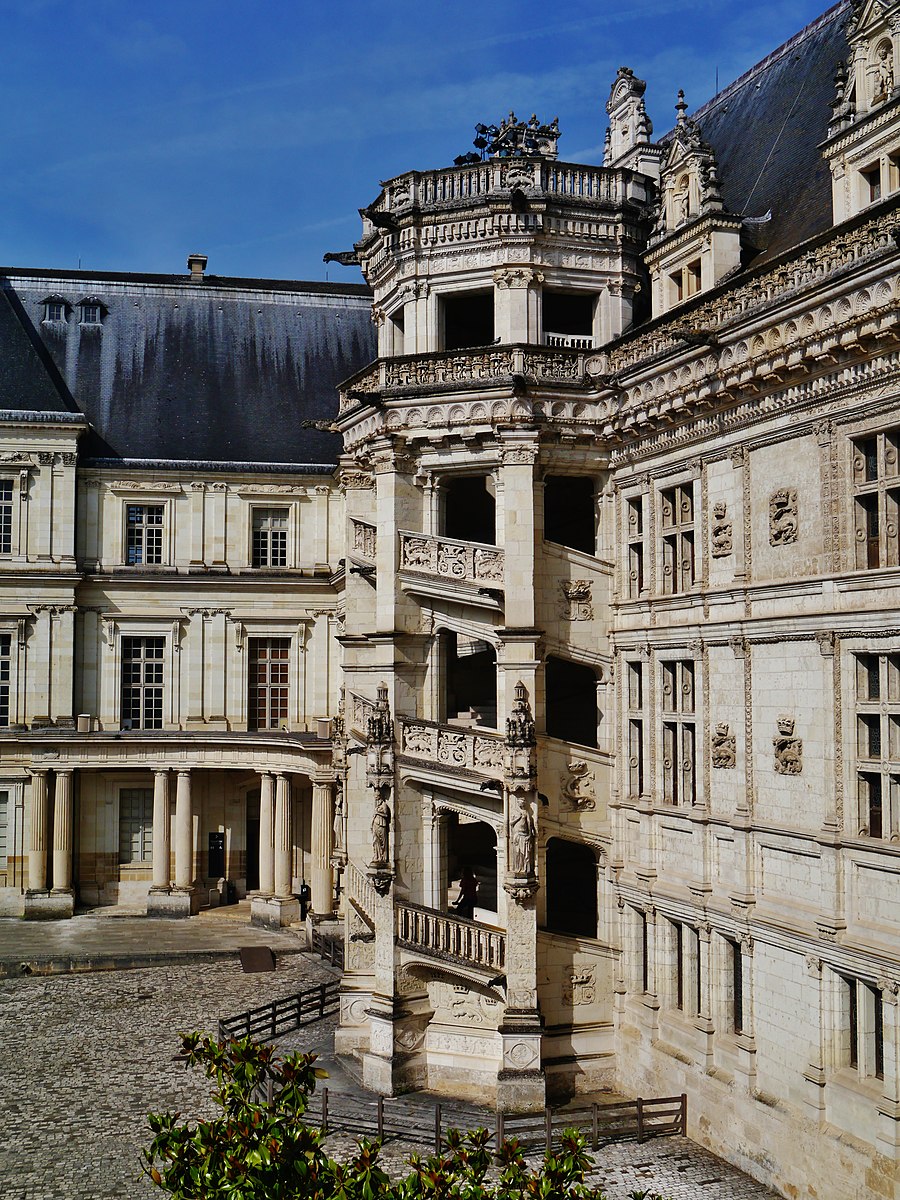
In 1515, François I and his wife Claude ascended to the throne. At Claude's urging, François began to refurbish the château de Blois, which had been used by French kings since the 13th century. He built a new wing with a spiral staircase at its center and consolidated his prodigious collection of books in the library. However, after Claude, mother of his seven children, died at the age of 24, François neglected Blois in favor of other palaces. He moved his library to Fontainebleau and seldom returned to Blois. Perhaps memories of his years there with Claude, of whom he had been fond, made François uncomfortable? Later in the century, Henri III resided at Blois with his mother, Catherine de Medici, during the chaos of the Wars of Religion. In December 1588, Henri summoned to Blois the Duc de Guise, a powerful and charismatic Catholic leader who nurtured ambitions for the throne. Once arrived, the Duc was assassinated by the king's body guard as the king looked on. How is that for an inciting incident, or a novel's climax?

Château d'AMBOISE


François I was raised at Amboise, the first French château to be "Italianized." Renovations had begun in the late 1490's under Charles VIII; François, crowned king in 1515, further embellished the buildings. At his invitation, Leonardo Da Vinci took up residence in nearby Clos Lucé from 1516-1519 and contributed to the transformation of Amboise. It was on the door of François's chamber at Amboise that Antoine Marcaut posted a list of the abuses of the "Papal Mass" during the Affair of the Placards in October 1534, outraging the king and disrupting his process of moderate ecclesiastic reform. In 1560, a Huguenot plot dubbed "The Amboise Conspiracy" attempted to kidnap the young king, François II, to remove him from the influence of the powerful Catholic uncles of his wife, Mary Queen of Scots. When the plot failed, the conspirators were arrested and hung from the château's balconies as an example. Lots of material for historical novels in the annals of this château!


Chambord is truly a Renaissance château--it was built from scratch on order of François I, beginning in 1519. Chambord, with its 440 rooms, 282 fireplaces, and 84 staircases, was never intended to serve as a primary residence, but as a symbol of François's power and aesthetic achievements. The king only slept there a total fifty days, but used Chambord to entertain his favorites and dazzle his rivals. Leonardo da Vinci was intimately involved in its design and construction; his artistry produced the château's famous double helix staircase, the center-plan design of its keep, and its double-pit evacuation system. The only historical event of note that occurred at Chambord during the sixteenth century was the visit of Charles V of Spain in December 1539, a stop on his elaborate state visit to France. I've always thought Chambord would be an excellent setting for some sort of time-slip or historical mystery novel.


Photo credit: Tim Sackton

The Château de Chenonceaux, with its arched gallery that stretches across the Cher river (see the third photo above), is one of the most readily recognized châteaux in France. It was also the location of intense passions--love, envy, and revenge. Between 1515-1521, nobleman Thomas Bohier razed the medieval fortress on the site and built a graceful new residence, where he entertained the king on several occasions. In 1535, François I seized the property in payment for outstanding debts. After he died, his son Henri II gifted the palace to his mistress, Diane de Poitiers, who built an arched bridge to the far bank and added extensive gardens. Henri's wife, Catherine de Médici, long envied the property; as soon as Henri died in 1559, she forced Diane to exchange Chenonceaux for the Château de Chaumont.

Chaumont. Photo credit: Tim Tim

Chenonceaux became Catherine's favorite residence, the one from which she administered the kingdom as Regent during her young son's reign. She built the enclosed gallery atop the bridge in 1577 and hosted elaborate parties and spectacles at the property. When Catherine died in 1589, she left the château to her daughter-in-law, wife of Henri III, who lived there in mourning for eleven years after Henri was assassinated months after his mother's death. From the love trysts of Henri II and Diane, to the showdown between Diane and the widowed Catherine, to Catherine's machinations behind the throne, to the haunted widowhood of Louise de Lorraine, the stones of Chenonceaux have witnessed their fair share of riveting intrigue.


Finally, we come to the Château de Fontainebleau, my personal favorite. Fontainebleau played a central role in history during the sixteenth century and beyond. François always considered Fontainebleau his true home. It was this château that he transformed into the showplace of the French Renaissance, building and embellishing the structure with the help of Italian artists he invited to live and work there. François housed his art collection at Fontainebleau, along with the massive library (the backbone of the Bibliothèque Nationale) he transferred from Blois. Fontainebleau seethed with competition, as artists vied for commissions, courtiers for preference, and lovers for favor. François hosted his longtime enemy Charles V of Spain at Fontainebleau in December 1539 in an attempt to shore up their tottering truce. Against a lavish backdrop of banquets and balls, pageants and hunts, the two monarchs grappled for ascendancy. The perfect setting for a historical novel, one that pits François's beloved ideal of honor against the grittier realities of gaining, and keeping, power.

Add to these amazing châteaux teeming cities like Paris and Lyon and one can claim without doubt that the sixteenth century offers an exciting array of settings for gripping historical fiction.

**********

Be sure to circle back and read Reasons #1-#7 for reading historical fiction set in sixteenth century France: ESCAPE, RELEVANCE, DRAMA, EMOTION, GLITZ, HISTORY, and FRANCE.


Monday, September 21, 2020

Festivals, Balls, and Hunts in Honor of Charles V

On this day in 1558, Charles V, the Holy Roman Emperor and King François I's longtime enemy, died in Spain. The official social media streams of the Château of Fontainebleau (Twitter: @CFontainebleau, Facebook: Château de Fontainebleau) are commemorating Charles Quint's passing by recalling his visit to France in 1539. The French feed reads: "In December 1539, he arrives at the Golden Gate adorned with the emblem of the King of the Renaissance! Festivals, balls and hunts follow one after the other in this dwelling decorated by the brushes of the greatest Italian artists." The feed includes lovely photos of the Porte Dorée and François's salamander emblem. You can learn about the history and architecture of the château, as well as details about Charles Quint's visit, at the Château website. 


Thursday, October 31, 2019

Beware the Ghost of the Grand-Veneur!


You're stealing through the Forest of Fontainebleau at dusk, a thick carpet of pine needles and fallen leaves muffling your footsteps, your breath rising in wispy clouds of white. The full moon peaks through the mist, bouncing off menacing piles of boulders, deepening shadows that obscure the dangerous maws of caves and the beasts that lurk within them. Owls hoot, frogs croak, unseen vermin skitter through the underbrush. Suddenly, new noises pierce the night: the thudding of hooves, the barking of dogs. The sounds grow louder and louder as they approach. The long, sad cry of a horn shreds the air, and before you appears a hunter, dressed in black, mounted on an all-black steed. A pack of dogs, eyes flaming like coals, mill, snarling and yapping, about the horse's legs. As the horse rears, forelegs flailing, the hunter stares down at you with blank, black eyes. He blasts his horn again, and as quickly as they appeared, horse, rider, and dogs vanish into the mist, leaving no trace of their presence but the chill that settles deep in your heart.

The Fantôme du Grand-Veneur, the Ghost of the Head Huntsman, has just appeared to deliver a grave warning: something dire is about to happen. Your own death, most likely. Heart pounding in terror, you flee, wishing you'd never set foot in the forest.

The ghost of the Grand-Veneur, also known as "le Chasseur Noir" (The Black Hunter), has been appearing in the Fôret de Fontainebleau, the dense forest of oak and pine that surrounds the château, for centuries. Tradition holds that the ghost is the spirit of a royal huntsman who was assassinated during the reign of François I and now roams the forest during the night with his pack of dogs. He appears during times of trouble to foretell tragic events. Numerous kings, including François himself, Charles IX, Henri IV, and Louis XIV, reportedly encountered him. The phantom announced an early death to Louis XVI and the assassination of the duc de Berry. Napoléon I received a visit on the eve of his abdication.

In a letter dated September 25, 1598, the diplomat Jacques Bongars recounts how the Chasseur Noir appeared to Henri IV during a hunt and warned him to "mend his ways":

On dit que le Roi retournant de la chasse en sa maison de Fontainebleau à dix heures du soir a entendu un chasseur qui faisait grand bruit. On assure même qu'il appelait ses chiens par leur nom (...) Le Roi étant entré dans le Château, fit venir les plus vieux des habitants du Bourg, pour savoir d'eux ce que ce pourrait être. Ils lui répondirent qu'on voyait paraître quelquefois, au milieu de la nuit, un Chasseur à cheval, avec sept ou huit chiens, qui courent la forêt, comme en chassant sans blesser personne. 


They say that the King, returning from the hunt to his home at Fontainebleau at ten o'clock at night, heard a hunter making a great noise. People swear he was calling his dogs by name... The King, having entered the palace, summoned the oldest inhabitants of the town, to learn from them what it might have been. They told him that sometimes people saw appear, in the middle of the night, a hunter on a horse, with seven or eight dogs, galloping through the forest as if hunting, without hurting anyone.

The Chasseur Noir appeared to Henri IV once again, this time with grave consequences. The king was hunting deer in the woods, and had stopped to dine with his mistress Gabrielle d'Estrées and several courtiers. The sound of dogs and horns arose nearby. The king sent his man Bassompierre to investigate. A quarter of an hour later, Bassompierre returned, greatly shaken. The Chasseur had spoken to him, telling him to warn the king that if he didn't repudiate his mistress that very day, a great misfortune would befall her. The king laughed off the Chasseur's prediction. Three days later, Gabrielle d'Estrées died of hideous convulsions.

Either the Grand-Veneur truly had prophetic powers, or his myth served as a convenient cover for a poisoning plot. The latter seems more likely.

In any case, don't ignore the Grand-Veneur's warning, should he appear in your path!

*****

Sources:

"Qui était vraiment le Chasseur Noir de la forêt de Fontainebleau?" BFMTV, 07/23/2017.
"Petit Promenade en Foret de Fontainebleau" Rando sac au dos--par Bleausard, 3/9/14
"La légende du chasseur noir de la forêt de Fontainebleau," Fontainebleau-Photo.

Sunday, July 19, 2015

"Musical Frescos" at Fontainebleau

The Château of Fontainebleau is presenting a series of concerts dedicated to illuminating the history of the château and reviving the memory of the great kings who counted it among their favorite residences. The "Musical Fresco" scheduled for August 29 centers on François I and includes four separate concerts commemorating different aspects of the king's persona:

Le roi galant et le roi mécène -- Rêver d’amour et d’Italie
Le roi conquérant -- François Ier et Charles Quint
Le roi chrétien -- La Réforme musicale
Le roi chevalier - -François Ier et les guerres d’Italie, de la victoire de Marignan à la défaite de Pavie

Gallant King and Patron King -- Dreaming of love and of Italy
Conquering King -- François I and Charles V
Christian King -- Musical reform
Warrior king -- François I and the Italian Wars, from the victory of Marignan to the defeat at Pavie

Each of the concerts will feature Renaissance music performed by noted Baroque ensembles on period instruments.

The Château's official Facebook page provided this historical vignette as context for the "Conquering King" concert [translation mine]:


"François I received his rival Charles V in all magnificence at Fontainebleau from December 24-30, 1539. In order to dazzle the emperor, the king organized fantastical skirmishes and tournaments at the palace gates and erected a temporary triumphal arch. François concluded the palace visit in his private gallery (he alone kept the keys, of which he was so proud), decorated by Rosso. In this picture, the two protagonists arrive in Paris after their stay at Fontainebleau. The Christmas celebrations of 1539, with the meeting between the two most powerful sovereigns of Europe, certainly count among the most brilliant of the sixteenth century at Fontainebleau."

An unforgettable moment in the château's history---and a perfect backdrop for a historical novel, wouldn't you say? ;)


Sunday, April 12, 2015

Fontainebleau Video

Follow the link for a lovely two-minute video of the château of Fontainebleau!


Tuesday, July 8, 2014

A Church, Two Palaces, and a Generous Heart

Question: What do excavations at Luxor, Egypt and Athens, Greece; the cathedral of Reims in France; the library of the Imperial University in Tokyo; Grand Teton National Park in Wyoming; the Cloisters museum in New York City; and the historical restoration of colonial Williamsburg have in common with the château de Fontainebleau?

Answer: Like Fontainebleau, they all received crucial funding from American philanthropist John D. Rockefeller, Jr. (1874-1960).


During his lifetime, Rockefeller, wielder of the Standard Oil Company family fortune, donated approximately $537 million to social, religious and cultural causes. He was particularly struck by the devastation German bombing and wartime neglect had wrought on France's historic sites. In 1924 he offered the French government several million dollars to restore three of them: the cathedral of Notre-Dame at Reims, the palace of Versailles, and the palace of Fontainebleau.


Fire and shelling had damaged and destroyed large portions of the cathedral at Reims, the traditional site of a French king's coronation. According to the cathedral's website, architect Henri Deneux had begun restoration work in 1919, but had difficulty finding the funds, materials, and manpower to support the effort. Rockefeller's generous grants in 1924 and 1927 allowed Deneux to reconstruct the church's nave, roof, and angel bell tower. The cathedral fully reopened to the public in 1938.


The château de Versailles had not been damaged by fighting during the first World War, but by neglect and the redirection of funds. According to a thesis on the uses of Versailles in the twentieth century, the condition of the site was alarming and conservation measures at the palace had come to a standstill, despite the Hall of Mirrors having witnessed the signing of the treaty that ended the war. Rockefeller earmarked seventy-six percent of his donation for Versailles. The money was used to restore the main palace buildings, the grounds, and the two Trianons. Without Rockeller's gift,  the palace as we know it today might not have survived.


The palace of Fontainebleau foundered in similar decrepitude. As at the two other sites, Rockefeller's grant repaired Fontainebleau's roofs, walls, woodwork, ironwork, and masonry--projects which ensured the safety and solidity of the structure itself, as this article in the 1925 Revue des deux mondes emphasizes. All of the windows and doors were replaced and railings reinforced. On the grounds, leaky basins and fountains were repaired, staircases restored, the canal and carp pond renewed. The theater's roof and attics, damaged by a fire in 1887, were rebuilt. Rockefeller's timely gift saved Fontainebleau from a disintegration that worsened daily.

photo by Trizek
In thanks for his dedication to the preservation of her treasured historic sites, France awarded John D. Rockefeller, Jr. its highest prize, the Grande Croix of the Légion d'honneur, in 1936. A celebration was held at the newly renovated palace of Versailles to honor its benefactor. (Watch a short newsreel of the event here.) Francophiles the world over are forever grateful that national boundaries could not  constrain the American philanthropist's foresight and generosity.

Tuesday, February 18, 2014

Fontainebleau Eager to Attract Film Shoots

Did you know the films "Cyrano de Bergerac" (1990),


"The Man in the Iron Mask" (1998)


and "Vatel" (2000)


were all filmed at the château de Fontainebleau? The palace also served as the setting for the music videos "Love of My Life" by Anna Calvi and "Born to Die" by Lana Del Rey. Variety magazine interviews the president of the château de Fontainebleau, Jean-François Hébert, who is eager to attract additional projects to the palace.

Should I tell him I have just the story? ;)

Monday, September 9, 2013

Feuilleton on Fontainebleau

photo credit: Marilane Borges
This week, channel France 2 is running a feature serial about the château of Fontainebleau. Today's installment focuses on the private apartments of Napoleon, although it includes a beautiful segment shot in the galérie François Ier. Straightening the cord across a velvet-upholstered armchair whose wooden back boasts a carving of François's salamander emblem, the security guard reminds viewers that the chairs which line the gallery are authentic period pieces, quite valuable and fragile. The Fontainebleau segment begins at the 28:25 minute mark. Just before it, starting at 25:24, is a segment on the old city of Lyon and its Italianate architecture. Hmmm, the settings of my two novels, back to back on French television... is it a message from the gods? One can hope. :)

Here's the link to the video, in French. Enjoy!

Sunday, September 1, 2013

Fontainebleau: More than a Castle

Say the word "Fontainebleau" and most people immediately think of the château outside Paris favored by both François I and Napoléon. Few realize that Fontainebleau also designates one of the largest and most popular forests in France. The fôret de Fontainebleau covers approximately 110 square miles in the department of Seine-et-Marne, southeast of Paris. Over 13 million visitors a year hike the forest's 200 miles of paths.


In 1528, François I decided to renovate the old medieval castle at Fontainebleau. He not only rebuilt the palace, but increased the grounds attached to the domain through a series of purchases and appropriations. By 1537, the royal forest covered 51 square miles. The forest was rich with game: deer, boar, lynx, wolves, martens, and over two hundred species of birds. Being an avid hunter, François spent countless hours pursuing his prey through stands of oak and beech trees and around the huge boulders that litter the site. To care for his beloved forest, François created the honorary position of Grand Forestier, the official who oversaw the corps of horse guards and that patrolled and managed the domain.

Forêt de Fontainebleau by Karl Bodmer. Etching, 1850
Countless boulders make the forêt de Fontainebleau a favorite spot of rock climbers today. The area was once covered by a sea, which deposited a deep layer of white sand. Over the millennia, this sand compressed into the long chains of rocky plateaux and oddly shaped boulders that characterize the landscape. The forest soil contains up to 98% sand; in places, there are dunes. Because of this high sand content, no streams are visible in the forest, only ponds where water gathers in hollows in the massif. The palace itself is built of this durable local sandstone.


Artists, photographers, writers and poets have long found inspiration in the forest's rocky wilderness. While early painters used the forest as a backdrop for hunting scenes, Camille Corot was one of the first painters to make the forest itself the subject of his paintings. Claude Monet, Renoir, Sisley, Cézanne, Seurat all painted there. Rousseau and Millet formed what is known as the école de Barbizon at Fontainebleau in the mid-nineteenth century. Photographers followed the painters, and numerous writers, among them Hugo, Stendhal, Sand, Balzac and Proust, visited the forest or evoked it in their works.

In the Forest of Fontainebleau by Paul Cézanne. 1880
Several scenes of my current novel take place in the forêt de Fontainebleau. In this one, Anne d'Étampes, King François's mistress, hurries to a rendez-vous deep in the woods:

       The path plunged beneath the canopy of new leaves, eager as Anne to escape the shimmering May sun and the scrutiny of the palace’s countless windows. The horses’ hooves drummed a steady beat on the ribbon of packed earth, cleared of debris and hazards in perpetual readiness for the royal hunt. Wasted effort on the groundskeepers’ part, of late; the pain in François’s belly had kept him from the saddle for more days now than she cared to count. She’d left him in his library in thrall to a desiccated scholar who claimed to hear the music of the celestial spheres. Would that François’s ears might detect the note of falsity in the man’s bombastic claims.
       She rode alone, save for the groom who followed a few lengths behind and knew better than to chatter. Late, she prodded her mare to pick up the pace. The grotto lay a fair distance away, and she knew he wouldn’t wait if she were slow to arrive. Why he refused to meet her in some secluded corner of the gardens instead of here in the godforsaken woods, she’d never understand. Riskier there, yes, but at least they’d be surprised by a pair of impatient lovers and not a pack of peckish wolves.
       Maybe she’d still beat him there. Curses on the chaplain for delaying her. She much preferred to be the first to arrive at any appointment; not only did it give her time to collect herself, but it allowed her to play on the inconvenience of being made to wait. Rushing, she almost missed the fork in the trail that lead to the grotto. This spur was but a narrow crevice between the trees, little more than footpath really, strewn with stones and knobby roots that slowed the horse to a careful walk. The groundskeepers hardly bothered to maintain it, for an army of hunters, horses, and dogs could never pick its way down the steep slope without landing in a jumbled heap. She only knew of the spot because François had taken her there once, in the early days, when they'd made a game of sneaking off alone. She was surprised when the painter suggested it. 
       Giant boulders loomed ahead, perched one atop the other in improbable piles that always made her uneasy to stand beside. She dismounted. “Wait here,” she told the groom, who took her reins and led the horses to nibble at a nearby bush while he pared his nails with a knife. No worries that he’d spy—she paid him plenty to ignore what she didn’t want him to see, and knew enough about him to ensure her wouldn’t tattle if he did fail to look away.
       She descended the last few feet of the path, slipping precariously on loose gravel, to stand on a large, flat rock that could have been the stage of a Roman amphitheater. On three sides, the tumble of carmel-colored rocks created a honeycomb of nooks and small caves, openings camouflaged by ropes of of ivy and tangles of exposed roots. Pine trees vied with a massive oak for light, casting deep pockets of shade on brittle drifts of last autumn’s leaves. Anne shivered. If one were a hunted beast, this must surely be the safest place in the domain to hide. She peered at the maw of the nearest cave, half-expecting to find yellow eyes of a forest cat staring back. 
       A pebble landed at her feet. Another tapped her shoulder. Shielding her head with her arm, she had turned to flee when a chuckle stopped her. “Leaving so soon, Aphrodite?”

Click here to watch a stunning video of the fôret de Fontainbleau in winter. It's no surprise that Fontainebleau and its domain were François's favorite palace. He spent more time there than anywhere else save Paris.

Sunday, December 30, 2012

Exhibit on Mannerist Painter Rosso Fiorentino

The Morgan Library and Museum in New York City is holding an exhibit on Renaissance painter Rosso Fiorentino, one of the main characters in my novel-in-progress. Fantasy and Invention: Rosso Fiorentino and Sixteenth-Century Florentine Drawing runs through February 3, 2013, and features one of only three paintings by Rosso in the United States, his Holy Family with Saint John the Baptist (1520). Twenty drawings by other Renaissance artists, including Andrea Del Sarto, Agnolo Bronzino and Giorgio Vasari, complement the painting.

Rosso is considered a leading proponent of the Mannerist movement. Born and trained in Florence, he made a name for himself in Rome before coming to France at the invitation of François I in 1530. He spent the next decade as the French King's Director of Artistic Work, overseeing the expansion and decoration of the château de Fontainebleau. The ornate Galérie François I at Fontainebleau is Rosso's best known extant work. Well-read and richly rewarded by King François, Rosso lived as a wealthy gentleman at Fontainebleau until his mysterious death in 1540 at the age of 46. The New York Times has written a review of the exhibit that includes some details about Rosso's sensational, troubled life.

I'm thrilled to see his work on exhibit here in the United States. He deserves to be better known by the general public. I've previously posted about Rosso and the galérie, his Descent from the Cross, his Pièta, and the Royal Elephant.

Tuesday, October 30, 2012

Daily Life at Fontainebleau


The French newspaper La Croix recently ran a story about daily life at Fontainebleau--daily life in the twenty-first century. The paper interviewed security guards, cleaning services, gardeners, cashiers, as well as administrators in order to better understand what is involved in maintaining this historical treasure and keeping it accessible to the 450,000 people who visit each year. Here are some interesting facts from the article, which is in French:

  • The palace contains 1500 rooms; the grounds cover about 300 acres.
  • Security's biggest fear is fire, which would directly menace eight hundred years' worth of tapestries, furniture, wood carvings and art objects
  • Boars in the park and bats in the eaves often set off security alarms.
  • The public rooms are dusted for 45 minutes daily before opening.
  • It takes the palace horlogier (clock specialist) two hours to wind the forty working clocks in the various salons each day.
  • The cashiers claim the politest visitors are the Japanese; the rudest, the French.
  • The palace welcomes 45,000 students, from grade school through high school, each year. There is a specific tour for each level, supported by an Internet site to prepare the students and teachers for the visit.
  • The French court spent time at the château de Fontainebleau continuously up until 1870. The palace's collections include 40,000 pieces (textiles, furniture, objects from everyday life).
  • Fourteen gardeners take care of the gardens and park.
  • A fontainier (fountain specialist) oversees the water system. A canal, various basins, and seven fountains are fed by two aqueducts and a water-tower. Most of the water system was constructed by François I and relies on nineteen regional streams.
  • The grand canal is drained every forty years, revealing various discarded objects. Three years ago, an elderly couple committed suicide by drowning themselves in it.
  • The jeu de paume (tennis court) was constructed in 1601 by Henri IV and is one of only three operational jeu de paume courts in France. About sixty players use the court to play the original game.
The article includes a slide show of the grounds and people at work there.

Thursday, July 26, 2012

A King and his Books: The Libraries of François I

"Roi chevalier" (warrior-king) though he was, François I might just as readily--and appropriately--have claimed the title "Roi lecteur" (reader-king). François's love of books contributed not only to the blossoming of the literary arts in sixteenth century France but to the foundation of the crown jewel of French letters, the Bibliothèque nationale (National Library).


Engraving of an anonymous miniature showing 
Antoine Macault reading his translation of Diodorus Siculus 
to François I and his sons

Educated according to humanist principles, François spent his youth reading the works of the ancients in Latin, as well as poetry and chronicles composed in French. Determined to see his kingdom achieve the intellectual and artistic renown Italy enjoyed, he supported the literary arts once he ascended to the throne, patronizing, among others, the poet Clément Marot and composing some two hundred poems of his own (Knecht, Francis I, 84). So great was François's love of letters that he created the post of lecteur du roi, an attendant whose chief duty was to read aloud to the king, particularly at mealtimes. Whenever François traveled, two chests filled with works of Roman history and French romances accompanied him.

François loved to collect books and manuscripts as much as to read them. Initially, he housed his books in a library at the château de Blois. Antonio De Beatis described this library in 1517:

[I]n the castle, or rather palace, we saw a library consisting of a sizeable room not only furnished with shelves from end to end but also lined with book-cases from floor to ceiling, and literally packed with books--to say nothing of those put away in chests in an inner room. These books are all of parchment, handwritten in beautiful lettering and bound in silk of various colours, with elaborate locks and clasps of gilt [quoted in Knecht, Renaissance Warrior and Patron, 471-72].

In 1518, the Blois collection included 1,626 volumes, of which forty-one were in Greek, four in Hebrew and two in Arabic. Throughout his reign, François expanded these holdings, commissioning agents to travel to Italy and the Near East to seek out and purchase rare books and instructing his diplomats to buy or copy all the Greek manuscripts they could find.

After the death of his wife Queen Claude in 1524, François began to assemble a second library at the château de Fontainebleau. He dedicated the third floor of his private wing, directly above the famed gallery decorated by the Italian artist Rosso Fiorentino and the bathing suite, to this library. In 1544, François moved the entire Blois collection, now numbering 1,890 items, to Fontainebleau, combining them with the few hundred books and manuscripts already there.


Library at Fontainebleau. 
Photo credit: Sébastien Bouthillette

Contemporaries marveled at the magnificence of the library's decoration, the quality and rarity of its holdings, and the hospitality with which visiting scholars were welcomed to consult them.

Even as François acquired Latin and Greek manuscripts, the printing industry flourished in France. In order to keep up with the flow of books spilling off presses at home and abroad, the king issued the Ordinance of Montpellier in December 1537. This royal decree ordered all printers and booksellers to deposit with the royal library a copy of any printed book put on sale in the kingdom. Although it does not appear to have been strictly enforced, the Montpellier ordinance is considered to be the first law of legal deposit enacted anywhere.

In 1567, some twenty years after François's death, the royal library, now consisting of 3,650 titles, was brought to Paris, where it became the nucleus of the Bibliothèque nationale. Ultimately, the books François loved and collected nourished the intellectual curiosity of an entire nation, for generations.

Sources:
A. Franklin, Précis de l'histoire de la Bibliothèque du roi, aujourd'hui Bibliothèque nationale (Paris, 1875).
    http://www.archive.org/stream/prcisdelhistoir00frangoog#page/n11/mode/2up
R. J. Knecht, Francis I (Cambridge UP, 1984)
----,  Renaissance Warrior and Patron: The Reign of Francis I (Cambridge UP, 1994)

Saturday, June 16, 2012

The Queen's Pin

According to the June 13, 2012 edition of the French newspaper La République, excavations in the Henri IV courtyard of the château de Fontainebleau unearthed a hairpin possibly belonging to queen Catherine de Medici.


The Henri IV courtyard, also known as the Cour des Offices, was built between 1606 and 1609 to house domestic and administrative services. Historians thought the area unimportant before construction of the buildings that enclosed it. However, two meters below the surface, archeologists discovered a former latrine that has yielded all sorts of discarded objects: bones, coins, crockery, a small gold cross. The most significant find has been a hairpin that probably belonged to the queen. Vincent Droguet, curator of the château, explains that the pin features two interlaced C's, the arms of Catherine de Medici. "It's a stunning find," he says, "as jewels belonging to Catherine de Medici are very rare." (Photo at the original article.)


The article goes on to speculate how this precious object wound up in the latrine. A hidden crime? A careless mistake? The mysteries of the Quartier Henri VI have yet to be resolved.


Food for thought and possible plot points for historical novelists...


Friday, June 15, 2012

Excavations at Fontainebleau

Archeological excavations continue in the Henri IV courtyard of the Château de Fontainebleau. Two meters below the surface, archeologists found a hairpin belonging to Catherine de Médicis. Details of the find will be shared in Monday's edition of La République; in today's edition of the paper, you can examine photographs from the site.

Tuesday, March 13, 2012

Fontainebleau, Then and Now


My work in progress is set at the Château de Fontainebleau, François I's favorite residence, which features in the above image. This depiction comes from one of the eight Valois tapestries woven in Spain in the 1580's. These tapestries portray court festivities from the second half of the sixteenth century during the reigns of François's grandsons. They present an enigma to scholars, in that no one is certain who commissioned the works nor who owned them, thus rendering a definitive "reading" of the tapestries difficult. Catherine de Medici, François's daughter-in-law and the mother of three French kings, figures prominently, dressed in her signature widow's black, in all but one of the tapestries. Other members of the French court, including her daughter Marguerite de Valois and François, the duc d'Anjou, can also be identified. One theory about the tapestries holds that Catherine de Medici, who masterminded the festivities depicted in them, ordered the commemorative series as proof that the courts of her sons were as prestigious and magnificent as those of François and her own husband, Henri II.

The tapestry pictured above shows entertainments staged at Fontainebleau in 1564 during King Charles IX's royal progress. A large lagoon lies along the southern exposure of the château, flanking the grande allée leading to the main entrance, the Porte Dorée (the three story tower-like structure on the far right). This water feature permitted the staging of mock sea battles and other maritime adventures, such as the tapestry's rescue of damsels from an enchanted island. The tapestry captures the wooded ambience of Fontainebleau, where François loved to hunt boar and deer. Despite the countrified setting, however, Fontainebleau became a showcase of French Renaissance art and decoration. It features Francois's breathtaking gallery as well as an immense ballroom completed by Catherine and her husband Henri. Unfortunately, later centuries' renovations destroyed many of the château's sixteenth-century structures and much of its Renaissance decoration. However, the lagoon, now known as the Carp Lake, and the Porte Dorée, as well as the gallery, are still recognizable today.

Thursday, September 2, 2010

Sixteenth Century Quote of the Week


"He [François I] liked it [Fontainebleau] so much that he spent most of his time there . . . all that he could find of excellence was for his Fontainebleau of which he was so fond that whenever he went there he would say that he was going home."

Jacques Androuet du Cerceau (1510-1584), French architect
Les plus excellents bastiments de France (1576)

Wednesday, August 11, 2010

Castle Graveyard

A student of architectural history photographs "things that would go unnoticed in the streets of Paris" for his blog, Paris 2e. This post documents fragments of the chateau of Fontainebleau that were discarded during recent renovations and now litter a nearby field. The blogger asks a good question: what should be done with these authentic but unneeded pieces? Museums can take only so many, I suppose. Should they be sold to raise money for additional renovations? I know I would love to place some of that stonework in my garden!

Be sure to check out the beautiful and unusual photos of Paris 2e.

Tuesday, September 29, 2009

The Royal Habitrail®

Where did a Renaissance king go to escape from it all? He'd take a hike--or rather a stroll. But not through the wilds of nature--the woods, after all, were for hunting. He'd walk in his own private gallery, one of the few places in the palace where he could dodge the crowds and think.

Galleries, in Renaissance châteaux, were long, hall-like structures attached to the monarch's private suite. While later in the century and beyond galleries were used as public waiting rooms or the setting for lavish receptions (think Hall of Mirrors--Galerie des Glaces--at Versailles), in the first half of the century they were intended for the king's private use and accessible only from his most secluded chamber.


Fontainebleau provides a prime example of this arrangement. The grande galerie, as it came to be known, jutted out at a perpendicular angle to the château proper. Before the renovations that began in 1528, the gallery served as a passage between the royal apartments and the neighboring abbey. When François I decided to build a bathing suite on the ground floor beneath the gallery, he moved the doorway to the upper passageway so that it communicated directly with his chamber. Since the staircase stood at the far end of the passageway, he had to traverse the gallery whenever he wished to access the baths or the garden below. He kept the gallery locked and the key on his person. Only those he expressly invited to accompany him ever saw the gallery's lavish frescoes and stucco work, executed by the Italian artist Rosso Fiorentino. An exterior terrace ran alongside the second-story gallery to facilitate the courtiers' passage from one area of the château to the other (the abbey was eventually replaced by new wings).

Other châteaux which featured private galleries included Bury, Écouen, Villers-Cotterêts, and the Louvre.

The purpose of these galleries was primarily exercise, as numerous contemporary references demonstrate. An architectural treatise dating from 1620 defined the gallery as the place where the lord could walk and converse with the visitors who came to discuss business with him. Henri IV was said to have constructed the grande galerie at the Louvre so that he could "stroll and watch what was going on on the Seine." La Grande Mademoiselle, his granddaughter, wrote that she walked by torchlight in her gallery at Saint-Fargeau for a half hour in the evening, and then again after supper with friends. Montaigne, the essayist, claimed that if it weren't for the cost, he would build galleries off each side of his library, each one hundred paces long by twelve wide, so that he could walk and think, for it was only while moving his legs that his thoughts took flight.

For a social class accustomed to the hard physical exertions of hunting and warfare, indoor galleries permitted uninterrupted exercise during times of darkness and inclement weather. Attached as they were to the private apartments, galleries provided members of the royal family a place where they could, quite literally, walk off the stress of being constantly in the public eye.

[Source: Jean Guillaume, "La galerie dans le chateau français: place et fonction," Revue de l'Art 1993, 102(1): 32-42. Photograph of Francis I Gallery, Fontainebleau, courtesy of Wikimedia.]