Showing posts with label Frances Stuart. Show all posts

Wednesday, February 5, 2014

Interview with Author Marci Jefferson; Giveaway of GIRL ON THE GOLDEN COIN

Marci Jefferson's debut novel, GIRL ON THE GOLDEN COIN, publishes from St. Martin's Press next Tuesday, February 11. Yesterday I reviewed this accomplished and engaging novel. Today Marci shares with us some thoughts about Frances Stuart and the writing of the book.


1. How did your understanding of Frances Stuart change from the day you first learned about her to the day you finished revising the book?

At first I saw her as many historians saw her, as a simple girl who eloped to avoid sleeping with King Charles II. When I read her letters and read what the French ambassadors and poets and diarists thought of her, I realized she was a very complex person. As I studied the historical events and the kings she interacted with, I realized how close she was and how involved she might have been. By the time I finished the book and realized the sacrifice she made might have saved England from disaster, I had developed a deep respect for Frances Stuart.

2. How did the general public of the time view Frances Stuart and her relationship with King Charles?

Letters between ladies in waiting indicate that, at first, Frances Stuart was celebrated as a fresh-from-France beauty, with the best clothes and jewels, the petted sister-figure of Charles II. As time went on, John Evelyn complained in his private diaries of the king's lewd behavior with mistresses. Ambassadors respected her as a woman with insider-knowledge of the king's business. Another famous diarist, Samuel Pepys, wavered between utter fascination with Frances Stuart's beauty and contempt for her position as the king's mistress. Poets and playwrights praised her beauty, not only because of her good-looks, but because the English respected her elevated rank as Duchess of Richmond.

3. Have you seen an actual golden coin bearing Frances's image as Britannia? Was this what sparked your interest in her?

Never in person, but the British Museum does have one of the Gold Medals struck with her image to commemorate the Peace of Breda. You can find it in their on-line database. This same image was used years later to mint England's copper coinage. I actually own a 1675 copper farthing.

The fact that she modeled as Britannia definitely sparked my interest in her. But it is because her choices matched the spirit of the Restoration Age that wrote her novel. She stood up for her beliefs and strove for independence, just as England was trying to do during the seventeenth century.
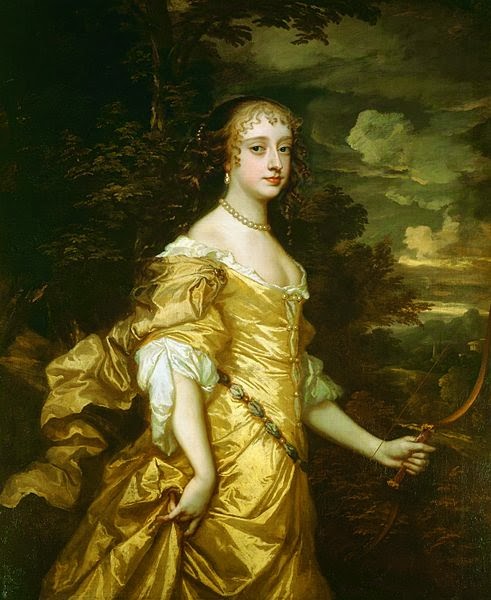

4. A stunning portrait of Frances Stuart graces the cover of the novel. Can you tell us about it? Did you request this image be used?

Thank you! That portrait of Frances Stuart was painted by Sir Peter Lely and is part of the “Windsor Beauties” in the Royal Collection at Hampton Court Palace. I actually did suggest the use of this portrait for the cover… along with about ten other suggestions! But I was delighted to see it used. Some historical fiction fans complain when the face of a portrait is "cut off" on book covers. But in this case I wasn't upset by it. Lely portraits were known at the time for their elegance, but also for bearing a poor likeness of the subject. So, while this is the most famous painting of Frances Stuart, it doesn't look much like her.


5. Jacob Huysmans painted a portrait of Frances Stuart wearing a "buff doublet like a soldier" (as Samuel Pepys described it), and in the novel there is a scene where Frances wears breeches. Was it a common practice at the Stuart court for women to sport men's clothing?

Not until Frances started the trend! When she arrived in England, it was not common practice for any women to sport men's clothing. But King Charles had just decreed that females could act in public theaters, and playwrights had discovered that the most popular plays were ones in which the actresses dressed up as men. Frances Stuart's first portrait in male dress was completed around 1661, so she was likely the first woman to dress this way at court. I imagine it was a court game at first, similar to the mock wedding scene between she and Lady Castlemaine in the novel. After a few years, it did become more common. Court women even wore male riding jackets and periwigs in public, which shocked the people. Still later, Nell Gwynn became well known for her rolls in male clothing.

As a side note, for her portraits in male attire, Frances wore a masculine-style blonde periwig. I think it is because of these portraits that so many people think Frances Stuart was a blond in real life. But her other portraits and her effigy at Westminster suggest she was brunette.


6. How did King Charles die? What do you imagine Frances felt upon learning of his death?

King Charles likely had a stroke, but there is a theory that his scientific experiments with mercury might have triggered it. When he died, Frances and he were on very friendly terms – but that was all. Their romantic relationship had ended, and Frances was preoccupied with her duties as a Lady of the Bedchamber to Queen Catherine and helping with her sister’s children. I imagine King Charles’ death pained her deeply, for she was ill for some time after she received the news.

What is remarkable about his death is that he died a king. His father was executed. His brother would be forced to abdicate. But King Charles II, the underestimated “Merry Monarch,” was one Stuart who knew how to keep a crown.

7. If you had to write an entire novel about one of the novel's secondary characters, which character would you choose and why?

Prudence Pope is an entirely fictional character in the novel, and possibly my favorite. As a lady’s maid and a Quaker, she exists in a more subservient role and is more of an outcast than any other character. Yet, she defies Frances and the Royalist status of the house she serves to embrace freedom in a way Frances could not. When Prudence moves to the Americas, she starts a new life in a land that would give people like her unprecedented freedoms. Sounds like a grand adventure to me!

8. What was the most difficult scene to write?

All of the love scenes were difficult to write! They seemed technical and outrageous at the same time. But because there are differing opinions among historians about whether Frances really did-or-did-not sleep with the king, the physical progression of their relationship actually became important to my plot and her life as I imagined it.

9. Please share an interesting piece of research that didn't make it into the book.

I kept trying to work one of the London Frost Fairs into the story, but it just never seemed to fit. The Thames did freeze during her lifetime, and exciting winter fairs were held on its frozen surface. Frances certainly would’ve enjoyed them.

10. Could you discuss the bird imagery in the book?

Every bird reference in the novel was intentional. Personal liberty is a major theme for Frances Stuart and for Restoration England, and Frances did own an African Gray Parrot, so the use of birds to symbolize the progression of her independence came naturally. Although I planned the final scene for years, where Frances opens a letter from Prudence, the bald-eagle feather didn’t materialize in my imagination until the moment I finally wrote it. It just fell out of the letter, and I felt the whole theme come full-circle.

11. What do you hope readers come away with after reading GIRL ON THE GOLDEN COIN?

I hope readers will find much to love about Stuart England, that they will recognize its important contribution to modern democracy, and that they remember Frances Stuart as the embodiment of her age.

************
To celebrate the publication of GIRL ON THE GOLDEN COIN, St. Martin's Press has generously offered to send one reader, chosen at random, a complimentary copy of the hardback. Marci herself will add a pair of sterling silver and pearl drop earrings, like the ones Frances wears on the cover, to the package. To enter the drawing, please leave a comment with your email address on this post before 11 pm PST on Wednesday, February 12, 2014. Winner must be a US resident. Winner's name will be posted Thursday morning, February 13, 2014.

Good luck, and please help spread the word about GIRL ON THE GOLDEN COIN!

Tuesday, February 4, 2014

Review: GIRL ON THE GOLDEN COIN by Marci Jefferson


Experience might teach readers not to judge books by their covers, but in the case of Marci Jefferson's debut novel, GIRL ON THE GOLDEN COIN (St. Martin's Press, February 11), readers have no need for caution. The gorgeous cover, which reproduces a contemporary portrait of the novel's protagonist, Frances Stuart, bespeaks with fitting perfection the sumptuous tale within.

The novel recounts the story of Stuart (1647-1702), mistress to King Charles II of England and model for Britannia, the personification of the realm that graced England's coins for decades. Despite her prominence during Charles's reign, Frances is a figure heretofore little examined in historical fiction. Jefferson depicts "La Belle Stuart" during the prime of her life, from her coming of age as a Royalist refugee at the French court of Louis XIV to her sudden widowhood at age forty. She surrounds Frances with a cast of convincing historical characters and sketches with clarity a political situation hazy, at best, to most American readers. Yet Jefferson's novel is more than a fictionalized biography set against a carefully constructed evocation of Restoration England. Like the best works of historical fiction, the novel projects the protagonist's inner life onto the broader political stage. Frances's struggle for autonomy mirrors that of England, determined to escape foreign entanglements and avoid an undesired imposition of the Catholic faith. The turmoil and soul-searching that accompanies Frances's attempt to reconcile her personal happiness with the good of the kingdom makes her plight a fascinating one.

Jefferson gives this "mistress of the king" story several interesting twists. First, Frances does not choose the role; it is thrust upon her by Louis XIV, who intends to use her as a way to keep Charles friendly to France, and by Charles's mother, who believes Frances can persuade her son to restore Catholicism to England. Frances, however, cannot comply with these demands: a secret that threatens to ruin her family necessitates that she remain free from scandal. She travels to England determined to befriend and influence Charles without becoming his mistress, a goal she soon discovers will satisfy neither Charles nor her own heart. Jefferson further complicates Frances's mission by establishing a friendship between her and Charles's Portuguese bride, Catherine of Brançaga, who arrives without a word of English and innocent of the ways of Charles's licentious court. Frances takes Catherine under her wing and develops a true respect and fondness for the foreign queen, making her decision on how far to pursue a relationship with Charles all the thornier. Third, Charles, an inveterate womanizer, considers Frances his pure and noble angel. Frances fears that if they consummate their relationship, Charles will lose the one thing that challenges him to be a better man. Frances knows her personal happiness lies in Charles's arms, but loyalties, politics, and the needs and expectations of others thwart her at every turn. Despite painful sacrifices, she never abandons the struggle to conform the desires of her heart with the realities of her situation.

Ultimately it is freedom, rather than love, that Jefferson's Frances -- reluctantly worldly, refreshingly loyal, spunky yet surprisingly wise -- seeks, the freedom to determine her own fate. A freedom for which England, of whom she serves as emblem, likewise searches. The Frances who withstands the pressure to conform in the final scene of the book is a far cry from the young girl forced to assume a role from which she shrinks in the opening chapters, and the reader who accompanies her on her journey to independence understands and appreciates the depth of the change.

Just as her protagonist escapes limits imposed from without, Marci Jefferson succeeds in slipping the restricted expectations that so often shackle debut novelists. If this first book, with its thoughtful characterizations, vivid settings, well-paced plot and subtle symbolism is any indication, Jefferson stands poised to become a definitive voice in the world of historical fiction. Accomplished and thoroughly satisfying, GIRL ON THE GOLDEN COIN glows with a luster that persists long after its striking cover falls closed.

************
MARCI JEFFERSON grew up in an Air Force family and so lived numerous places, including North Carolina, Georgia, and the Philippines. Her passion for history sparked while living in Yorktown, Virginia, where locals still share Revolutionary War tales. She lives in Indiana with her husband and children. This is her first novel.

************ 
Return tomorrow to read my interview with Marci and enter to win a complimentary copy of GIRL ON THE GOLDEN COIN, along with a special gift!


Tuesday, July 30, 2013

Cover Reveal Tour: Marci Jefferson's GIRL ON THE GOLDEN COIN, A NOVEL OF FRANCES STUART

Today I am pleased to participate in friend Marci Jefferson's cover release blog tour and contest. Her novel, GIRL ON THE GOLDEN COIN, A NOVEL OF FRANCES STUART, will release on February 11, 2014 from Thomas Dunne Books/St. Martin's Press. If you pre-order this week and comment on Marci's blog, you'll be entered in a drawing for a pair of sterling silver pearl-drop earrings like the ones Frances wears on the book's elegant cover (be prepared to present your receipt).


MORE ABOUT THE BOOK

Impoverished and exiled to the French countryside after the overthrow of the English Crown, Frances Stuart survives merely by her blood-relation to the Stuart Royals. But in 1660, the Restoration of Stuart Monarchy in England returns her family to favor. Frances discards threadbare gowns and springs to gilded Fontainebleau Palace, where she soon catches King Louis XIV’s eye. But Frances is no ordinary court beauty, she has Stuart secrets to keep and people to protect. The king turns vengeful when she rejects his offer to become his Official Mistress. He banishes her to England with orders to seduce King Charles II and stop a war.

Armed in pearls and silk, Frances maneuvers through the political turbulence of Whitehall Palace, but still can’t afford to stir a scandal. Her tactic to inspire King Charles to greatness captivates him. He believes her love can make him an honest man and even chooses Frances to pose as Britannia for England’s coins. Frances survives the Great Fire, the Great Plague, and the debauchery of the Restoration Court, yet loses her heart to the very king she must control. Until she is forced to choose between love or war.

On the eve of England’s Glorious Revolution, James II forces Frances to decide whether to remain loyal to her Stuart heritage or, like England, make her stand for Liberty. Her portrait as Britannia is minted on every copper coin. There she remains for generations, an enduring symbol of Britain’s independent spirit and her own struggle for freedom.

ADVANCE PRAISE

"In her wonderfully evocative debut, Girl on the Golden Coin, Marci Jefferson recreates the fascinating story of Frances Stuart, whose influence over England's Charles II became the talk of a nation. As vibrant and delightful as the woman it's based on, Girl on the Golden Coin is a jewel of a novel!"
—Michelle Moran, New York Times bestselling author of The Second Empress and Madame Tussaud 

"Beauty is not always a blessing, as young Frances Stuart finds out when her lovely face pits her between the desires and politics of rival kings Louis XIV and Charles II. Frances makes an appealing heroine, by turns wary and passionate, sophisticated and innocent, as she matures from destitute young pawn to the majestic duchess whose figure would grace Britain's coins for centuries. Her struggles to support her loved ones, uncover her family secrets, and somehow find a life of her own amid the snake-pit courts of the Sun King and the Merry Monarch make for lively, entertaining reading in this lush Restoration novel by debut author Marci Jefferson."
—Kate Quinn, New York Times bestselling author of Mistress of Rome

"Girl on the Golden Coin is a fantastic novel. I couldn’t put it down. The plot is fast-paced and compelling, with intriguing characters, lush settings and captivating narrative voice. Jefferson’s debut paints an intriguing portrait of Frances Stuart, a novel worthy of the determined, golden spirit of the woman whose face became the model for Britannia herself."
—Susan Spann, author of Claws of the Cat

FIND IT HERE

Barnes & Noble

IndieBound

Amazon

Goodreads