Showing posts with label Marci Jefferson. Show all posts

Tuesday, March 1, 2016

Review: FALL OF POPPIES: Stories of Love and the Great War (William Morrow)


Riding high on the current wave of interest in the Great War, FALL OF POPPIES (William Morrow, March 1) offers lovers of historical fiction a poignant array of stories from some of the genre’s most popular writers. The nine-story collection explores the panoply of emotions that gripped the war-weary world on Armistice Day, dramatizing the effect of the end of conflict on those who survived to see it. Like the blood-red ceramic poppies planted in the moat of the Tower of London to commemorate the war’s fallen soldiers, each story pays tribute, through the evocative, emotional power of fiction, to the soldiers and civilians that experienced the relief, joy, grief, and hope that swept over Europe and America on that long-awaited day.

FALL OF POPPIES includes stories by Jessica Brockmole, Hazel Gaynor, Evangeline Holland, Marci Jefferson, Kate Kerrigan, Jennifer Robson, Heather Webb, Beatriz Williams, and Lauren Willig. Each story exhibits the sound, vivid writing expected of established authors. Linked only by Armistice Day as a point of reference, the collection presents a broad range of characters, settings, and conflicts. The selections move from an Allied hospital in Belgium to a coffee plantation in Kenya to the nightclubs of Paris to a museum in Dublin. Novice pilots, generous sculptors, vengeful mothers, and conscientious objectors all search to make sense of their disrupted lives and disordered worlds. The fallen are mourned as new births are celebrated; aspirations die through tragic mistakes even as happy coincidence opens unimagined futures; destruction and upheaval force change and forge opportunity. It is hope that unites and animates these characters on their disparate paths: the hope of finding their missing, of hugging their beloved, of living another messy, uncertain, yet glorious day. Victim and victor alike struggle to build a future from the ruins of the past, a future all the stronger and more beautiful for the suffering endured along the way.

Readers will appreciate the individual stories for varied reasons, be it unforgettable characters (Webb’s devastated mother, Brockmole’s selfless pilot, Gaynor’s dedicated midwife), unique voice (William’s idealistic airman, Holland’s cautious cabaret dancer), heartrending conflict (Kerrigan’s ill-fated Irish/English romance, Willig’s disastrous misunderstanding), or distinctive historical content (Robson’s masks for the maimed, Jefferson’s underground nurses). Fans of particular authors will be more than satisfied by their favorites’ contributions and grateful for the introduction to the other authors’ work. An engaging, electrifying read, FALL OF POPPIES channels broader questions of love and loss through the prism of the Great War and demonstrates with convincing aplomb why historical fiction enjoys its current appeal.


Thursday, August 20, 2015

Winner of ENCHANTRESS OF PARIS Giveaway

And the winner of a hardback copy of Marci Jefferson's ENCHANTRESS OF PARIS, courtesy of Thomas Dunne Books, is....

KimberlyV !


Thank you to all who entered.


Wednesday, August 12, 2015

Interview: Marci Jefferson, author of ENCHANTRESS OF PARIS

Today I welcome Marci Jefferson, author of the newly released historical novel ENCHANTRESS OF PARIS (St. Martin's Press), to answer some questions about her characters and seventeenth century France.

Marie Mancini is a fascinating character. Where did you first encounter her and why did you decide to write about her? 

I actually learned about Marie Mancini while doing research for GIRL ON THE GOLDEN COIN. In most sources Marie is mentioned as King Louis’ first love, someone he might have married if not for his duty to his country. But a deeper study revealed a story far more complex.

Marie Mancini, author and date unknown
You cite Marie’s memoirs as one of your sources. What was it like reading about Marie’s life in her own words? What insights did you glean that you might not have found in secondary sources? Were there instances where the Memoirs complicated the path you envisioned for your narrative and how did you resolve the conflict?

Marie’s memoir is pure enjoyment. I’ve read it over and over! She lays out events in an orderly way, which is useful because biographers sometimes don’t provide details chronologically. Her narrative never complicated the novel - quite the opposite - I try to allow historical facts to structure my plots. The one complication in using her memoir as a source is that one must remember *why* she wrote a memoir in the first place. She had scandalized her family by leaving her high-born husband, fleeing Italy for refuge in France in defiance of the Pope. She needed to defend herself without offending the world powers. She set her memoir to paper to justify her actions, and it is evident in her writing that she took pains not to insult the men she had defied. She also avoids telling the whole story, respecting King Louis’ privacy and leaving researchers to read between the lines. Those fine areas between the lines - that is where the historical novelist steps in to provide answers!

Did the historical Marie truly believe she had a valid chance at becoming Queen of France? Why would she think the King would—or ever could—put his personal wishes above the needs of the nation?

King Louis told Marie he would make her his queen, and Marie believed him because she needed to believe in love. There is no other explanation for her behavior and for the severity with which her uncle, Cardinal Mazarin, treated her. I believe Mazarin suppressed her, exiled her, and may have even tried to kill her because she was doing everything she could to convince King Louis that he was strong enough to act without Mazarin’s approval. Though Cardinal Mazarin won the battle, it cost him dearly. Mazarin’s health deteriorated so badly during the ordeal, he died shortly after. I wrote the novel exactly as I believe things happened.

Cardinal Mazarin, c. 1660 by Pierre Mignard
You portray Cardinal Mazarin as a cruel, thoroughly self-serving character. Did he have any redeeming qualities? Did his influence over King Louis and the queen mother yield any benefit for France?

Cardinal Mazarin is a rare example of a seventeenth century commoner bettering themselves. In his era, men and women remained within the station to which they were born. Mazarin’s father had been a commoner, raised to a position of service in the powerful Colona family in Rome. A bright young man, Mazarin impressed the right people in the Catholic Church. He became protege to Cardinal Richelieu, securing his own future in France. Mazarin used his connections to marry his common-born sisters into noble Italian families. He then moved his extended family to France, marrying his nieces into French noble families. I tried to highlight this generosity in the novel, because a villain that is all bad quickly becomes boring. But the truth is, he did these “generous” things to improve his own power connections. He employed men who were “creative” about making him money. It’s true he brought the Fronde wars to an end, but those wars started in part because of his abuse of power. One thing he did that benefited France was orchestrate a peace treaty with Spain. This damaged his income streams, as the war was one of his biggest sources of “creative” money making, and some believe he had the power to stop that war whenever he wanted. Incidentally, this peace was sealed with King Louis’ marriage to the Spanish princess, which ended Louis’ relationship with Marie, causing both his niece and the king a great deal of pain. I try to be objective when studying historical figures, but in the case of Cardinal Mazarin, the best I can say of him is that he was a political mastermind.

The numerous Mancini siblings all led interesting, unconventional lives. How do you explain their courage and/or recklessness? Which sibling intrigues you most after Marie?

The Mancini’s were bold and unconventional because they were brought up by an unconventional man: Cardinal Mazarin. None of the Mancini’s respected him, but they all strove to change their lot in life much as he had done. I almost cannot pick a favorite Mancini sister, but Hortense is certainly as remarkable as Marie.

ENCHANTRESS OF PARIS covers roughly the same time period as GIRL ON THE GOLDEN COIN. Did your research unearth any interesting differences between the French and the English court cultures of the mid-seventeenth century?

The primary difference between the French and English courts in the seventeenth century is religious. France was firmly Catholic, while England had been dealing with the aftermath of their protestant reformation for generations. The difference in religions make the power structures different in each court. Some Catholic aristocrats in the French court still held to a number of superstitious beliefs that drove them to seek the services of an underground ring of witches and renegade priests dabbling in the occult arts. The majority of the English court hated Catholics and were ever on-guard against plots of a Catholic take-over.

Louis XIV of France, 1661 by Charles Le Brun
Which king—Charles II of England or Louis XIV of France—appeals to you more and why? Which woman, Frances Stuart or Marie Mancini, would you trade places with if you could?

King Louis learned to be a powerful man with Marie Mancini’s help, and only seized power of his own kingdom when his corrupt advisor died. After this, Louis was emotionally distant, politically skilled but not particularly pleasant to be around. Charles II inherited his throne while his kingdom was losing a terrible war. After a period of exile, his countrymen restored him to power because they believed in him. Charles was easygoing, witty, and a master at balancing factions. King Louis spent his energy enforcing Catholicism and expanding his boundaries. Charles spent his energy keeping the peace and enforcing the need to be tolerant of other religions. For these reasons, Charles is more appealing.

Though I enjoy writing about heroic seventeenth century women, I wouldn’t dare trade places with Marie or Frances. I appreciate my civil rights too much to go back to a time when women were expected to be subservient.

Hortense and Marie Mancini, c. 1680 by Jacob Ferdinand Voet
You have now written two historical novels. What did you learn, in terms of work habits, research practices, or narrative technique while writing the first that helped you to write the second? What is the most important thing you have learned so far on your journey?

After two novels I’ve learned that all the cliches about writing are true: you have to write every day, read a lot, and cut the parts that people skim. But perhaps most importantly, persistence is just as important as talent in traditional publishing.

**********
To celebrate the publication of ENCHANTRESS OF PARIS, Marci Jefferson is giving away a lovely faux diamond bracelet like the one below. To enter the random drawing, leave a comment with a contact email address. Entrants must reside within the continental United States. Contest will close at 9 pm Pacific Standard time on Wednesday, August 19. Winner's name will be posted Friday, August 21. Good luck! ***PLEASE NOTE: This giveaway is completely separate from yesterday's book giveaway. If you'd like to enter both contests, you need to leave a comment on each post. Thank you.


**********
Marci Jefferson, author of GIRL ON THE GOLDEN COIN (St. Martin's, 2014) and ENCHANTRESS OF PARIS (St. Martin's, 2015) writes about remarkable women in history who dared to defy men. You can learn more about Marci and her books at her website.

Tuesday, August 11, 2015

Review and Giveaway: ENCHANTRESS OF PARIS by Marci Jefferson


Marci Jefferson's ENCHANTRESS OF PARIS, just released from Thomas Dunne Books/St. Martin's Press, addresses a glaring need in the panoply of historical fiction: novels set during the seventeenth century, and more specifically, in France. The French Revolution and two World Wars draw the lion's share of interest from authors and readers interested in France; huge swaths of fascinating history from earlier eras remain virtually untouched. Tapping into this treasure trove, Jefferson reanimates the personalities and intrigue of the court of Louis XIV, the Sun King. With an energetic, skillful flair, she examines the relationship between Marie Mancini, the defiant niece of the powerful Cardinal Mazarin, and young Louis, who wishes, despite all expectations, to marry her. Based on Marie's own memoirs, Jefferson's captivating novel sparkles like the diamonds that grace the beautiful Mazarinette's neck.

One of five daughters of Cardinal Mazarin's sister, Marie has spent most of her life secluded in convents in order to protect her family's political and social aspirations from the threat she embodies. Born under an evil star, she is predicted to disgrace her family in a way no woman had ever done before. Summoned to the palace bid farewell to her dying mother, Marie catches the eye of the serious young king, whose face mirrors her own loneliness. She wins Louis away from her sister Olympia, his current mistress, and by promising to bend the king to her uncle's will, gains her freedom from the convent. Marie's fierce love inspires Louis with a confidence he has never felt; she encourages him to escape his dependence on Mazarin and act as king in his own right. Disgusted by Mazarin's brazen abuse of power and threatened by his unrestrained hostility, Marie searches for ways to thwart her uncle's designs. Mazarin's political hopes center on a peace treaty with Spain that requires Louis to marry the Spanish princess. Desperate to save her future, Marie searches for proof of the long-ago affair between Mazarin and the queen mother that resulted in Louis's birth, and turns to the very black arts that prophesied her downfall. Will her efforts assure her marriage to the king or force her to forsake him? Dare Louis ignore the needs of his nation to satisfy the desires of his heart?

Although at times the focus on the royal romance threatens to overwhelm the novel's plot, the intriguingly unfamiliar history and strong characterizations counter this danger. By examining the early years of Louis's reign, Jefferson humanizes a king who later came to epitomize the absolute monarch, revealing a tender vulnerability that succumbs to both Mazarin's control and Marie's influence. By embracing the possibility that Louis is in fact Mazarin's son, a theory recently suggested by historians, Jefferson provides a motivation for Mazarin's scheming and the means for his undoing. Finally, by casting Marie as a "Mazarinette," one of the bevy of sisters and cousins the Cardinal exploits to further his own schemes, Jefferson cleverly justifies Marie's audacious behavior. Nieces of an exceptional man, the Mazarinettes all exhibit extraordinary tendencies and lead unconventional lives. Marie's boldness, unusual in a young woman of that era, rings true in the context of her family and her upbringing. Forced to rely on no one but herself if she hopes to change her destiny, Marie inspires Louis to look within for the courage he needs to transform from obedient son to authentic king--and make her his bride in the process.

In the vein of 2014's GIRL ON THE GOLD COIN (several of whose characters make cameo appearances here), ENCHANTRESS OF PARIS spotlights a strong, spirited woman who rebels against those who would sacrifice her for their own gain, a woman who, determined to direct the course of her own life, stands to alter the course of a nation. Shining light into the darkest corners of the Sun King's glittering court, ENCHANTRESS OF PARIS examines whether love, grit and will can indeed revise what is written in the stars.

**********
To celebrate the publication of ENCHANTRESS OF PARIS, St. Martin's Press is providing one hardback copy for giveaway. To enter the drawing, leave a comment with a contact email address by 9 pm Pacific Standard Time on August 18, 2015. Winner's name, chosen at random, will be posted August 20. Entrants must reside in the continental US. Good luck!

**********
Be sure to return tomorrow for an interview with Marci about Marie and the history behind the novel.
**********
MARCI JEFFERSON graduated from Virginia Commonwealth University’s Medical College as a Registered Nurse. She is a member of the Historical Novel Society and lives in Indiana with her husband and children. This is her second novel. You can learn more about Marci and her books at her website. ENCHANTRESS OF PARIS can be ordered from all the usual outlets.


Thursday, August 6, 2015

Cover Reveal and Giveaway: FALL OF POPPIES (William Morrow, March 2016)

I'm excited to announce a forthcoming collection of short stories, three of which were written by friends of mine--Heather Webb (RODIN'S LOVER), Marci Jefferson (ENCHANTRESS OF PARIS), and Jessica Brockmole (LETTERS FROM SKYE). The nine short stories that comprise FALL OF POPPIES paint a haunting picture of loss, longing, and hope in the aftermath of World War I.

Image Map

Fall of Poppies: Stories of Love and the Great War

by Heather Webb, Hazel Gaynor, Beatriz Williams, Jennifer Robson, Jessica Brockmole, Kate Kerrigan, Evangeline Holland, Lauren Willig, Marci Jefferson

William Morrow Trade Paperback; March 1, 2016; $14.99; ISBN: 9780062418548

Top voices in historical fiction deliver an intensely moving collection of short stories about loss, longing, and hope in the aftermath of World War I—featuring bestselling authors such as Hazel Gaynor, Jennifer Robson, Beatriz Williams, and Lauren Willig and edited by Heather Webb.

A squadron commander searches for meaning in the tattered photo of a girl he’s never met…

A Belgian rebel hides from the world, only to find herself nursing the enemy…

A young airman marries a stranger to save her honor—and prays to survive long enough to love her…The peace treaty signed on November 11, 1918, may herald the end of the Great War but for its survivors, the smoke is only beginning to clear. Picking up the pieces of shattered lives will take courage, resilience, and trust.

Within crumbled city walls and scarred souls, war’s echoes linger. But when the fighting ceases, renewal begins…and hope takes root in a fall of poppies.

**********

Here is an excerpt from Heather Webb's story, "Hour of the Bells":

Beatrix whisked around the showroom, feather duster in hand. Not a speck of dirt could remain or Joseph would be disappointed. The hour struck noon. A chorus of clocks whirred, their birds popping out from hiding to announce midday. Maidens twirled in their frocks with braids down their backs, woodcutters clacked their axes against pine, and the odd sawmill wheel spun in tune to the melody of a nursery rhyme. Two dozen cuckoos warbled and dinged, each crafted with loving detail by the same pair of hands—those with thick fingers and a steady grip.
Beatrix paused in her cleaning. One clock chimed to its own rhythm, apart from the others.
She could turn them off—the tinkling melodies, the incessant clatter of pendulums, wheels, and cogs, with the levers located near the weights—just as their creator had done before bed each evening, but she could not bring herself to do the same. To silence their music was to silence him, her husband, Joseph. The Great War had already done that; ravaged his gentle nature, stolen his final breath, and silenced him forever.
In a rush, Beatrix scurried from one clock to the next, assessing which needed oiling. With the final stroke of twelve, she found the offending clock. Its walnut face, less ornate than the others, had been her favorite, always. A winter scene displayed a cluster of snow-topped evergreens; rabbits and fawns danced in the drifts when the music began, and a scarlet cardinal dipped its head and opened its beak to the beauty of the music. The animals’ simplicity appealed to her now more than ever. With care, she removed the weights and pendulum, and unscrewed the back of the clock. She was grateful she had watched her husband tend to them so often. She could still see Joseph, blue eyes peering over his spectacles, focused on a figurine as he painted detailing on the linden wood. His patient hands had caressed the figures lovingly, as he had caressed her.
The memory of him sliced her open. She laid her head on the table as black pain stole over her body, pooling in every hidden pocket and filling her up until she could scarcely breathe.
“Give it time,” her friend Adelaide had said, as she set a basket of jam and dried sausages on the table; treasures in these times of rations, yet meager condolence for what Beatrix had lost.
“Time?” Beatrix had laughed, a hollow sound, and moved to the window overlooking the grassy patch of yard. The Vosges mountains rose in the distance, lording over the line between France and Germany along the battle front. Time’s passage never escaped her—not for a moment. The clocks made sure of it. There weren’t enough minutes, enough hours, to erase her loss.
         As quickly as the grief came, it fled. Though always powerful, its timing perplexed her. Pain stole through the night, or erupted at unlikely moments, until she feared its onslaught the way others feared death. Death felt easier, somehow.
Beatrix raised her head and pushed herself up from the table to finish her task. Joseph would not want her to mourn, after two long years. He would want to see her strength, her resilience, especially for their son. She pretended Adrien was away at school, though he had enlisted, too. His enlistment had been her fault. A vision of her son cutting barbed wire, sleeping in trenches, and pointing a gun at another man reignited the pain and it began to pool again. She suppressed the horrid thoughts quickly, and locked them away in a corner of her mind.
With a light touch she cleaned the clock’s bellows and dials, and anointed its oil bath with a few glistening drops. Once satisfied with her work, she hung the clock in its rightful place above the phonograph, where a disk waited patiently on the spool. She spun the disk once and watched the printed words on its center blur. Adrien had played Quand Madelon over and over, belting out the patriotic lyrics in time with the music. To him, it was a show of his support for his country. To Beatrix it had been a siren, a warning her only son would soon join the fight. His father’s death was the final push he had needed. The lure of patrimoine, of country, throbbed inside of him as it did in other men. They talked of war as women spoke of tea sets and linens, yearned for it as women yearned for children. Now, the war had seduced her Adrien. She stopped the spinning disk and plucked it from its wheel, the urge to destroy it pulsing in her hands.
She must try to be more optimistic. Surely God would not take all she had left.
Reprinted Courtesy of HarperCollins Publishers

**********
To celebrate the publication of FALL OF POPPIES, HarperCollins is giving away print copies of AFTER THE WAR IS OVER, A MEMORY OF VIOLETS, and LAND OF DREAMS. Follow this link to enter the drawing.

a Rafflecopter giveaway
Good luck! FALL OF POPPIES is available for pre-order as of today.

Thursday, October 16, 2014

Bags Full of Reading Goodness

Several weeks ago, I made a general plea to my Facebook author friends. I was interested in putting together a basket of autographed books for my son's school auction. I asked that anyone interested in helping donate a signed copy of her book in return for some publicity on the blog. I was astounded and humbled by the response. Eleven authors sent me one or more copies of their book(s); two others offered, but unfortunately, I was not able to receive their books in time. This generous response from the writing community allowed me to put together two baskets, each valued at approximately $185. I divided the books into two lots and packaged them in bookish totes from Barnes & Noble along with fancy bookmarks.


Here is a list of authors who donated their books. If you are looking for holiday gifts or excellent additions to your own library, please consider purchasing something from this list. I have read most of the books myself; many I've reviewed here on the blog and additional reviews will be forthcoming. They are all excellent reads.

Helene Wecker, THE GOLEM AND THE JINNI
Ann Weisberger, THE PROMISE and THE PERSONAL HISTORY OF RACHEL DUPREE
Maryanne O'Hara, CASCADE
Patricia Bracewell, SHADOW ON THE CROWN
Heather Webb, BECOMING JOSEPHINE
Anna Elliott, KITTY BENNET'S DIARY
Susan Spann, CLAWS OF THE CAT and BLADE OF THE SAMURAI
Julie K. Rose, OLEANNA
LJ Cohen, DERELICT, THE BETWEEN, and FUTURE TENSE
Marci Jefferson, GIRL ON THE GOLD COIN
MK Tod, UNRAVELLED
Lucy Pick, PILGRIMAGE
Laura Bradbury, MY GRAPE ESCAPE and MY GRAPE VILLAGE

I am very grateful to my author friends and thrilled that new readers will soon experience their wonderful books. These bags are sure to start a bidding war at the auction! I wish I could bid on them myself.

Thanks again to all involved!

Thursday, February 13, 2014

Winner of GIRL ON THE GOLDEN COIN Giveaway

The winner of Marci Jefferson's GIRL ON THE GOLDEN COIN plus a pair of pearl drop earrings is

cyn209

Congratulations! I will be contacting you to get your mailing address to forward to Marci.

Thank you to all who entered. And many, many congratulations to Marci on the publication of her first novel!

GIRL ON THE GOLDEN COIN is now available in bookstores and online in all the usual locations.

Wednesday, February 5, 2014

Interview with Author Marci Jefferson; Giveaway of GIRL ON THE GOLDEN COIN

Marci Jefferson's debut novel, GIRL ON THE GOLDEN COIN, publishes from St. Martin's Press next Tuesday, February 11. Yesterday I reviewed this accomplished and engaging novel. Today Marci shares with us some thoughts about Frances Stuart and the writing of the book.


1. How did your understanding of Frances Stuart change from the day you first learned about her to the day you finished revising the book?

At first I saw her as many historians saw her, as a simple girl who eloped to avoid sleeping with King Charles II. When I read her letters and read what the French ambassadors and poets and diarists thought of her, I realized she was a very complex person. As I studied the historical events and the kings she interacted with, I realized how close she was and how involved she might have been. By the time I finished the book and realized the sacrifice she made might have saved England from disaster, I had developed a deep respect for Frances Stuart.

2. How did the general public of the time view Frances Stuart and her relationship with King Charles?

Letters between ladies in waiting indicate that, at first, Frances Stuart was celebrated as a fresh-from-France beauty, with the best clothes and jewels, the petted sister-figure of Charles II. As time went on, John Evelyn complained in his private diaries of the king's lewd behavior with mistresses. Ambassadors respected her as a woman with insider-knowledge of the king's business. Another famous diarist, Samuel Pepys, wavered between utter fascination with Frances Stuart's beauty and contempt for her position as the king's mistress. Poets and playwrights praised her beauty, not only because of her good-looks, but because the English respected her elevated rank as Duchess of Richmond.

3. Have you seen an actual golden coin bearing Frances's image as Britannia? Was this what sparked your interest in her?

Never in person, but the British Museum does have one of the Gold Medals struck with her image to commemorate the Peace of Breda. You can find it in their on-line database. This same image was used years later to mint England's copper coinage. I actually own a 1675 copper farthing.

The fact that she modeled as Britannia definitely sparked my interest in her. But it is because her choices matched the spirit of the Restoration Age that wrote her novel. She stood up for her beliefs and strove for independence, just as England was trying to do during the seventeenth century.


4. A stunning portrait of Frances Stuart graces the cover of the novel. Can you tell us about it? Did you request this image be used?

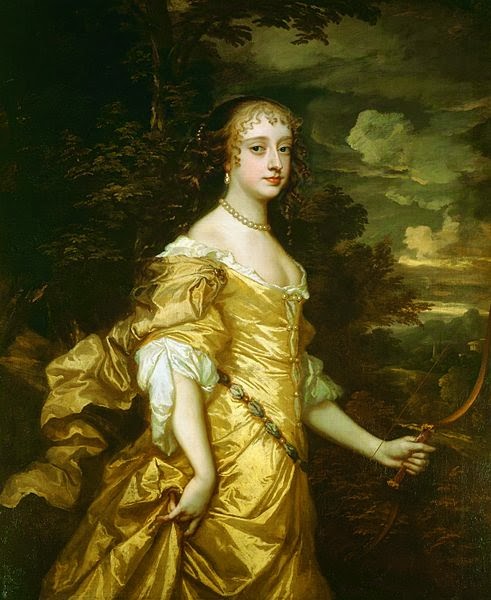
Thank you! That portrait of Frances Stuart was painted by Sir Peter Lely and is part of the “Windsor Beauties” in the Royal Collection at Hampton Court Palace. I actually did suggest the use of this portrait for the cover… along with about ten other suggestions! But I was delighted to see it used. Some historical fiction fans complain when the face of a portrait is "cut off" on book covers. But in this case I wasn't upset by it. Lely portraits were known at the time for their elegance, but also for bearing a poor likeness of the subject. So, while this is the most famous painting of Frances Stuart, it doesn't look much like her.


5. Jacob Huysmans painted a portrait of Frances Stuart wearing a "buff doublet like a soldier" (as Samuel Pepys described it), and in the novel there is a scene where Frances wears breeches. Was it a common practice at the Stuart court for women to sport men's clothing?

Not until Frances started the trend! When she arrived in England, it was not common practice for any women to sport men's clothing. But King Charles had just decreed that females could act in public theaters, and playwrights had discovered that the most popular plays were ones in which the actresses dressed up as men. Frances Stuart's first portrait in male dress was completed around 1661, so she was likely the first woman to dress this way at court. I imagine it was a court game at first, similar to the mock wedding scene between she and Lady Castlemaine in the novel. After a few years, it did become more common. Court women even wore male riding jackets and periwigs in public, which shocked the people. Still later, Nell Gwynn became well known for her rolls in male clothing.

As a side note, for her portraits in male attire, Frances wore a masculine-style blonde periwig. I think it is because of these portraits that so many people think Frances Stuart was a blond in real life. But her other portraits and her effigy at Westminster suggest she was brunette.


6. How did King Charles die? What do you imagine Frances felt upon learning of his death?

King Charles likely had a stroke, but there is a theory that his scientific experiments with mercury might have triggered it. When he died, Frances and he were on very friendly terms – but that was all. Their romantic relationship had ended, and Frances was preoccupied with her duties as a Lady of the Bedchamber to Queen Catherine and helping with her sister’s children. I imagine King Charles’ death pained her deeply, for she was ill for some time after she received the news.

What is remarkable about his death is that he died a king. His father was executed. His brother would be forced to abdicate. But King Charles II, the underestimated “Merry Monarch,” was one Stuart who knew how to keep a crown.

7. If you had to write an entire novel about one of the novel's secondary characters, which character would you choose and why?

Prudence Pope is an entirely fictional character in the novel, and possibly my favorite. As a lady’s maid and a Quaker, she exists in a more subservient role and is more of an outcast than any other character. Yet, she defies Frances and the Royalist status of the house she serves to embrace freedom in a way Frances could not. When Prudence moves to the Americas, she starts a new life in a land that would give people like her unprecedented freedoms. Sounds like a grand adventure to me!

8. What was the most difficult scene to write?

All of the love scenes were difficult to write! They seemed technical and outrageous at the same time. But because there are differing opinions among historians about whether Frances really did-or-did-not sleep with the king, the physical progression of their relationship actually became important to my plot and her life as I imagined it.

9. Please share an interesting piece of research that didn't make it into the book.

I kept trying to work one of the London Frost Fairs into the story, but it just never seemed to fit. The Thames did freeze during her lifetime, and exciting winter fairs were held on its frozen surface. Frances certainly would’ve enjoyed them.

10. Could you discuss the bird imagery in the book?

Every bird reference in the novel was intentional. Personal liberty is a major theme for Frances Stuart and for Restoration England, and Frances did own an African Gray Parrot, so the use of birds to symbolize the progression of her independence came naturally. Although I planned the final scene for years, where Frances opens a letter from Prudence, the bald-eagle feather didn’t materialize in my imagination until the moment I finally wrote it. It just fell out of the letter, and I felt the whole theme come full-circle.

11. What do you hope readers come away with after reading GIRL ON THE GOLDEN COIN?

I hope readers will find much to love about Stuart England, that they will recognize its important contribution to modern democracy, and that they remember Frances Stuart as the embodiment of her age.

************
To celebrate the publication of GIRL ON THE GOLDEN COIN, St. Martin's Press has generously offered to send one reader, chosen at random, a complimentary copy of the hardback. Marci herself will add a pair of sterling silver and pearl drop earrings, like the ones Frances wears on the cover, to the package. To enter the drawing, please leave a comment with your email address on this post before 11 pm PST on Wednesday, February 12, 2014. Winner must be a US resident. Winner's name will be posted Thursday morning, February 13, 2014.

Good luck, and please help spread the word about GIRL ON THE GOLDEN COIN!

Tuesday, February 4, 2014

Review: GIRL ON THE GOLDEN COIN by Marci Jefferson


Experience might teach readers not to judge books by their covers, but in the case of Marci Jefferson's debut novel, GIRL ON THE GOLDEN COIN (St. Martin's Press, February 11), readers have no need for caution. The gorgeous cover, which reproduces a contemporary portrait of the novel's protagonist, Frances Stuart, bespeaks with fitting perfection the sumptuous tale within.

The novel recounts the story of Stuart (1647-1702), mistress to King Charles II of England and model for Britannia, the personification of the realm that graced England's coins for decades. Despite her prominence during Charles's reign, Frances is a figure heretofore little examined in historical fiction. Jefferson depicts "La Belle Stuart" during the prime of her life, from her coming of age as a Royalist refugee at the French court of Louis XIV to her sudden widowhood at age forty. She surrounds Frances with a cast of convincing historical characters and sketches with clarity a political situation hazy, at best, to most American readers. Yet Jefferson's novel is more than a fictionalized biography set against a carefully constructed evocation of Restoration England. Like the best works of historical fiction, the novel projects the protagonist's inner life onto the broader political stage. Frances's struggle for autonomy mirrors that of England, determined to escape foreign entanglements and avoid an undesired imposition of the Catholic faith. The turmoil and soul-searching that accompanies Frances's attempt to reconcile her personal happiness with the good of the kingdom makes her plight a fascinating one.

Jefferson gives this "mistress of the king" story several interesting twists. First, Frances does not choose the role; it is thrust upon her by Louis XIV, who intends to use her as a way to keep Charles friendly to France, and by Charles's mother, who believes Frances can persuade her son to restore Catholicism to England. Frances, however, cannot comply with these demands: a secret that threatens to ruin her family necessitates that she remain free from scandal. She travels to England determined to befriend and influence Charles without becoming his mistress, a goal she soon discovers will satisfy neither Charles nor her own heart. Jefferson further complicates Frances's mission by establishing a friendship between her and Charles's Portuguese bride, Catherine of Brançaga, who arrives without a word of English and innocent of the ways of Charles's licentious court. Frances takes Catherine under her wing and develops a true respect and fondness for the foreign queen, making her decision on how far to pursue a relationship with Charles all the thornier. Third, Charles, an inveterate womanizer, considers Frances his pure and noble angel. Frances fears that if they consummate their relationship, Charles will lose the one thing that challenges him to be a better man. Frances knows her personal happiness lies in Charles's arms, but loyalties, politics, and the needs and expectations of others thwart her at every turn. Despite painful sacrifices, she never abandons the struggle to conform the desires of her heart with the realities of her situation.

Ultimately it is freedom, rather than love, that Jefferson's Frances -- reluctantly worldly, refreshingly loyal, spunky yet surprisingly wise -- seeks, the freedom to determine her own fate. A freedom for which England, of whom she serves as emblem, likewise searches. The Frances who withstands the pressure to conform in the final scene of the book is a far cry from the young girl forced to assume a role from which she shrinks in the opening chapters, and the reader who accompanies her on her journey to independence understands and appreciates the depth of the change.

Just as her protagonist escapes limits imposed from without, Marci Jefferson succeeds in slipping the restricted expectations that so often shackle debut novelists. If this first book, with its thoughtful characterizations, vivid settings, well-paced plot and subtle symbolism is any indication, Jefferson stands poised to become a definitive voice in the world of historical fiction. Accomplished and thoroughly satisfying, GIRL ON THE GOLDEN COIN glows with a luster that persists long after its striking cover falls closed.

************
MARCI JEFFERSON grew up in an Air Force family and so lived numerous places, including North Carolina, Georgia, and the Philippines. Her passion for history sparked while living in Yorktown, Virginia, where locals still share Revolutionary War tales. She lives in Indiana with her husband and children. This is her first novel.

************ 
Return tomorrow to read my interview with Marci and enter to win a complimentary copy of GIRL ON THE GOLDEN COIN, along with a special gift!


Tuesday, July 30, 2013

Cover Reveal Tour: Marci Jefferson's GIRL ON THE GOLDEN COIN, A NOVEL OF FRANCES STUART

Today I am pleased to participate in friend Marci Jefferson's cover release blog tour and contest. Her novel, GIRL ON THE GOLDEN COIN, A NOVEL OF FRANCES STUART, will release on February 11, 2014 from Thomas Dunne Books/St. Martin's Press. If you pre-order this week and comment on Marci's blog, you'll be entered in a drawing for a pair of sterling silver pearl-drop earrings like the ones Frances wears on the book's elegant cover (be prepared to present your receipt).


MORE ABOUT THE BOOK

Impoverished and exiled to the French countryside after the overthrow of the English Crown, Frances Stuart survives merely by her blood-relation to the Stuart Royals. But in 1660, the Restoration of Stuart Monarchy in England returns her family to favor. Frances discards threadbare gowns and springs to gilded Fontainebleau Palace, where she soon catches King Louis XIV’s eye. But Frances is no ordinary court beauty, she has Stuart secrets to keep and people to protect. The king turns vengeful when she rejects his offer to become his Official Mistress. He banishes her to England with orders to seduce King Charles II and stop a war.

Armed in pearls and silk, Frances maneuvers through the political turbulence of Whitehall Palace, but still can’t afford to stir a scandal. Her tactic to inspire King Charles to greatness captivates him. He believes her love can make him an honest man and even chooses Frances to pose as Britannia for England’s coins. Frances survives the Great Fire, the Great Plague, and the debauchery of the Restoration Court, yet loses her heart to the very king she must control. Until she is forced to choose between love or war.

On the eve of England’s Glorious Revolution, James II forces Frances to decide whether to remain loyal to her Stuart heritage or, like England, make her stand for Liberty. Her portrait as Britannia is minted on every copper coin. There she remains for generations, an enduring symbol of Britain’s independent spirit and her own struggle for freedom.

ADVANCE PRAISE

"In her wonderfully evocative debut, Girl on the Golden Coin, Marci Jefferson recreates the fascinating story of Frances Stuart, whose influence over England's Charles II became the talk of a nation. As vibrant and delightful as the woman it's based on, Girl on the Golden Coin is a jewel of a novel!"
—Michelle Moran, New York Times bestselling author of The Second Empress and Madame Tussaud 

"Beauty is not always a blessing, as young Frances Stuart finds out when her lovely face pits her between the desires and politics of rival kings Louis XIV and Charles II. Frances makes an appealing heroine, by turns wary and passionate, sophisticated and innocent, as she matures from destitute young pawn to the majestic duchess whose figure would grace Britain's coins for centuries. Her struggles to support her loved ones, uncover her family secrets, and somehow find a life of her own amid the snake-pit courts of the Sun King and the Merry Monarch make for lively, entertaining reading in this lush Restoration novel by debut author Marci Jefferson."
—Kate Quinn, New York Times bestselling author of Mistress of Rome

"Girl on the Golden Coin is a fantastic novel. I couldn’t put it down. The plot is fast-paced and compelling, with intriguing characters, lush settings and captivating narrative voice. Jefferson’s debut paints an intriguing portrait of Frances Stuart, a novel worthy of the determined, golden spirit of the woman whose face became the model for Britannia herself."
—Susan Spann, author of Claws of the Cat

FIND IT HERE

Barnes & Noble

IndieBound

Amazon

Goodreads