Showing posts with label Victorian. Show all posts

Sunday, November 14, 2021

Review: DOWN A DARK RIVER by Karen Odden


Any novel that quoted Victorian poet Matthew Arnold's "Dover Beach" would be a favorite of mine, but when one of the victims in Karen Odden's just-released mystery DOWN A DARK RIVER (Crooked Lane) offers the poet's famous admonition--"Ah, love, let us be true / To one another! for the world /... / Hath really neither joy, nor love, nor light, / Nor certitude, nor peace, nor help for pain"-- as a message of hope, it's icing on an already delectable cake. Odden's fourth novel, the first installment of her new Inspector Corravan series, links matter and message together so profoundly readers will find themselves musing on the fundamental questions the novel poses long after they close the cover on this thoroughly satisfying read.

An expert in Victorian literature and culture, Odden conjures a vividly convincing setting populated with memorable characters that reverberate with historical and psychological authenticity. An emotionally scarred Irishman who grew up on the docks in the seedy Whitechapel district of London, protagonist Michael Corravan has traded the boxing ring for the neighborhood precinct. He now works for Scotland Yard at a time when the agency is under intense scrutiny for corruption. When a dead young woman in a ball gown is discovered floating down the Thames in a boat à la Lady of Shalott, Corravan must apprehend her murderer before newspaper coverage sparks panic among London's upper crust. Concurrently working on the case of a runaway wife, Corravan suspects the two cases might be connected, but all too soon another body comes floating down the river, then another.... Abrasive and irregular in his methods, Corravan incurs the censure of his superiors just as his investigation begins to bear fruit. With his career, the reputation of the Yard, the safety of his lover, and the lives of future victims on the line, Corravan pieces together the clues, only to face a soul-wrenching question--can justice be served in the face of horrendous injustice? Corravan's answer and actions to this dilemma upends the mystery genre's traditional norms and provides plenty of fodder for thought on the meaning of justice in an unjust world of stark class and economic disparities. 

Odden's intricate plot merits praise for its keen execution, but the completeness and particularity of her characters endows this novel deep emotional resonance. No cardboard characters populate these pages; the reader can sense the detailed backstory Odden has imagined for each and every player. Issues in the characters' pasts complicate their present, and the author reveals just enough in just the right places to elucidate the characters' motivations. Corravan's traumatic past shapes his effectiveness as an inspector in strong yet subtle ways, and readers will be pleased to discover a man of broad generosity and deep compassion behind his prickly exterior.

Though the novel's action takes place in the kitchens, gentlemen's clubs, and grimy streets of Victorian London, the issue at the heart of DOWN A DARK RIVER--whether the powerless can ever receive justice from the hands of the powerful who have wronged them--remains relevant, and just as thorny, today. Now, as then, the silenced need a voice to bring injustice to light. Through the efforts and humanity of Inspector Michael Corravan, a welcome addition to the ranks of fictional police inspectors, Karen Odden gives them one.

**********


Karen Odden earned her Ph.D. in English from New York University and subsequently taught literature at the University of Wisconsin-Milwaukee. She has contributed essays to numerous books and journals, written introductions for Victorian novels in the Barnes & Noble classics series, and edited for the journal Victorian Literature and Culture (Cambridge UP). Her previous novels, also set in 1870s London, have won awards for historical fiction and mystery. A member of Mystery Writers of America and Sisters in Crime and the recipient of a grant from the Arizona Commission on the Arts, Karen lives in Arizona with her family and her rescue beagle Rosy.

Visit her website to learn more about Karen and her novels.


Wednesday, September 30, 2020

Guest Post by Karen Odden: The “Mysnomer” in the Label “Historical Mystery”

I asked Karen Odden, author of the Victorian mysteries A DANGEROUS DUET (2018) and A TRACE OF DECEIT (2019) about the differences between historical mystery and straight historical fiction. Here's what she had to say!


The “Mysnomer” in the Label “Historical Mystery”
by Karen Odden

Years ago, one of the earliest readers of my first book, A Lady in the Smoke, wrote me this email: “I loved your book! My only issue was the cover. It says A Victorian Mystery, and it wasn’t really a mystery. It was all about characters and railway history—and I loved the romance!”


I stared at that message for a long time, truly perplexed. Yes, the book shows Lady Elizabeth Fraser’s difficult relationship with her mother, her dead father’s adultery, her budding relationship with the railway surgeon Paul Wilcox … but the railway crash happened because of flagrant corruption committed years before, and there’s another crime of enormous fraud about to be committed! Elizabeth and Paul must work together to uncover it before it happens. How is this not a mystery?

This question has nagged at me ever since, even as I wrote my next two books, giving rise to other questions: Where is the crossover between historical fiction and historical mysteries? And why do people who love historical fiction shy away from books labelled historical mysteries?

One clue came to me last year when I was at a mystery-writers’ conference, where two famous thriller writers agreed that they didn’t spend much time developing their secondary characters. One said, “There’s really only five types, right? A friend/ally, the villain, a thorn (bothersome but not the villain), the expert (who tells the detective something important), and the red shirt (the dead person).” Another explained that he jots down a secondary character’s age, hair color, eye color, maybe whether he smokes or drinks, a few habits—and that’s enough to start with. 

I found myself staring, disconcerted. This wasn’t how I worked. At all. I have stacks of backstory written for characters. I have a list, with every character, of physical traits, psychological aspects, bad habits, worst memories, who they love, what they want, and their deepest fears, along with pictures of objects in their homes and buildings they see on their daily walks.


Of course, thrillers are a particular sub-genre of mystery. They rely more heavily on plot than historicals or cozies tend to. And these writers are enormously successful, New York Times bestselling authors who have sold millions of books to avid fans. They’re crafting suspenseful, heart-pounding, fast-paced thriller mysteries.

But when it comes to historical mysteries, I’ve found readers have a different set of expectations.

Most readers of historicals (whether fiction or mysteries) frown when a book is poorly researched or contains anachronisms (like a Starbucks in 1970s New York). They roll their eyes at villains who have absolutely no redeeming traits and at overused tropes and conventional stereotypes, as in, “All Victorian women were prudes.” In general, readers are smart and savvy; they discuss works in book clubs; they read blogs and reviews; they want a book that entertains, provides an emotional journey, and even educates (without being a lecture). I know these readers—because I’m one of them! 

So when Julianne asked me to write about where historical novels and historical mysteries intersect, I did what I often do: I started researching by combing through my bookshelves. Like most avid readers, I own a mishmash of fiction, mystery, memoir, classics, how-to, some poetry, books from grad school and college, and some old childhood favorites I can’t part with. (Anne of Green Gables is up there, as are A Wrinkle in Time and The Witch of Blackbird Pond.) I also have (on low shelves, easily reachable) my non-fiction reference books on Victorian England railway systems, clothing, crime, country house architecture, and so on. 


I pulled down forty historical works to review, and this is what I found: the historical novels I truly love have some element of mystery, some dark secret from the past that must be discovered and resolved. And the historical mysteries that I love—many of which have received literary awards, including Canada’s coveted Costa Book of the Year and the Hammett prize for Best Novel of the Year—have complex, detailed world-building, fully developed characters, and fresh, descriptive language.

That led me to an insight. The label “mystery” is, in a way, a misnomer because it points to only one aspect of the book—the plot. This implies that the plot is paramount, as if detailed worldbuilding and complex characters and fresh, descriptive writing won’t be present, or at least not as present, as in a historical novel. 

But in reducing a book to a single element—the plot—the label “mystery” is like a cheesy trailer for what might be a great movie. It might steer some readers away from a finely wrought book that has many of the elements they love in historical novels! (Perish the thought of missing out on a good read!)

What are these elements? I’d say there are three main ones, common to historical novels and mysteries, that make a book a favorite for me:

First, all good historicals—whether novels or mysteries—rely heavily on worldbuilding. This usually means an author does enormous amounts of research. I have a map of 1870 London on my wall 


with a piece of string kept handy to map distances, so I can estimate, for example, how long it will take my main character to walk from one place to another. Solid worldbuilding means knowing how the streets are paved, who’s traveling on them at different times of day, and how they’re lit (if they’re lit). It means knowing the proper names for things: in 1870s London, a street vendor is called a “costermonger” and a sidewalk is called a “pavement.” I know what people ate in 1870s London, what sorts of books and objects were on tables in a woman’s parlor versus a man’s study, what the weather was like at different times of year, and what people wore, depending on their class.

An author of historicals also must know the specifics of historical events. For example, I set A Trace of Deceit very purposefully in 1875 because it needed to be after the Slade School of Art was founded in 1871, so my heroine Annabel could attend it, and also after the devastating Pantechnicon fire in Mayfair in 1874, so a priceless French oil painting that was supposed to have gone up in ashes can mysteriously reappear in Annabel’s brother’s studio. It’s important to get these small historical details and dates—easily fact-checked—correct. 

But more than that, it’s important to recognize the political, social, legal, and economic aspects that will govern or influence a character’s behavior. For example, in 1860s London, under the legal doctrine of “coverture,” a married woman could not keep her wages, divorce a violent husband, or claim her children as her own. But as of 1870, when the Married Women’s Property Act was passed, she could at last own property. That could be an important plot point, couldn’t it? My point is, it is important to stay true to the times. Victorian women had very real constraints put on their autonomy and behavior, and no amount of “feistiness” in a heroine can overcome that. 

Here are some of my other favorite historical mysteries for worldbuilding: David Liss’s A Conspiracy of Paper (an Edgar Award winner), set in eighteenth-century London, amidst coffee houses, drawing rooms, and bordellos. Another is The Gods of Gotham by Lyndsay Faye, set in 1845 New York, with its kerosene lamps, butcher paper, worn tombstones, New England rum, charcoal drawings, and bootprints (within the first two pages). Other favorites are A Rising Man by Abir Mukherjee, set in 1919 Calcutta; Anne Perry’s William Monk series, set in Victorian London; Baroness Orczy’s classic The Scarlet Pimpernel about the French Revolution; and Lou Berney’s November Road, set in 1963 New Orleans and beyond.


Second, both historical fiction and historical mysteries have narrative arcs that move both forward and backward. The critic Tzvetan Todorov wrote that a mystery novel “contains not one but two stories: the story of the crime and the story of the investigation.” That is, if there is a dead body on page 5, the remainder of the book is discovering how it got there in the first place (the “backstory”). But even in historical novels, there is almost always an ugly secret from the past, a sordid event, or something that led to the situation in chapter 1. If a book is to succeed, the characters have backstories—big, emotional backstories that have shaped their psychology and the way they look at the world. It’s inevitable there will be some skeletons back there. 

For example, in Kate Quinn’s historical novel The Huntress, in post-WWII Boston, the former Russian night bomber and war criminal Nina Markova is masquerading as a soft-spoken German widow. The plot is propelled forward by Ian Graham, a Nazi hunter, and young would-be photographer Jordan McBride, whose questions about The Huntress take them straight back to the crimes of the war. 


Third, they have life-like, psychologically complex characters. Precisely because we are asking readers to journey to another time and place, we have to have our characters deeply believable. They need to breath and live and love and hate before they get to the page, or they come off as mere vehicles for the plot. One of my favorite historicals for this is Stef Penney’s The Tenderness of Wolves. Set in 1867, in the Northern Territory, the main character Mrs. Ross stumbles upon a murder and sees the tracks leading from the dead man’s cabin north toward the tundra. Focalized through half a dozen characters, the story unfolds in a way that reflects the individuals’ old family hurts, systemic racism, long-standing fears and prejudices. I go back and reread this novel every few years for its a psychologically complex cast of characters. 

So I would say that historical mysteries and historical novels are really branches on the same tree. To me, the trunk of that tree is the true mystery (of books, of life)—namely, people’s psychology, motivations, fears, assumptions, behaviors, and beliefs. Where did they come from? What past experiences formed them? What misconceptions does my heroine have? And how must she grow and change in order to resolve whatever problem lies before her? This is the true mystery, after all, because all of us can only know each other in part. 

For more about the books I love, visit my book review blog. (Note: I do not review books I’d rate only one star or don’t finish.)

I’d love to hear about your favorite historicals, of whatever kind. Reach me at my website, on twitter: @karen_odden, or IG: @karen_m_odden. 

**********


Karen Odden received her Ph.D. in English literature from New York University and taught at the University of Wisconsin-Milwaukee. She has contributed essays and chapters to books and journals, including Studies in the Novel, the Journal of Victorian Culture, and Victorian Crime, Madness, and Sensation; she has written introductions for Barnes and Noble editions of books by Dickens and Trollope; and she edited for the academic journal Victorian Literature and Culture. She freely admits she might be more at home in nineteenth-century London than today, especially when she tries to do anything complicated on her iPhone. Her first novel, A Lady in the Smoke, was a USA Today bestseller and won the New Mexico-Arizona 2016 Book Award for e-Book Fiction. Her second novel, A Dangerous Duet, about a young pianist who stumbles on a notorious crime ring while playing in a Soho music hall in 1870s London, won the New Mexico-Arizona 2019 Book Award for Best Historical Fiction. A Trace of Deceit is her third novel. She resides in Arizona with her family and a ridiculously cute beagle named Rosy.

**********

Thanks to Amy Bruno of Historical Fiction Virtual Book Tours for arranging Karen Odden's tour.

Tuesday, September 29, 2020

Review: A TRACE OF DECEIT by Karen Odden

I've never been a reader of mysteries, but Karen Odden is turning me into one! I read Karen's first Victorian Mystery, A DANGEROUS DUET (William Morrow, 2018) and fell in love with the novel's feisty protagonist, intriguing plot, and convincing Victorian world. Odden's second Victorian Mystery, loosely connected to the first, is even better: A TRACE OF DECEIT (William Morrow, 2019) delves into the dark world of art forgery and auction house corruption as a young female artist struggles to solve her brother's murder and clear his name.

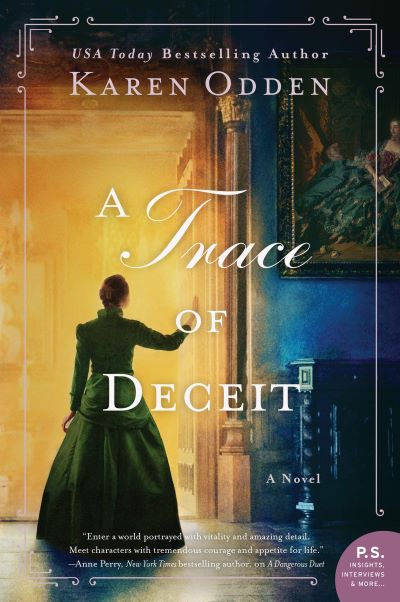
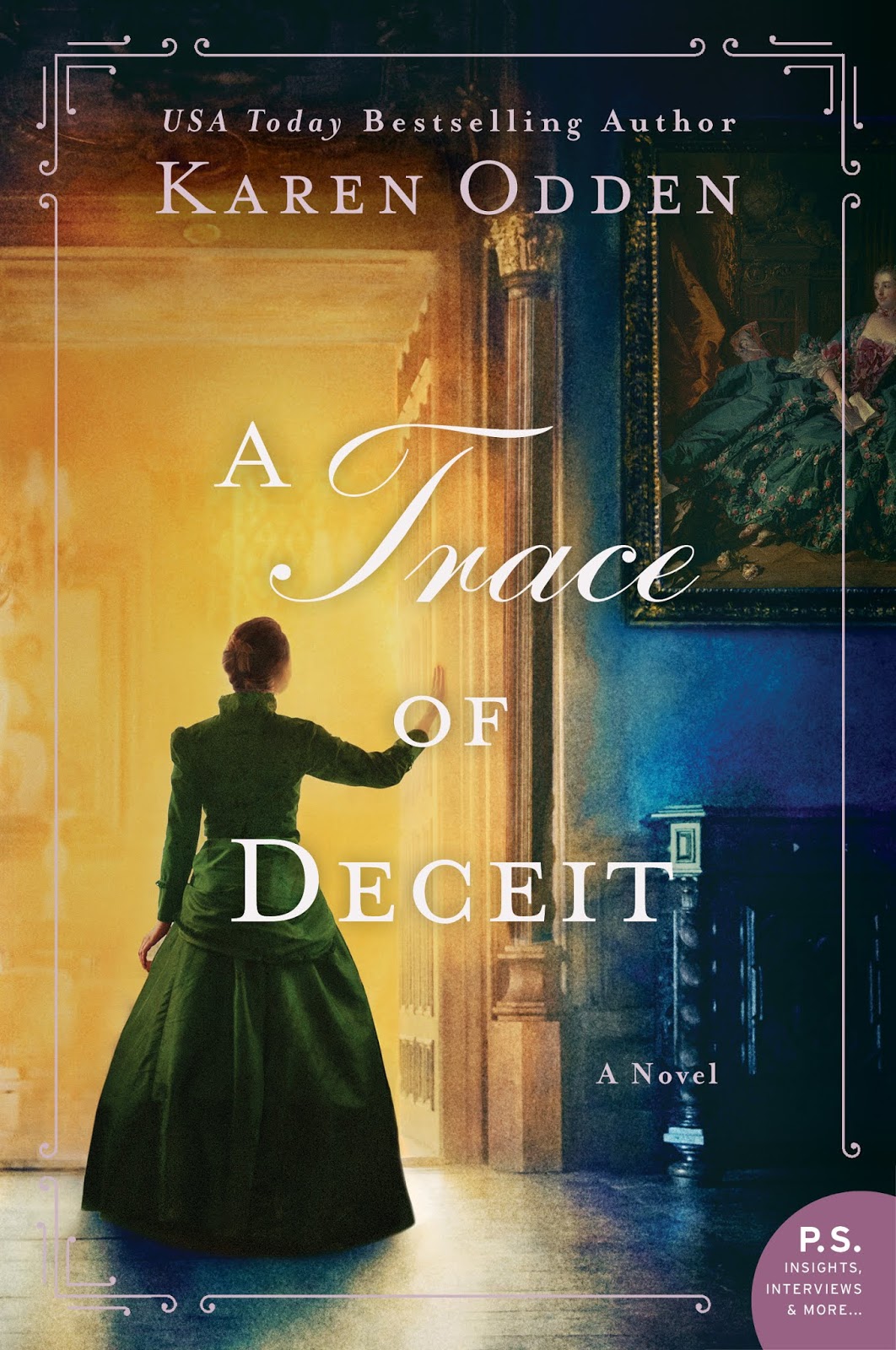
A Trace of Deceit by Karen Odden

Publication Date: December 17, 2019
William Morrow
Paperback & eBook; 416 pages
Genre: Historical Mystery/Victorian
From the author of A Dangerous Duet comes the next book in her Victorian mystery series, this time following a daring female painter and the Scotland Yard detective who is investigating her brother’s suspicious death. A young painter digs beneath the veneer of Victorian London’s art world to learn the truth behind her brother’s murder... Edwin is dead. That’s what Inspector Matthew Hallam of Scotland Yard tells Annabel Rowe when she discovers him searching her brother’s flat for clues. While the news is shocking, Annabel can’t say it’s wholly unexpected, given Edwin’s past as a dissolute risk-taker and art forger, although he swore he’d reformed. After years spent blaming his reckless behavior for their parents’ deaths, Annabel is now faced with the question of who murdered him—because Edwin’s death was both violent and deliberate. A valuable French painting he’d been restoring for an auction house is missing from his studio: find the painting, find the murderer. But the owner of the artwork claims it was destroyed in a warehouse fire years ago. As a painter at the prestigious Slade School of Art and as Edwin’s closest relative, Annabel makes the case that she is crucial to Matthew’s investigation. But in their search for the painting, Matthew and Annabel trace a path of deceit and viciousness that reaches far beyond the elegant rooms of the auction house, into an underworld of politics, corruption, and secrets someone will kill to keep.

My Review

    A TRACE OF DECEIT is a mystery with a heart, a compelling story whose emotional resolution is as important to its success as the solving of the crime. An art student living independently in Victorian London after the death of her parents, Annabel Rowe is shocked to learn that her brother Edwin, an artist so talented he'd once turned to forging paintings to feed his opium habit, has been murdered and the valuable painting he'd been cleaning for an auction house has gone missing. Annabel joins forces with Inspector Matthew Hallam of Scotland Yard to uncover evidence that might pinpoint a motive and a murderer. But for all she is determined to uncover the killer, Annabel's true quest is to understand why Edwin's life veered off into the shadowy underworld in the first place. Was he was truly on a path to redemption when he was murdered? If so, how can she forgive herself for withholding her complete forgiveness for the history of hurt and disappointment they shared? Haunted by the possibility that Edwin died thinking himself unforgiven, Annabel works tirelessly to unearth the dark secrets from deep in his past that contribute in no small measure to the complicated fraud his murder is meant to disguise. 
    Annabel's emotional journey unfolds against a rich and convincing Victorian backdrop. The author combines her intimate knowledge of the art world, gained through years of employment at Christie's auction house, with her deep familiarity with the culture and physical reality of 1870's London to evoke a world that feels as real, and as broad, as the reader's own. Annabel and Matthew dodge carriages and horse dung in the streets, interview lords and ladies in elegant salons, threaten newspaper editors in shabby offices, tour a tony boys' school, sweat out an art auction, and stalk criminals at a market. The crime that results in Edwin's murder originates in a historical event--the 1874 destruction by fire of the Pantechnicon, the state-of-the-art warehouse where the rich stored their excess furniture and art--and cleverly incorporates political and social details that completely validate its execution. The era-appropriate psychology and behavior of the characters, combined with the vivid, believable setting make A TRACE OF DECEIT a delightful, satisfying read.
    Karen Odden is an author to watch. Her skillful writing and profound knowledge of the Victorian era have opened a new world to me, and I'm eager to follow her on her next mystery adventure!

*******
You can read my interview with Karen Odden here. Be sure to return tomorrow to read Karen's guest post, "The 'Mysnomer' in the Label 'Historical Mystery.'"

Find A TRACE OF DECEIT at: 

About the Author

Karen Odden received her Ph.D. in English literature from New York University and taught at the University of Wisconsin-Milwaukee. She has contributed essays and chapters to books and journals, including Studies in the Novel, the Journal of Victorian Culture, and Victorian Crime, Madness, and Sensation; she has written introductions for Barnes and Noble editions of books by Dickens and Trollope; and she edited for the academic journal Victorian Literature and Culture. She freely admits she might be more at home in nineteenth-century London than today, especially when she tries to do anything complicated on her iPhone. Her first novel, A Lady in the Smoke, was a USA Today bestseller and won the New Mexico-Arizona 2016 Book Award for e-Book Fiction. Her second novel, A Dangerous Duet, about a young pianist who stumbles on a notorious crime ring while playing in a Soho music hall in 1870s London, won the New Mexico-Arizona 2019 Book Award for Best Historical Fiction. A Trace of Deceit is her third novel. She resides in Arizona with her family and a ridiculously cute beagle named Rosy.

Website | Facebook | Twitter | Pinterest | BookBub | Goodreads

Blog Tour Schedule

Monday, September 7 Review at Books and Backroads Review at WTF Are You Reading? Tuesday, September 8 Feature at I'm All About Books Wednesday, September 9 Review at Hallie Reads Thursday, September 10 Review at Gwendalyn's Books Friday, September 11 Review at Historical Fiction with Spirit Monday, September 14 Review at Pursuing Stacie Tuesday, September 15 Review at Faery Tales Are Real Wednesday, September 16 Review at Into the Hall of Books Thursday, September 17 Review at Novels Alive Friday, September 18 Review at A Darn Good Read Saturday, September 19 Review at Nursebookie Monday, September 21 Review at Books and Zebras Tuesday, September 22 Review at Passages to the Past Thursday, September 24 Guest Post at Novels Alive Friday, September 25 Review at The Lit Bitch Monday, September 28 Review at Amy's Booket List Review at Chicks, Rogues, and Scandals Tuesday, September 29 Review at Impressions In Ink Review at Writing the Renaissance Wednesday, September 30 Review at Probably at the Library Guest Post at Writing the Renaissance Thursday, October 1 Excerpt at Books In Their Natural Habitat Review at History from a Woman’s Perspective Friday, October 2 Review at Jessica Belmont Review at Jorie Loves A Story Review at View from the Birdhouse

Giveaway

During the Blog Tour, we are giving away one paperback copy of A Trace of Deceit! To enter, please use the Gleam form linked below. The giveaway is open to US residents only and ends on October 2nd. You must be 18 or older to enter. A Trace of Deceit

Tuesday, May 26, 2020

Interview with Karen Odden, author of A TRACE OF DECEIT

When I visited my intrepid agent Josh Getzler at HGLiterary last June, he offered me, as a parting gift, a selection of novels that he had represented. The blue cover of A DANGEROUS DUET (William Morrow, 2018), a Victorian mystery written by Karen Odden, immediately caught my eye. I so enjoyed reading it that when I recently saw Karen promoting her latest release, A TRACE OF DECEIT (William Morrow, 2019), I reached out to her on social media. Turns out we have a lot in common (besides our industrious and generous agent!). Like me, Karen has a doctorate in literature and writes novels set in the era of her academic specialty. Unlike me, she has been published three times over and has another book in the pipeline. She graciously agreed to answer some questions about her background, her novels, and her writing career. Sample her expertise and engaging voice in the interview below, and you'll be eager to read her exceptional mysteries for yourself. I know I can't wait to get my hands on A TRACE OF DECEIT!


1. Your three books all take place in London during the Victorian era (1870s). How did you become interested in this time period? Why does it fascinate you so? 

Years ago, I wrote my PhD dissertation at NYU on Victorian railway disasters. It probably seems odd to most of us, but people were obsessed with them—sort of the way we’re riveted by computer hacking or terrorism. Accounts of train wrecks appeared in novels, medical literature, newspaper accounts, parliamentary papers, legal trial reports, and so on. In order to understand their power in the public imagination, I studied Victorian literature and history, especially London during Queen Victoria’s era, 1837-1901.

But as I researched, the 1870s became my favorite decade because so much changed so rapidly in the social, economic, and political spheres. It was like someone set loose a rollercoaster car! Some of this is because literacy rates were rising, so people wrote, read, and talked about social issues more. But many of the debates of the 1850s and 1860s led to a swath of new laws in the 1870s. For example, traditionally under British law, a married woman was “covered” by her husband. This meant she could not vote, hold her own money, initiate a contract or divorce, or inherit property. In 1870, as a result of the Married Woman’s Property Act, for the first time, a woman could earn and keep her wages (shocking, I know!) and she could inherit property up to £200. It was one small but significant reversal of a huge social inequality. The Elementary Education Act of 1870 finally made education mandatory for all children ages 6-12. A series of safety and labor laws were passed to protect works in the mills and factories. Furthermore, new institutions such as the Slade School of Art (founded 1871) were opening to women. And the Franco-Prussian War (1871) tipped the balance of power in continental Europe from France to newly-united Germany—with results that we’d continue to see well into the twentieth century. Yet all this change occurred during a decade that was smack in the middle of the longest stable reign in British history. I find that so interesting.

2. What sparks a new book for you first—a character, a situation, or a setting? How do you work to construct a mystery plot? 

At the heart of each of my novels is a story I read or heard that clutched at me and refused to let go. As I researched railways, I found descriptions of people climbing out of burning carriages, horses trapped and screaming in stock cars, railway surgeons faced with hundreds of patients lying in the surrounding fields. So a railway disaster became the propelling event in A Lady in the Smoke. Similarly, when I was researching for A Dangerous Duet, I discovered the brilliant pianist Fanny Dickens (Charles’s older sister) was forced to leave the Royal Academy because she could no longer afford tuition. There were no opportunities for Fanny to make the money—and even if she earned it, she could have been forced to hand it over to her father to pay the family’s debts. It felt horribly unfair to me. A Trace of Deceit was shaped by painful stories of addiction, told to me by friends. And my next book is about the brutality of the African slave and ivory trades in the 1870s. In 2013, I read a book that included accounts of how Belgian agents would seize African women and children and put them in cages with no food or water, freeing them only when their husbands or fathers brought back the requisite 70 pounds of rubber. Now, seven years later, I’ll put this story to use.

3. Do you travel for your research? What has been your most thrilling discovery?

I had been to London a few times, even before I started writing books set there. My most thrilling discovery was Wilton’s Music Hall in Whitechapel—not far from where the Ripper murders took place. It is (so far as I know) the only standing Victorian Music Hall in London, and it’s an amazing space. If you’ve seen Sherlock Holmes: A Game of Shadows with Robert Downey, Jr., you’ve seen Wilton’s. As Sherlock, Downey is chased all over the theater by a Cossack.

Photo credit: http://www.wiltons.org.uk
Wilton’s was created in the mid-1800s by John Wilton, who joined together three houses in Graces Alley to make the music hall. As I walked through the doors, I could smell the hops, and I tripped over a nail in the wooden floorboards. I went downstairs and prowled around the basement with its uneven floors and plaster coming off the bricks. Then I came up and looked at the music hall itself—the U-shaped room, painted blue, with gilt and turned pillars. Instantly, I could see Nell in her piano alcove, and the setting for my story began to feel solid.

Photo credit: Karen Odden

Photo credit: Karen Odden
That trip, I also went to the Royal Academy of Music, where I found the 1820s class roster with Fanny Dickens’s name and a plaque with information about her. The music hall industry arose too late for Fanny, but by the 1850s there were dozens of halls in London willing to pay for talent—though men made twice what women did. And so was born the story of the pianist Nell Hallam, who needs to earn money for her tuition at the Academy and dresses as a man to take a position in a Soho music hall.


4. Inspector Matthew Hallam, the brother of the protagonist in your previous book A DANGEROUS DUET, reappears as a main character in A TRACE OF DECEIT. Are you building a series featuring Matthew? Does Nell, the protagonist of DUET, figure in TRACE?

Nell appears incidentally in A Trace of Deceit, but I don’t want to do a “series” in the usual way. I do have a few secondary overlapping characters—particularly Tom Flynn, my shrewd, straight-talking writer for the (fictional) London newspaper, the Falcon. He is based on my high school English teacher, who was the first person who told me I could write.

Frankly, I don’t trust myself to keep a protagonist interesting (or to stay interested in her!) to the same degree, after her first book, when the “big” issue from her past is resolved. Besides, I’m a research junkie. I’ve explored railways, music halls, the London art and auction world, and now the African ivory trade … and assuming there’s a fifth book, I want to move on to another aspect of Victorian London.


5. What do you love most about your new heroine, Annabel Rowe? How does she frustrate you? 

I love Annabel because she cares. She cares about her brother Edwin’s well-being. She cares about honoring his memory by finding out who he was before he died. She cares about telling the truth in her paintings—representing people as they really are, rather than some idealized version.

I wouldn’t say she frustrated me, necessarily … maybe she should have! But from the outset, I knew how she had to change. As a child, Annabel grew up the fourth person in a house with a very intense triangle: her father was fiercely ambitious for Edwin, who resented his father’s demands, and her mother ran interference. Annabel was always the observer because as a child, it was safer. Even as an adult, her habit of observing kept her out of the fray, and it worked (up to a point) for becoming a painter. But over the course of the novel, she has to learn how being solely an onlooker limits her. She needs to find a way to deepen her engagement with the world, or she will never become the painter she could be … and she won’t solve Edwin’s murder.

6. What authors inspired you to become a mystery writer? How does their work influence yours? 

As a child, my family spent every Sunday out at my grandparents’ house where my parents played bridge and I was left to scavenge in my grandmother’s library. There I found all kinds of books—bodice rippers, mysteries, suspense! I was probably around eleven when I found Mary Stewart, Victoria Holt, and Daphne DuMaurier, and I’d say they were my first “adult” mysteries. (I had already torn through Nancy Drew, etc.) I loved the way these three women authors created vivid settings, fashioned young women characters who weren’t superheroes but seemed to have something in common with me, and had plots that wove together past tragedies and present events. I also loved how a single murder and a personal desire for truth could spin suspense for an entire book. A plot didn’t need to have fast cars and exploding buildings and bloodbaths to be a page-turner. The suspense for me came through the small scenes, the interactions among characters. Over the years, I realize I’m drawn to books that have some of these qualities—Tana French’s books and Stef Penney’s The Tenderness of Wolves are books I reread every year or two. As far as being influenced, I like to think my books place the reader in Victorian London, where they will hear “Oranges and Lemons” from the church bells and smell the tallow from the chandler’s shop. And my protagonists, young women amateur sleuths, all have to learn something from their past in order to move forward in their present, and to solve the mystery in front of them.

7. You have now published three mystery novels. What have you learned over the course of these three books? Do you have any advice for aspiring writers? 

Oh gosh. I could write a book just on what I’ve learned! But I’ll pick two things that stand out. First, it’s great to start with a clear plot idea (a railway crash, say). But I’ve come to realize the importance of spending hours and hours on backstories for my characters—even the minor ones. Then, after I write the first draft, I go back to my backstories and revise them, which in turn deepens my manuscript. I have separate pages for each character, and I write their histories from their point-of-view, although that information doesn’t all make it into the novel. The codicil to “backstories are vital” is that although backstories need to be in my head, they don’t need to be in my book.

Second, after writing, I trim. By my third or fourth draft, the manuscript is about 120,000 words—and then, when I feel my manuscript is “done” as far as plot and character, and all the details fit, and I love it exactly the way it is, I slash 20,000 words out. It inevitably makes a leaner, cleaner manuscript—and reducing redundancy, or even omitting a few lines here and there leaves room for the reader to fill in. Readers feel more engaged when they have to do some of the work … and I’ve learned to trust my readers. They’re smart.


8. What has been the most exciting moment of your writing career so far? Have you ever been ready to throw in the towel? What made you persevere? 

Eight years ago, before I found my agent, I nearly gave up. I’d been working on the manuscript for A Lady in the Smoke, and some YA manuscripts, for years. I just couldn’t find an agent to take more than a passing interest, and though I’d taken classes and read books on writing, I didn’t know what was wrong with them. I remember talking to my friend Jody Hallam (for whom Matthew Hallam is named) about how incredibly discouraged I was, and how I could write for another ten years and still get nowhere. The uncertainty was terrible. She urged me to find a free-lance editor before I gave up. Another friend, also a writer, recommended someone who helped me get the manuscript in shape for submission—and I sent it out to ten agents I found on Publisher’s Marketplace. I heard back from eight, and two eventually offered representation.

Like Annabel (and all my heroines) I had something to learn: I need feedback at various stages. My advice is to find a strong critique group, or a mentor who will work one-on-one, if that suits you. Join organizations such as Sisters in Crime and Mystery Writers of America, who have resources to help you. And of course, keep writing.

The thing is, even if I had never found an agent or a publisher, I’d write anyway. I have dozens of notebooks and piles of manuscript pages and drafts of articles and essays that will probably never see the light of day. A friend asked me once, “Don’t you ever want to take a day off from writing?” I replied that it’s sort of like brushing my teeth; I could skip a day, but it doesn’t feel good. Honestly, I love writing more than I hate failing at it. And my reading and writing has brought me to a community with so many lovely, smart, talented readers, librarians, bloggers, booksellers, and writers that even if I never publish another book, I’ve won.

**********

Karen Odden served as an Associate Lecturer at the University of Wisconsin-Milwaukee and taught classes in English language and literature at New York University and the University of Michigan-Ann Arbor. She has contributed essays and chapters to books and journals, including Studies in the Novel, Journal of Victorian Culture, and Victorian Crime, Madness, and Sensation; for ten years, she served as an Assistant Editor for the academic journal, Victorian Literature and Culture (Cambridge UP); and she has written introductions for Barnes and Noble's Classics Series editions of books by Dickens and Trollope. Prior to receiving her Ph.D. in English, she worked as an Editorial Assistant at Harcourt Brace Jovanovich and McGraw-Hill, as a Media Buyer for Christie's Auction House in New York, and as a bartender at the airport in Rochester, where she learned how to stop being shy. She is a member of SCBWI and Mystery Writers of America. Her first book, A Lady in the Smoke, was a USA Today Bestseller and won the 2017 New Mexico-Arizona award for eBook Fiction. Her second book, from William Morrow/Harper Collins, is A Dangerous Duet, which won the New Mexico-Arizona book award for Historical Fiction in 2019; and her third Victorian mystery, A Trace of Deceit, was published in December 2019. 

Karen currently resides in Scottsdale, Arizona with her husband, her two children, and her ridiculously cute beagle, Rosy.

Learn more about Karen and her books by visiting her website.