The next reason I'll propose for reading historical fiction set in sixteenth century France is a corollary of Reason #7--FRANCE, but one that merits its own mention...
Reason #8--CHATEAUX
France's scenic countryside is dotted with thousands of castles. They range from ruined medieval fortresses
to elaborate nineteenth century wine estates
to Renaissance royal palaces.
It has always been impossible for me to see these buildings and not immediately start imagining the intrigue and drama that took place within their walls--precisely what historical fiction set during the sixteenth century aims to do! So many important historical events and struggles took place at these locations, they readily lend themselves as fantastic settings for novels. Let's travel to some of the most important Renaissance châteaux and examine what happened there.
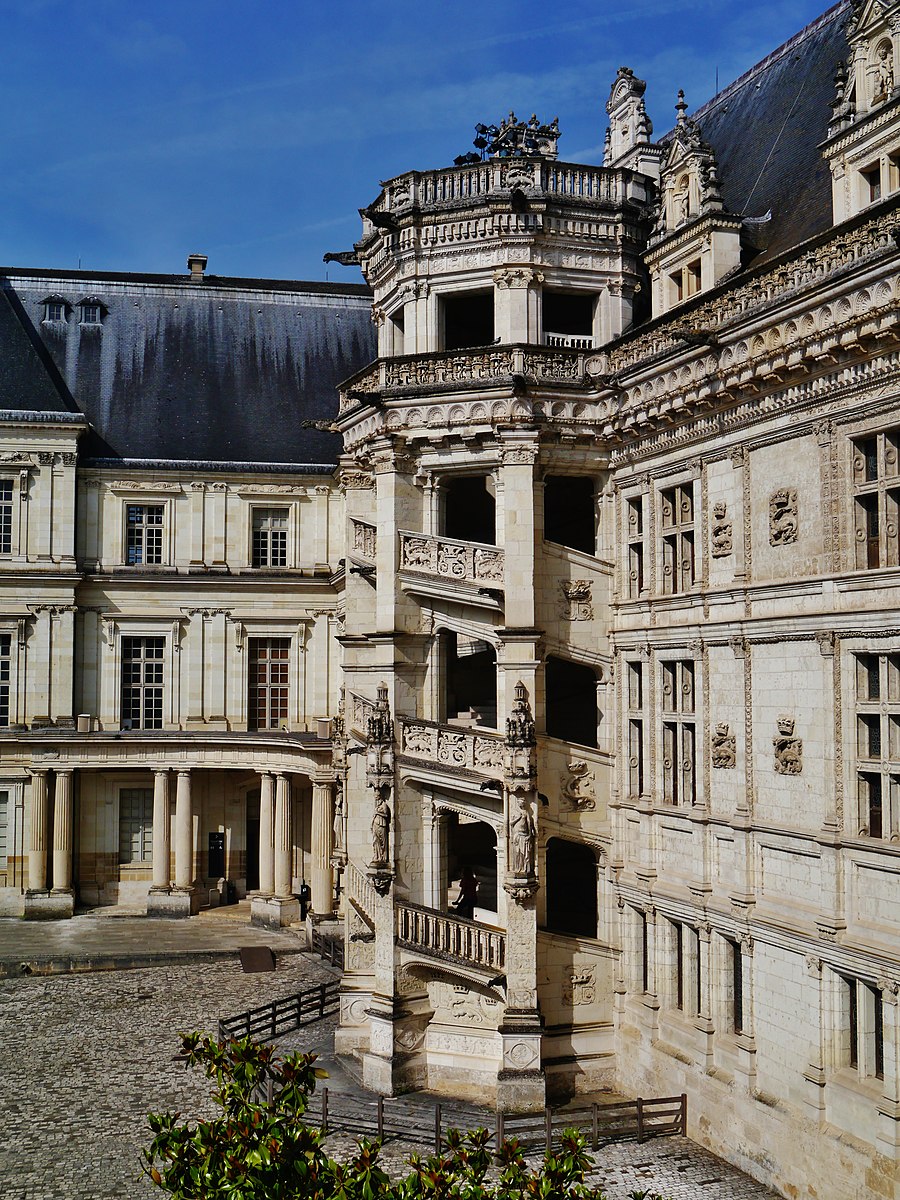
Château de BLOIS
In 1515, François I and his wife Claude ascended to the throne. At Claude's urging, François began to refurbish the château de Blois, which had been used by French kings since the 13th century. He built a new wing with a spiral staircase at its center and consolidated his prodigious collection of books in the library. However, after Claude, mother of his seven children, died at the age of 24, François neglected Blois in favor of other palaces. He moved his library to Fontainebleau and seldom returned to Blois. Perhaps memories of his years there with Claude, of whom he had been fond, made François uncomfortable? Later in the century, Henri III resided at Blois with his mother, Catherine de Medici, during the chaos of the Wars of Religion. In December 1588, Henri summoned to Blois the Duc de Guise, a powerful and charismatic Catholic leader who nurtured ambitions for the throne. Once arrived, the Duc was assassinated by the king's body guard as the king looked on. How is that for an inciting incident, or a novel's climax?
Château d'AMBOISE
François I was raised at Amboise, the first French château to be "Italianized." Renovations had begun in the late 1490's under Charles VIII; François, crowned king in 1515, further embellished the buildings. At his invitation, Leonardo Da Vinci took up residence in nearby Clos Lucé from 1516-1519 and contributed to the transformation of Amboise. It was on the door of François's chamber at Amboise that Antoine Marcaut posted a list of the abuses of the "Papal Mass" during the Affair of the Placards in October 1534, outraging the king and disrupting his process of moderate ecclesiastic reform. In 1560, a Huguenot plot dubbed "The Amboise Conspiracy" attempted to kidnap the young king, François II, to remove him from the influence of the powerful Catholic uncles of his wife, Mary Queen of Scots. When the plot failed, the conspirators were arrested and hung from the château's balconies as an example. Lots of material for historical novels in the annals of this château!
Chambord is truly a Renaissance château--it was built from scratch on order of François I, beginning in 1519. Chambord, with its 440 rooms, 282 fireplaces, and 84 staircases, was never intended to serve as a primary residence, but as a symbol of François's power and aesthetic achievements. The king only slept there a total fifty days, but used Chambord to entertain his favorites and dazzle his rivals. Leonardo da Vinci was intimately involved in its design and construction; his artistry produced the château's famous double helix staircase, the center-plan design of its keep, and its double-pit evacuation system. The only historical event of note that occurred at Chambord during the sixteenth century was the visit of Charles V of Spain in December 1539, a stop on his elaborate state visit to France. I've always thought Chambord would be an excellent setting for some sort of time-slip or historical mystery novel.
The Château de Chenonceaux, with its arched gallery that stretches across the Cher river (see the third photo above), is one of the most readily recognized châteaux in France. It was also the location of intense passions--love, envy, and revenge. Between 1515-1521, nobleman Thomas Bohier razed the medieval fortress on the site and built a graceful new residence, where he entertained the king on several occasions. In 1535, François I seized the property in payment for outstanding debts. After he died, his son Henri II gifted the palace to his mistress, Diane de Poitiers, who built an arched bridge to the far bank and added extensive gardens. Henri's wife, Catherine de Médici, long envied the property; as soon as Henri died in 1559, she forced Diane to exchange Chenonceaux for the Château de Chaumont.
Chenonceaux became Catherine's favorite residence, the one from which she administered the kingdom as Regent during her young son's reign. She built the enclosed gallery atop the bridge in 1577 and hosted elaborate parties and spectacles at the property. When Catherine died in 1589, she left the château to her daughter-in-law, wife of Henri III, who lived there in mourning for eleven years after Henri was assassinated months after his mother's death. From the love trysts of Henri II and Diane, to the showdown between Diane and the widowed Catherine, to Catherine's machinations behind the throne, to the haunted widowhood of Louise de Lorraine, the stones of Chenonceaux have witnessed their fair share of riveting intrigue.

Finally, we come to the Château de Fontainebleau, my personal favorite. Fontainebleau played a central role in history during the sixteenth century and beyond. François always considered Fontainebleau his true home. It was this château that he transformed into the showplace of the French Renaissance, building and embellishing the structure with the help of Italian artists he invited to live and work there. François housed his art collection at Fontainebleau, along with the massive library (the
backbone of the Bibliothèque Nationale) he transferred from Blois. Fontainebleau seethed with competition, as artists vied for commissions, courtiers for preference, and lovers for favor. François hosted his longtime enemy Charles V of Spain at Fontainebleau in December 1539 in an attempt to shore up their tottering truce. Against a lavish backdrop of banquets and balls, pageants and hunts, the two monarchs grappled for ascendancy. The perfect setting for a historical novel, one that pits François's beloved ideal of honor against the grittier realities of gaining, and keeping, power.
Add to these amazing châteaux teeming cities like Paris and Lyon and one can claim without doubt that the sixteenth century offers an exciting array of settings for gripping historical fiction.
**********




 Posts
Posts


,_vu_du_ciel.JPG)


.jpg)