Showing posts with label author interview. Show all posts

Tuesday, February 23, 2021

Q & A with Patricia Bracewell, Author of THE STEEL BENEATH THE SILK

The final volume of Patricia Bracewell's trilogy on Emma of Normandy, Queen of England, publishes on March 2, 2021 from Bellastoria Press. Yesterday, I reviewed this marvelous book; today, Patricia answers a few questions about her novel.

1. Why Emma? How is the saga of an 11th century queen of Anglo-Saxon England relevant to today’s readers? What aspects of her actions and personality do you think speak most strongly to modern women?

I think that women of today will find Emma inspirational. In our time women are breaking glass ceilings; in Emma’s time that ceiling was made of marble. The Anglo-Saxons were wary of the very concept of queenship, and Emma was only the second queen of all England. She was burdened by her youth and by the fact that she was a foreigner. She had to learn about England’s history, language and cultural norms, probably as an adolescent, and then figure out how to use them to her advantage. That took courage, but Emma has another kind of courage, as well. She is willing to speak truth to power, and although she is rarely thanked for it, that doesn’t stop her. So I think that courage and tenacity are two qualities that speak to women today, as well as Emma’s willingness to recognize the limits of her power and reach out to those who can help her get whatever she is after.

2. While writing, did you ever fear that Emma might teeter on the brink of "the perfect queen" stereotype? How did you try to humanize her? What faults define her and how does she suffer for them? 

I am not a fan of novels in which the heroine is adored by everybody else in the book. So I’ve given Emma plenty of enemies who despise her, or don’t trust her, or who misinterpret her actions. Æthelred, Edmund, Edyth, Elgiva, even Emma’s own son are definitely not fans of the queen. Their opinions of her, right or wrong, throw some shade on her character. Emma herself, as clever as she is, does not have all the answers to the problems that she faces. She has to turn to others for help. Sometimes she makes bad decisions. On one occasion she acquires important information but doesn’t do anything with it, and that leads to catastrophe. On another occasion she makes a decision that leads to anguish when she realizes that she’s put her children at risk. Emma is courageous, yes, but that means, too, that she’s a risk-taker. She weighs the risks and makes a choice, but sometimes it turns out to be the wrong choice and she is not the only one who pays the price. 

3. Æthelred,  Athelstan, Cnut, Elgiva, Thorkell, Edmund, Edward, Edyth, Richard of Normandy—Emma has personal and political relationships with so many characters over the course of the trilogy, and these relationships all had to be tied up in this final volume. Which relationship was the hardest to get “right”? Is there any relationship you wished you could have spent more time wrapping up? Which relationship did you most enjoy exploring?

The relationship between Emma and Cnut was the most difficult to get “right” especially because I wanted anyone who had not read the earlier books to be able to understand it; and that is the relationship I most enjoyed exploring. They had a few scenes together in Shadow on the Crown when we saw Cnut through Emma’s eyes, and of course as I wrote that first book I was already thinking about what would happen in this one. But when I began writing The Steel Beneath the Silk I had to figure out a way for each of them to recall that first meeting which had happened ten years earlier. When I finally brought them together again towards the end of the book, I had to design some scenes that would allow them to interact and would reveal in a very short time how their relationship was evolving on both sides. It meant a lot of revisions. I think I was successful. I hope so. I wish I could have found a way to wrap up the relationship between Emma and Thorkell—have some sort of dialogue between them. But I had to focus on Emma and Cnut. Thorkell would have gotten in the way!

Winchester's Norman Great Hall, which is evocative of Anglo-Saxon great halls


4. How did you manage to keep the setting fresh over the course of three novels? Which location in the book did you most enjoy visiting in real life during your extensive research?
 

The first novel opens in Normandy, but almost all of it is set in Wessex, mostly Winchester, with side trips to Exeter and to the Rollright Stones in Oxfordshire. The second novel is split between various royal estates in southern England and manors located in the northeast. All of these estates and manors were based on places I found mentioned in the Domesday Book, but I actually visited those areas if not the sites themselves. This third book goes much further afield, to Jorvik (York), Denmark, and Normandy as well as to numerous sites all over England. Of course, the scenes themselves are set in the great hall, or a church, or a bed-chamber or an abbey. There are several that are set on ships and one in the tower of one of the gates of London. I tried very hard to vary the setting as much as possible. I suppose the place I enjoyed visiting the most was Winchester. It was the Anglo-Saxon royal city; it was where Emma had a manor named Godbegot, the site of which you can still see today; and it is where Emma and Cnut are buried. It was, for me, the most evocative of that Anglo-Saxon world, and I’m longing to go back.


Godbegot House in Winchester, which dates back to the 11th c

5. Emma has occupied your thoughts and hours for so many years now—how will your own life change now that you have completed your task and made her known to new readers? What did you learn about yourself as you researched and imagined her life and captured it in the pages of three books?

Well, I expect that I will have more time to pursue other activities like gardening and, unfortunately, dealing with piles of books and papers that need sorting, closets and drawers that need cleaning out, and a garage that resembles an industrial waste site. But I already have a list of books that I want to read or study, and I might find myself pondering ideas for a new novel—although not a trilogy! What I’ve learned about myself is that I love research; that I’m not interested in travel unless there is an element of education involved; and that I have more determination than I ever realized. Also, now, when I run up against some difficulty or hardship, I tend to ask myself “What would Emma do?”

**********

Many thanks to Patricia for offering this behind-the scenes look at her novel.

THE STEEL BENEATH THE SILK can be purchased from AmazonBarnes and Noble, and Indiebound.

**********

Patricia Bracewell's love of reading led to college degrees in Literature, a career as a high school English teacher, and an  unquenchable desire to write. Shadow on the Crown, the first book in her trilogy about the 11th century queen Emma of Normandy, was published in 2013 in the U.S. and England, and has been translated into Italian, German, Portuguese and Russian. Her second novel, The Price of Blood, published in 2015, continues the gripping tale of a queen whose marriage to an English king set in motion a series of events that would culminate in the Norman Conquest of 1066. In 2014 Patricia was honored to serve as Writer-in-Residence at Gladstone's Library in Wales where she conducted research for The Steel Beneath the Silk, the third book in her trilogy about Queen Emma. Patricia and her husband live in Oakland, California. Visit her at her website.


Tuesday, May 26, 2020

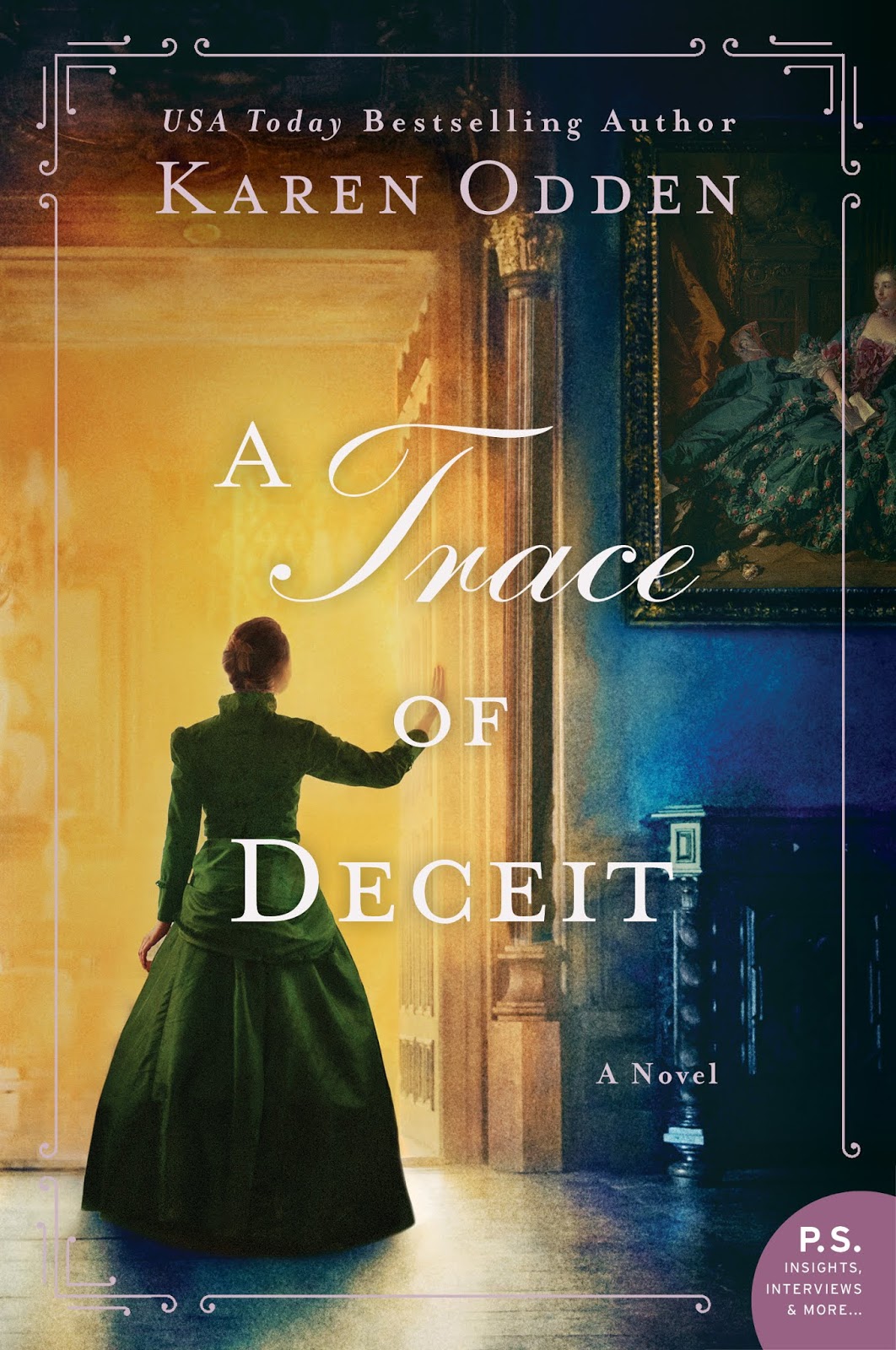
Interview with Karen Odden, author of A TRACE OF DECEIT

When I visited my intrepid agent Josh Getzler at HGLiterary last June, he offered me, as a parting gift, a selection of novels that he had represented. The blue cover of A DANGEROUS DUET (William Morrow, 2018), a Victorian mystery written by Karen Odden, immediately caught my eye. I so enjoyed reading it that when I recently saw Karen promoting her latest release, A TRACE OF DECEIT (William Morrow, 2019), I reached out to her on social media. Turns out we have a lot in common (besides our industrious and generous agent!). Like me, Karen has a doctorate in literature and writes novels set in the era of her academic specialty. Unlike me, she has been published three times over and has another book in the pipeline. She graciously agreed to answer some questions about her background, her novels, and her writing career. Sample her expertise and engaging voice in the interview below, and you'll be eager to read her exceptional mysteries for yourself. I know I can't wait to get my hands on A TRACE OF DECEIT!


1. Your three books all take place in London during the Victorian era (1870s). How did you become interested in this time period? Why does it fascinate you so? 

Years ago, I wrote my PhD dissertation at NYU on Victorian railway disasters. It probably seems odd to most of us, but people were obsessed with them—sort of the way we’re riveted by computer hacking or terrorism. Accounts of train wrecks appeared in novels, medical literature, newspaper accounts, parliamentary papers, legal trial reports, and so on. In order to understand their power in the public imagination, I studied Victorian literature and history, especially London during Queen Victoria’s era, 1837-1901.

But as I researched, the 1870s became my favorite decade because so much changed so rapidly in the social, economic, and political spheres. It was like someone set loose a rollercoaster car! Some of this is because literacy rates were rising, so people wrote, read, and talked about social issues more. But many of the debates of the 1850s and 1860s led to a swath of new laws in the 1870s. For example, traditionally under British law, a married woman was “covered” by her husband. This meant she could not vote, hold her own money, initiate a contract or divorce, or inherit property. In 1870, as a result of the Married Woman’s Property Act, for the first time, a woman could earn and keep her wages (shocking, I know!) and she could inherit property up to £200. It was one small but significant reversal of a huge social inequality. The Elementary Education Act of 1870 finally made education mandatory for all children ages 6-12. A series of safety and labor laws were passed to protect works in the mills and factories. Furthermore, new institutions such as the Slade School of Art (founded 1871) were opening to women. And the Franco-Prussian War (1871) tipped the balance of power in continental Europe from France to newly-united Germany—with results that we’d continue to see well into the twentieth century. Yet all this change occurred during a decade that was smack in the middle of the longest stable reign in British history. I find that so interesting.

2. What sparks a new book for you first—a character, a situation, or a setting? How do you work to construct a mystery plot? 

At the heart of each of my novels is a story I read or heard that clutched at me and refused to let go. As I researched railways, I found descriptions of people climbing out of burning carriages, horses trapped and screaming in stock cars, railway surgeons faced with hundreds of patients lying in the surrounding fields. So a railway disaster became the propelling event in A Lady in the Smoke. Similarly, when I was researching for A Dangerous Duet, I discovered the brilliant pianist Fanny Dickens (Charles’s older sister) was forced to leave the Royal Academy because she could no longer afford tuition. There were no opportunities for Fanny to make the money—and even if she earned it, she could have been forced to hand it over to her father to pay the family’s debts. It felt horribly unfair to me. A Trace of Deceit was shaped by painful stories of addiction, told to me by friends. And my next book is about the brutality of the African slave and ivory trades in the 1870s. In 2013, I read a book that included accounts of how Belgian agents would seize African women and children and put them in cages with no food or water, freeing them only when their husbands or fathers brought back the requisite 70 pounds of rubber. Now, seven years later, I’ll put this story to use.

3. Do you travel for your research? What has been your most thrilling discovery?

I had been to London a few times, even before I started writing books set there. My most thrilling discovery was Wilton’s Music Hall in Whitechapel—not far from where the Ripper murders took place. It is (so far as I know) the only standing Victorian Music Hall in London, and it’s an amazing space. If you’ve seen Sherlock Holmes: A Game of Shadows with Robert Downey, Jr., you’ve seen Wilton’s. As Sherlock, Downey is chased all over the theater by a Cossack.

Photo credit: http://www.wiltons.org.uk
Wilton’s was created in the mid-1800s by John Wilton, who joined together three houses in Graces Alley to make the music hall. As I walked through the doors, I could smell the hops, and I tripped over a nail in the wooden floorboards. I went downstairs and prowled around the basement with its uneven floors and plaster coming off the bricks. Then I came up and looked at the music hall itself—the U-shaped room, painted blue, with gilt and turned pillars. Instantly, I could see Nell in her piano alcove, and the setting for my story began to feel solid.

Photo credit: Karen Odden

Photo credit: Karen Odden
That trip, I also went to the Royal Academy of Music, where I found the 1820s class roster with Fanny Dickens’s name and a plaque with information about her. The music hall industry arose too late for Fanny, but by the 1850s there were dozens of halls in London willing to pay for talent—though men made twice what women did. And so was born the story of the pianist Nell Hallam, who needs to earn money for her tuition at the Academy and dresses as a man to take a position in a Soho music hall.


4. Inspector Matthew Hallam, the brother of the protagonist in your previous book A DANGEROUS DUET, reappears as a main character in A TRACE OF DECEIT. Are you building a series featuring Matthew? Does Nell, the protagonist of DUET, figure in TRACE?

Nell appears incidentally in A Trace of Deceit, but I don’t want to do a “series” in the usual way. I do have a few secondary overlapping characters—particularly Tom Flynn, my shrewd, straight-talking writer for the (fictional) London newspaper, the Falcon. He is based on my high school English teacher, who was the first person who told me I could write.

Frankly, I don’t trust myself to keep a protagonist interesting (or to stay interested in her!) to the same degree, after her first book, when the “big” issue from her past is resolved. Besides, I’m a research junkie. I’ve explored railways, music halls, the London art and auction world, and now the African ivory trade … and assuming there’s a fifth book, I want to move on to another aspect of Victorian London.


5. What do you love most about your new heroine, Annabel Rowe? How does she frustrate you? 

I love Annabel because she cares. She cares about her brother Edwin’s well-being. She cares about honoring his memory by finding out who he was before he died. She cares about telling the truth in her paintings—representing people as they really are, rather than some idealized version.

I wouldn’t say she frustrated me, necessarily … maybe she should have! But from the outset, I knew how she had to change. As a child, Annabel grew up the fourth person in a house with a very intense triangle: her father was fiercely ambitious for Edwin, who resented his father’s demands, and her mother ran interference. Annabel was always the observer because as a child, it was safer. Even as an adult, her habit of observing kept her out of the fray, and it worked (up to a point) for becoming a painter. But over the course of the novel, she has to learn how being solely an onlooker limits her. She needs to find a way to deepen her engagement with the world, or she will never become the painter she could be … and she won’t solve Edwin’s murder.

6. What authors inspired you to become a mystery writer? How does their work influence yours? 

As a child, my family spent every Sunday out at my grandparents’ house where my parents played bridge and I was left to scavenge in my grandmother’s library. There I found all kinds of books—bodice rippers, mysteries, suspense! I was probably around eleven when I found Mary Stewart, Victoria Holt, and Daphne DuMaurier, and I’d say they were my first “adult” mysteries. (I had already torn through Nancy Drew, etc.) I loved the way these three women authors created vivid settings, fashioned young women characters who weren’t superheroes but seemed to have something in common with me, and had plots that wove together past tragedies and present events. I also loved how a single murder and a personal desire for truth could spin suspense for an entire book. A plot didn’t need to have fast cars and exploding buildings and bloodbaths to be a page-turner. The suspense for me came through the small scenes, the interactions among characters. Over the years, I realize I’m drawn to books that have some of these qualities—Tana French’s books and Stef Penney’s The Tenderness of Wolves are books I reread every year or two. As far as being influenced, I like to think my books place the reader in Victorian London, where they will hear “Oranges and Lemons” from the church bells and smell the tallow from the chandler’s shop. And my protagonists, young women amateur sleuths, all have to learn something from their past in order to move forward in their present, and to solve the mystery in front of them.

7. You have now published three mystery novels. What have you learned over the course of these three books? Do you have any advice for aspiring writers? 

Oh gosh. I could write a book just on what I’ve learned! But I’ll pick two things that stand out. First, it’s great to start with a clear plot idea (a railway crash, say). But I’ve come to realize the importance of spending hours and hours on backstories for my characters—even the minor ones. Then, after I write the first draft, I go back to my backstories and revise them, which in turn deepens my manuscript. I have separate pages for each character, and I write their histories from their point-of-view, although that information doesn’t all make it into the novel. The codicil to “backstories are vital” is that although backstories need to be in my head, they don’t need to be in my book.

Second, after writing, I trim. By my third or fourth draft, the manuscript is about 120,000 words—and then, when I feel my manuscript is “done” as far as plot and character, and all the details fit, and I love it exactly the way it is, I slash 20,000 words out. It inevitably makes a leaner, cleaner manuscript—and reducing redundancy, or even omitting a few lines here and there leaves room for the reader to fill in. Readers feel more engaged when they have to do some of the work … and I’ve learned to trust my readers. They’re smart.


8. What has been the most exciting moment of your writing career so far? Have you ever been ready to throw in the towel? What made you persevere? 

Eight years ago, before I found my agent, I nearly gave up. I’d been working on the manuscript for A Lady in the Smoke, and some YA manuscripts, for years. I just couldn’t find an agent to take more than a passing interest, and though I’d taken classes and read books on writing, I didn’t know what was wrong with them. I remember talking to my friend Jody Hallam (for whom Matthew Hallam is named) about how incredibly discouraged I was, and how I could write for another ten years and still get nowhere. The uncertainty was terrible. She urged me to find a free-lance editor before I gave up. Another friend, also a writer, recommended someone who helped me get the manuscript in shape for submission—and I sent it out to ten agents I found on Publisher’s Marketplace. I heard back from eight, and two eventually offered representation.

Like Annabel (and all my heroines) I had something to learn: I need feedback at various stages. My advice is to find a strong critique group, or a mentor who will work one-on-one, if that suits you. Join organizations such as Sisters in Crime and Mystery Writers of America, who have resources to help you. And of course, keep writing.

The thing is, even if I had never found an agent or a publisher, I’d write anyway. I have dozens of notebooks and piles of manuscript pages and drafts of articles and essays that will probably never see the light of day. A friend asked me once, “Don’t you ever want to take a day off from writing?” I replied that it’s sort of like brushing my teeth; I could skip a day, but it doesn’t feel good. Honestly, I love writing more than I hate failing at it. And my reading and writing has brought me to a community with so many lovely, smart, talented readers, librarians, bloggers, booksellers, and writers that even if I never publish another book, I’ve won.

**********

Karen Odden served as an Associate Lecturer at the University of Wisconsin-Milwaukee and taught classes in English language and literature at New York University and the University of Michigan-Ann Arbor. She has contributed essays and chapters to books and journals, including Studies in the Novel, Journal of Victorian Culture, and Victorian Crime, Madness, and Sensation; for ten years, she served as an Assistant Editor for the academic journal, Victorian Literature and Culture (Cambridge UP); and she has written introductions for Barnes and Noble's Classics Series editions of books by Dickens and Trollope. Prior to receiving her Ph.D. in English, she worked as an Editorial Assistant at Harcourt Brace Jovanovich and McGraw-Hill, as a Media Buyer for Christie's Auction House in New York, and as a bartender at the airport in Rochester, where she learned how to stop being shy. She is a member of SCBWI and Mystery Writers of America. Her first book, A Lady in the Smoke, was a USA Today Bestseller and won the 2017 New Mexico-Arizona award for eBook Fiction. Her second book, from William Morrow/Harper Collins, is A Dangerous Duet, which won the New Mexico-Arizona book award for Historical Fiction in 2019; and her third Victorian mystery, A Trace of Deceit, was published in December 2019. 

Karen currently resides in Scottsdale, Arizona with her husband, her two children, and her ridiculously cute beagle, Rosy.

Learn more about Karen and her books by visiting her website.


Wednesday, August 17, 2016

Interview with Susan Spann, Author of THE NINJA'S DAUGHTER


Today I welcome my friend Susan Spann, author of the popular Shinobi Mystery series set in sixteenth century Japan. Susan has just published the fourth novel in the series. In THE NINJA'S DAUGHTER (which I reviewed yesterday), master ninja Hiro Hattori and Portuguese Jesuit Father Mateo investigate the murder of an actor's daughter from the Kyoto theater district--an investigation that soon reveals a mysterious golden coin, a forbidden love affair, a missing mask, and a dangerous link to corruption that leaves both Hiro and Father Mateo running for their lives. I hope the following interview with Susan will have you running to your nearest bookstore for a copy of THE NINJA'S DAUGHTER as soon as you reach the end!

THE NINJA’S DAUGHTER is set in the theater district of sixteenth-century Kyoto, with actors as primary characters. What about this milieu particularly appealed to you as a rich setting for a historical mystery?

Medieval Japanese culture was multifaceted, with each social or mercantile group coexisting but also living distinctly separately from the others. I love exploring a different aspect of the culture in every book, and the theater world had such fascinating customs that I wanted to bring it to life. For example, the custom that only men could act on the stage made women far less prominent in the acting guilds than they often were among merchant families. The idea that an actor’s daughter might not accept her societal role—and what might happen to her as a result—intrigued me, and that in turn gave birth to THE NINJA'S DAUGHTER.


What is your favorite scene from THE NINJA’S DAUGHTER and why? Which scene was the most difficult to write?

My favorite scene is one that actually didn’t appear in the original manuscript. My fabulous agent, Sandra Bond, read the completed story before we sent it on to my editor, Dan Mayer, at Seventh Street Books. When she finished reading, she sent me an email that basically said, “it’s great . . . but it needs another death.” Without giving away too much (or any spoilers) I added a scene in which Hiro and Father Mateo have to deal with an unexpected (and unwanted) body.

All of the scenes involving the victim’s family were difficult to write, because of their high emotional charge. The victim was a teenaged girl, and portraying that loss realistically was difficult, both in the writing and on an emotional level.

Last year you were able to travel to Japan for research. How have your descriptions benefitted from your sensory experience of Japan? Did cultural or historical discoveries influence the trajectory of your plot?

I adore Japan, and spending time there definitely impacts my novels. The biggest benefit is walking in the footsteps of my characters—seeing the temples and shrines that form the settings of many scenes in the novel helps me set the scenery in a more realistic and accurate way. For example, visiting Fushimi Inari shrine helped me recreate the nō play that takes place near the base of Mt. Inari in THE NINJA'S DAUGHTER.

I spent a lot of time researching nō theater and the performers’ customs, particularly the treatment of the special, often sacred masks the performers wore on stage. Although most of that research did not make it onto the page, my fascination with masks did inspire and influence one of the story’s major subplots.


Since I’ve never written a mystery, I’d love to hear how you construct one. Do you begin from a forward-looking “what if” sort of question or work backwards from a desired end result? Do you layer in different characters’ reactions and alibis in subsequent drafts or do you have most things worked out before you begin? As you write, how do you judge whether misdirection and red herrings are working?

Since I write series mystery, I already have my detectives and their basic world in mind before I start each book. Because of that, I normally start with the setting and work from there. THE NINJA'S DAUGHTER is unusual, because it was originally supposed to be set among the outcaste classes—butchers and tanners—but I switched it to a theater book about halfway through the initial draft when I realized my original setting wouldn’t work for the plot I had in mind. (Fortunately, I already knew I wanted to write a theater book, so it was more a matter of overlaying the theater on the existing skeleton than a total rewrite.)

With most of my mysteries, including next year’s BETRAYAL AT IGA, I start with a setting—for that book, the mountain village that’s home to my detective’s Iga ninja clan—and then decide what kind of death would likely occur in that particular time and place. Since the Iga ninjas were assassins, and Hiro and Father Mateo are traveling there to keep the peace during tense negotiations with the rival Koga clan, the most alarming death I could imagine was the murder of the Koga ambassador, by poison, under conditions that made it look as if the Iga clan was responsible for his death. The rest of the plot, the suspects, and the story grew from there.

I write an 8-10 page outline before I start drafting, and most of the alibis, red herrings, and major clues get figured out at the outline stage. Once I start writing, however, the outline always changes. New characters show up unexpectedly, existing characters act in ways I hadn’t anticipated, and I often discover subplots and additional clues as I go along.

Hiro and Father Mateo have worked together now through four novels. How has their relationship changed since the first book? What obstacle/character flaw/cultural restriction poses the greatest threat to their friendship? Do you foresee a time when their mutual trust might become sorely tested?

Hiro and Father Mateo’s relationship has definitely deepened, and their friendship strengthened substantially, since CLAWS OF THE CAT. They’ve begun to trust one another more, which allows me to share more about them with readers (through their communications). Their different perspectives—Hiro’s pragmatism and Father Mateo’s faith—continue to be stumbling blocks on occasion, but their growing mutual respect allows them to get along despite their differences.

Their mutual trust will absolutely be tested in future books, starting with the next installment, BETRAYAL OF IGA.

Of the numerous secondary characters who populate your novels, which intrigues you the most? Has any character turned out very different from what you first envisioned?

I love writing secondary characters, because they can be so unique and so different—and because I don’t necessarily have to bring them back in every book. Many of them do surprise me, mainly by becoming more important to the story than I originally anticipated. In THE NINJA'S DAUGHTER, my favorite secondary character is the victim’s younger brother, Haru. The scene in which he saves a giant Japanese beetle runs a close second for my favorite scene in the book.

THE NINJA’S DAUGHTER is your fourth published novel. How have you progressed as a writer since penning the first, CLAWS OF THE CAT? How do you challenge yourself to improve and grow, especially within the confines of a series?

I try to improve my craft with every book I write (and hopefully, I succeed!). My dialogue skills have definitely improved since CLAWS OF THE CAT, and I think my characters have more depth now, too. I’ve learned to tap into deeper emotions, which was important for THE NINJA'S DAUGHTER.

From a series perspective, I don’t let myself get away with repeating tricks. Each novel has to involve a different kind of murder, in a different setting, and my ninja detective, Hiro, has to use a different kind of ninja skill or tool in every book. In the future installments, I’ll also be putting my medieval Japanese spin on a few classic mystery tropes, like the “locked room murder”—but presented in a fresh, new way.


What advice do you have for aspiring writers, especially in today’s difficult market?

To quote the movie GALAXY QUEST: “Never give up—Never surrender.” Publishing is difficult, and the journey to publication can be long, hard, and apparently never-ending. It took me ten years and five full manuscripts to find my agent and secure my first publishing deal. Many times, I wondered if the effort was worth it or if I should just give up. The problem is, you never know if the last rejection really was the last one, and the next response you receive might be the “yes” that you’ve been waiting for.

My advice is keep writing, keep believing, and keep pushing forward. As soon as you finish one book, start the next one. Each manuscript you write will make you stronger, and bring you that much closer to fulfillment of your dream.

**********
You can learn more about Susan Spann and her books at her website.


Wednesday, December 9, 2015

Interview: Sophie Perinot, author of MÉDICIS DAUGHTER

Today I welcome Sophie Perinot, whose novel MÉDICIS DAUGHTER has just been published by St. Martin's Press. The novel (which I reviewed yesterday) recounts the story of Marguerite, the Valois princess who comes of age during the turmoil of the French Wars of Religion. Here, Sophie sheds some light on the writing of the book and the history it portrays.


1. What inspired you to write about Marguerite de Valois and how does your portrayal of her flow from or differ from previous fictional portrayals, be they literary (Alexandre Dumas), film (Patrice Chéreau), or television (Reign)? How difficult was it to work in the shadow of these other depictions?

My desire to explore the Valois court and Marguerite specifically actually originates with Dumas. I am a devotee of this grandfather of historical fiction. I can still remember the first time I read his work and how his ability to write fast-paced compelling stories of adventure and romance captivated me. When I read MARGUERITE DE VALOIS (more popularly known as LA REINE MARGOT) the novel made a special connection. The more times that I re-read it, the more convinced I became that Marguerite deserved a fuller depiction and a more historically based (Dumas was quite open about playing fast and loose with history) exploration. MÉDICIS DAUGHTER is the direct result of that conviction.

Although my desire to tell Margot’s story flows from Dumas, I never felt burdened by him or by any other portrayal of the Valois Court. I never felt in anyone’s shadow. My fiction reflects two primary things: my research and my personal sense of theme and story. So I don’t think of my depiction of the Valois court as competing with Chéreau’s, Dumas’ or anyone else’s. That is one of the wonderful things about historical dramas (whether in books, on TV or in film), they allow each creator to filter and to form—to not just recount history, but to shape narrative in a manner that is meaningful to them personally, as well as to audiences.

I’d like to think my results can stand up to the creations of others though. I recently got a review that thrilled me to the bone when it said: “Dumas's LA REINE MARGOT may have been the first novel to immortalize this indomitable French Queen, but the version of the queen in MÉDICIS DAUGHTER is the most realistic and believable I've yet come across."


2. The relationship between Marguerite and her mother Catherine de Médicis sits at the center of the book--why? What, specifically, about their relationship intrigued you the most?

I chose to focus on the Margot-Catherine relationship because the mother-daughter bond is such a seminal one in the lives of most women. I mean, doesn’t every daughter desire both to please her mother and find a separate existence from that powerful influencer? Margot is certainly no exception. Early on I wrote the following on my desk blotter: “The mother-daughter relationship is always perilous. Now imagine your mother was Catherine de Médicis.” That’s a pretty scary thought—and a very creatively inspiring one!

The most intriguing thing about this particular relationship is that of all Catherine’s children, Margot may have the most like her. Margot was certainly the strongest. Yet despite Margot’s intellect, her strong health and the gift of premonition that she shared with her mother, Catherine never really seemed to like this youngest daughter much. In fact it is reported that Catherine once told Margot she was “born in an evil day."

I came to believe that if Catherine had invested the type of time and energy in Margot that she did in Anjou, the Queen would have been richly rewarded. Even without her mother’s attentions Margot turned out to be a pretty savvy political operator.

3. The Valois, as a waning royal house, was slandered by its political adversaries and suffered a certain degree of prejudice in historical accounts of the time. What measures do you take in your novel to temper this bias? Was it difficult to judge the truthfulness of your historical sources? 

I don’t think this problem is limited to situations where there is an overt bias. In fact knowing there was one—that the Valois had many enemies who created contemporary sources with a particular agenda—was helpful because at least then I, as researcher, knew exactly what I was dealing with. Everyone, whether propagandist, memoirist or historian, comes at the “facts” and the “truths” of history with baggage. For many generations objectivity wasn’t even the goal of “H”istorians. Sometimes patronage drove perspective. For example, Catherine de Médicis had favorite chroniclers of the Court (like Brantôme), and you can bet Catherine wasn’t looking for an unbiased account. Sometimes the perspective of a historian is less overtly driven. It may come from their life experiences, opinions or, and this is still true today, from the desire to make a point or intellectual argument that will put him/her into the spotlight in their his/her discipline. So no matter what source we are reading—primary or secondary—it behooves us to be aware of possible filters.

Fortunately as writers of historical fiction (as opposed to academic historians) we are allowed to filter things as well—through our narrative structure, the points-of-view of our characters, etc. Ultimately story drives historical fiction. And author’s notes exist so we can own the decisions and judgments we make in weaving those stories.


4. What insights did you glean into Marguerite or her family from her memoir, published in 1628? Did the existence of this memoir help or hinder you? 

I find memoirs fascinating. I mean knowing how someone choses to curate their own life is as interesting as the life itself. That is particularly true when you are writing from a character’s point of view in the first person. I needed to be Margot, to see the world as Margot saw it. Her memoir was invaluable to me in this.

Margot was not attempting to provide a “just the facts” story of her history in the “letters” that comprise her memoir. By the time she sat down to write of her life, this last-of-the-Valois had very specific needs. She was being held at the Château d’Usson, and, after 1592, the annulment of her marriage to Henri of Navarre, now Henri IV King of France, was under negotiation. So what Margot included and excluded would have been purposeful. She clearly does not include everything she remembered. For example, she claims to have no recollection of much of the court’s Grand Progress in the 1560s—a claim that is hardly credible given that the trip lasted more than two years and involved the sort of sights and events that would surely have impacted an impressionable young woman. In addition, many of the key players from the early years of her life were dead. Margot had the opportunity to portray them without rebuttal. Yet in a number of cases she was quite charitable. For example, Margot called her brother Charles “the only stay and support of my life; a brother from whose hands I never received anything but good.” That is absolutely revisionist history. Trust me. So Margot’s decisions in constructing her memoir illuminated not only her actions and the actions of those around her but her thought process and political judgments. They gave me something that no secondary source could have.


5. Which scene was the most difficult to write? Which scene was the most fun to concoct?

My novel includes the infamous and bloody Saint Bartholomew’s Day Massacre. In many ways those scenes were the most difficult to craft. Not because of the violence—but because we are a society that has largely become insensible to violence. I ultimately decided that the best way to convey the horror and despair that the massacre must have inspired in someone of conscience witnessing it first hand was to keep my images small and personal. Margot is encountering slaughter in the halls of the palace she calls home. She is observing it at close range, involving individuals she recognizes—people she has dined with, perhaps even danced with—in the roles of both victims and perpetrators. I think sometimes in most overwhelming moments of our lives we become focused, even fixated, on very small details. We remember what was on the radio the day we took the call saying someone we cared for had been killed in an accident for example. So I worked hard to distill Margot’s experiences, especially the next day when she is forced to ride out into the streets while they are still choked with the bodies of the dead.

When it came to fun, nothing beat the scenes between Margot and her cousin Henri of Navarre. They are so wrong together, such opposites, that something very right comes of it. There is always repartee when they are together. And later there is camaraderie, a chemistry touched by exasperation, which I really enjoyed.


6. If you could write a novel about one of the other characters in the book, who would you choose and why?

The Valois court offers an embarrassment of riches—so many fascinating individuals and so many years of violence and conflict yet to come. I’d love to write more about the entire cast of characters. If I did a sequel to MÉDICIS DAUGHTER, the POV I’d most like to add would be Margot’s cousin/husband, Henri of Navarre. Henri’s philosophy and perspective is so very different than that of his wife that he would add a marvelous counterpoint. But why stop at two voices? A royal court is an ensemble cast waiting to take the stage, so if I approached the Valois again it would be a riot to do TV mini-series style treatment—multiple points of view, serpentine subplots.

********

Sophie Perinot is the author of THE SISTER QUEENS and one of six contributing authors of A DAY OF FIRE: A NOVEL OF POMPEII. A former attorney, Perinot is now a full-time writer. She lives in Great Falls, Virginia with her three children, three cats, one dog and one husband.

An active member of the Historical Novel Society, Sophie has attended all of the group's North American Conferences and served as a panelist multiple times. Find her among the literary Twitterati as @Lit_gal or on Facebook.