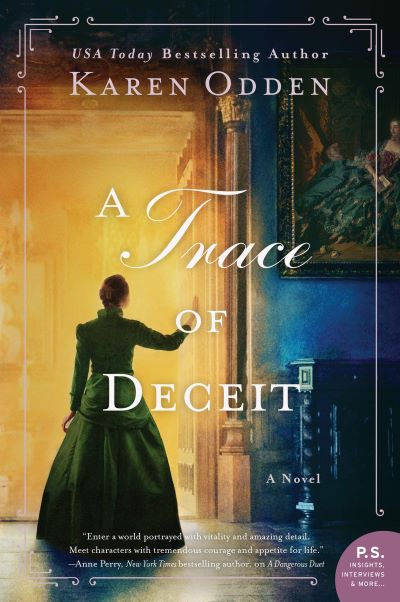
I asked Karen Odden, author of the Victorian mysteries A DANGEROUS DUET (2018) and A TRACE OF DECEIT (2019) about the differences between historical mystery and straight historical fiction. Here's what she had to say!

The “Mysnomer” in the Label “Historical Mystery”
by Karen Odden
Years ago, one of the earliest readers of my first book, A Lady in the Smoke, wrote me this email: “I loved your book! My only issue was the cover. It says A Victorian Mystery, and it wasn’t really a mystery. It was all about characters and railway history—and I loved the romance!”

I stared at that message for a long time, truly perplexed. Yes, the book shows Lady Elizabeth Fraser’s difficult relationship with her mother, her dead father’s adultery, her budding relationship with the railway surgeon Paul Wilcox … but the railway crash happened because of flagrant corruption committed years before, and there’s another crime of enormous fraud about to be committed! Elizabeth and Paul must work together to uncover it before it happens. How is this not a mystery?
This question has nagged at me ever since, even as I wrote my next two books, giving rise to other questions: Where is the crossover between historical fiction and historical mysteries? And why do people who love historical fiction shy away from books labelled historical mysteries?
One clue came to me last year when I was at a mystery-writers’ conference, where two famous thriller writers agreed that they didn’t spend much time developing their secondary characters. One said, “There’s really only five types, right? A friend/ally, the villain, a thorn (bothersome but not the villain), the expert (who tells the detective something important), and the red shirt (the dead person).” Another explained that he jots down a secondary character’s age, hair color, eye color, maybe whether he smokes or drinks, a few habits—and that’s enough to start with.
I found myself staring, disconcerted. This wasn’t how I worked. At all. I have stacks of backstory written for characters. I have a list, with every character, of physical traits, psychological aspects, bad habits, worst memories, who they love, what they want, and their deepest fears, along with pictures of objects in their homes and buildings they see on their daily walks.

Of course, thrillers are a particular sub-genre of mystery. They rely more heavily on plot than historicals or cozies tend to. And these writers are enormously successful, New York Times bestselling authors who have sold millions of books to avid fans. They’re crafting suspenseful, heart-pounding, fast-paced thriller mysteries.
But when it comes to historical mysteries, I’ve found readers have a different set of expectations.
Most readers of historicals (whether fiction or mysteries) frown when a book is poorly researched or contains anachronisms (like a Starbucks in 1970s New York). They roll their eyes at villains who have absolutely no redeeming traits and at overused tropes and conventional stereotypes, as in, “All Victorian women were prudes.” In general, readers are smart and savvy; they discuss works in book clubs; they read blogs and reviews; they want a book that entertains, provides an emotional journey, and even educates (without being a lecture). I know these readers—because I’m one of them!
So when Julianne asked me to write about where historical novels and historical mysteries intersect, I did what I often do: I started researching by combing through my bookshelves. Like most avid readers, I own a mishmash of fiction, mystery, memoir, classics, how-to, some poetry, books from grad school and college, and some old childhood favorites I can’t part with. (Anne of Green Gables is up there, as are A Wrinkle in Time and The Witch of Blackbird Pond.) I also have (on low shelves, easily reachable) my non-fiction reference books on Victorian England railway systems, clothing, crime, country house architecture, and so on.

I pulled down forty historical works to review, and this is what I found: the historical novels I truly love have some element of mystery, some dark secret from the past that must be discovered and resolved. And the historical mysteries that I love—many of which have received literary awards, including Canada’s coveted Costa Book of the Year and the Hammett prize for Best Novel of the Year—have complex, detailed world-building, fully developed characters, and fresh, descriptive language.
That led me to an insight. The label “mystery” is, in a way, a misnomer because it points to only one aspect of the book—the plot. This implies that the plot is paramount, as if detailed worldbuilding and complex characters and fresh, descriptive writing won’t be present, or at least not as present, as in a historical novel.
But in reducing a book to a single element—the plot—the label “mystery” is like a cheesy trailer for what might be a great movie. It might steer some readers away from a finely wrought book that has many of the elements they love in historical novels! (Perish the thought of missing out on a good read!)
What are these elements? I’d say there are three main ones, common to historical novels and mysteries, that make a book a favorite for me:
First, all good historicals—whether novels or mysteries—rely heavily on worldbuilding. This usually means an author does enormous amounts of research. I have a map of 1870 London on my wall

with a piece of string kept handy to map distances, so I can estimate, for example, how long it will take my main character to walk from one place to another. Solid worldbuilding means knowing how the streets are paved, who’s traveling on them at different times of day, and how they’re lit (if they’re lit). It means knowing the proper names for things: in 1870s London, a street vendor is called a “costermonger” and a sidewalk is called a “pavement.” I know what people ate in 1870s London, what sorts of books and objects were on tables in a woman’s parlor versus a man’s study, what the weather was like at different times of year, and what people wore, depending on their class.
An author of historicals also must know the specifics of historical events. For example, I set A Trace of Deceit very purposefully in 1875 because it needed to be after the Slade School of Art was founded in 1871, so my heroine Annabel could attend it, and also after the devastating Pantechnicon fire in Mayfair in 1874, so a priceless French oil painting that was supposed to have gone up in ashes can mysteriously reappear in Annabel’s brother’s studio. It’s important to get these small historical details and dates—easily fact-checked—correct.
But more than that, it’s important to recognize the political, social, legal, and economic aspects that will govern or influence a character’s behavior. For example, in 1860s London, under the legal doctrine of “coverture,” a married woman could not keep her wages, divorce a violent husband, or claim her children as her own. But as of 1870, when the Married Women’s Property Act was passed, she could at last own property. That could be an important plot point, couldn’t it? My point is, it is important to stay true to the times. Victorian women had very real constraints put on their autonomy and behavior, and no amount of “feistiness” in a heroine can overcome that.
Here are some of my other favorite historical mysteries for worldbuilding: David Liss’s A Conspiracy of Paper (an Edgar Award winner), set in eighteenth-century London, amidst coffee houses, drawing rooms, and bordellos. Another is The Gods of Gotham by Lyndsay Faye, set in 1845 New York, with its kerosene lamps, butcher paper, worn tombstones, New England rum, charcoal drawings, and bootprints (within the first two pages). Other favorites are A Rising Man by Abir Mukherjee, set in 1919 Calcutta; Anne Perry’s William Monk series, set in Victorian London; Baroness Orczy’s classic The Scarlet Pimpernel about the French Revolution; and Lou Berney’s November Road, set in 1963 New Orleans and beyond.

Second, both historical fiction and historical mysteries have narrative arcs that move both forward and backward. The critic Tzvetan Todorov wrote that a mystery novel “contains not one but two stories: the story of the crime and the story of the investigation.” That is, if there is a dead body on page 5, the remainder of the book is discovering how it got there in the first place (the “backstory”). But even in historical novels, there is almost always an ugly secret from the past, a sordid event, or something that led to the situation in chapter 1. If a book is to succeed, the characters have backstories—big, emotional backstories that have shaped their psychology and the way they look at the world. It’s inevitable there will be some skeletons back there.
For example, in Kate Quinn’s historical novel The Huntress, in post-WWII Boston, the former Russian night bomber and war criminal Nina Markova is masquerading as a soft-spoken German widow. The plot is propelled forward by Ian Graham, a Nazi hunter, and young would-be photographer Jordan McBride, whose questions about The Huntress take them straight back to the crimes of the war.

Third, they have life-like, psychologically complex characters. Precisely because we are asking readers to journey to another time and place, we have to have our characters deeply believable. They need to breath and live and love and hate before they get to the page, or they come off as mere vehicles for the plot. One of my favorite historicals for this is Stef Penney’s The Tenderness of Wolves. Set in 1867, in the Northern Territory, the main character Mrs. Ross stumbles upon a murder and sees the tracks leading from the dead man’s cabin north toward the tundra. Focalized through half a dozen characters, the story unfolds in a way that reflects the individuals’ old family hurts, systemic racism, long-standing fears and prejudices. I go back and reread this novel every few years for its a psychologically complex cast of characters.
So I would say that historical mysteries and historical novels are really branches on the same tree. To me, the trunk of that tree is the true mystery (of books, of life)—namely, people’s psychology, motivations, fears, assumptions, behaviors, and beliefs. Where did they come from? What past experiences formed them? What misconceptions does my heroine have? And how must she grow and change in order to resolve whatever problem lies before her? This is the true mystery, after all, because all of us can only know each other in part.
For more about the books I love, visit my book review blog. (Note: I do not review books I’d rate only one star or don’t finish.)
I’d love to hear about your favorite historicals, of whatever kind. Reach me at my website, on twitter: @karen_odden, or IG: @karen_m_odden.
**********

Karen Odden received her Ph.D. in English literature from New York University and taught at the University of Wisconsin-Milwaukee. She has contributed essays and chapters to books and journals, including Studies in the Novel, the Journal of Victorian Culture, and Victorian Crime, Madness, and Sensation; she has written introductions for Barnes and Noble editions of books by Dickens and Trollope; and she edited for the academic journal Victorian Literature and Culture. She freely admits she might be more at home in nineteenth-century London than today, especially when she tries to do anything complicated on her iPhone. Her first novel, A Lady in the Smoke, was a USA Today bestseller and won the New Mexico-Arizona 2016 Book Award for e-Book Fiction. Her second novel, A Dangerous Duet, about a young pianist who stumbles on a notorious crime ring while playing in a Soho music hall in 1870s London, won the New Mexico-Arizona 2019 Book Award for Best Historical Fiction. A Trace of Deceit is her third novel. She resides in Arizona with her family and a ridiculously cute beagle named Rosy.
**********
Thanks to Amy Bruno of Historical Fiction Virtual Book Tours for arranging Karen Odden's tour.





 Posts
Posts


.jpg)


